North Korea and the US clash in a new chapter of nuclear tension

Tension on the Korean Peninsula escalates with military maneuvers and nuclear promises.

Bombers, missiles and a lot of diplomacy (or lack thereof)

It seems that the geopolitical drama between North Korea and United States is in its reboot season, because here we go again. The American B-1Bs made their stellar appearance in the Korean skies, just as Pyongyang celebrated the birthday of Kim Jong Un‘s grandfather, Kim Il Sung. Coincidence? Of course not. It’s like sending him a “Happy Birthday” balloon filled with dynamite.

North Korea does not mess around

If there is something we know about Kim Yo Jong (the sister with the most attitude of the North Korean leader) it is that she does not hesitate to release epic statements. This time, he called the denuclearization efforts led by the United States a “dream.” Come on, North Korea and its missiles are like that toxic former that swore to change but remains the same. Spoiler: they are not going to give up their nuclear arsenal.

RelatedNorth Korea tests hypersonic missiles for its nuclear arsenal

Meanwhile, Donald Trump continues trying to revive his “friendship” with Kim Jong Un, but Pyongyang has not even let him know. Could it be that they are no longer in the mutual “like” phase?

And to close with a flourish, the Rodong Sinmun (the official North Korean newspaper) published an editorial calling for unity behind Kim Jong Un. Basically, the classic “everyone with the leader” that sounds more like a cult than news. But hey, to each their own traditions.

What’s next? Probably more missile tests, more military exercises and more Trump tweets. Meanwhile, the world continues to watch with popcorn in hand.

Are you interested in the topic? Share this article and continue exploring more content on geopolitics on our networks. Because this promises more twists than a soap opera.
Venezuela announces its definitive withdrawal from the International Criminal Court

The Venezuelan government makes its departure from the international court official after criticizing geographical biases.

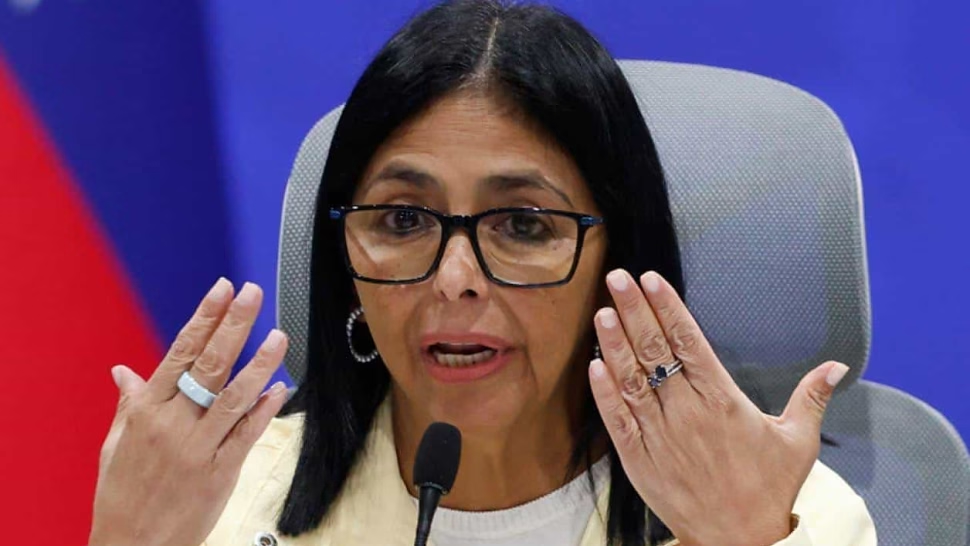
The government of Venezuela’s interim president, Delcy Rodríguez, announced on Friday its “firm and definitive” decision to withdraw from the International Criminal Court (ICC).

Foreign Minister Félix Plasencia explained in

The reasons behind the departure

The decision comes seven months after the National Assembly, with a pro-government majority, approved a law to repeal accession to the Statute. Plasencia accused the court of “geographical bias” and of concentrating its work “disproportionately in African and Latin American countries.” He added that the ICC has been “instrumentalized to deepen inequalities” and rejected the use of “lawfare”, a term that describes the use of the law as a political weapon.

Venezuela ratified the Statute in June 2000 during the mandate of Hugo Chávez. The ICC investigates war crimes and crimes against humanity when countries are unable or unwilling to do so.

Tensive relationship with the Prosecutor’s Office

The now former president Nicolás Maduro had criticized the Prosecutor’s Office in The Hague for closing its office in Caracas last December. The court argued “lack of real progress” in cooperation. Despite the closure, the investigation into the violence following the 2017 protests “remains active,” according to the ICC.

The investigation was opened in 2021 after a request from Argentina, Canada, Colombia, Chile, Paraguay and Peru. So far there are no arrest warrants.

In parallel, former chief prosecutor Karim Khan was dismissed on Friday for “serious misconduct”, in an unprecedented decision. Khan had already been suspended last June.

Continue reading

Marco Rubio recognizes difficulties in resolving the conflict in Ukraine

Rubio seeks diplomatic alternatives for Ukraine at ASEAN summit.

Rubio at the ASEAN summit

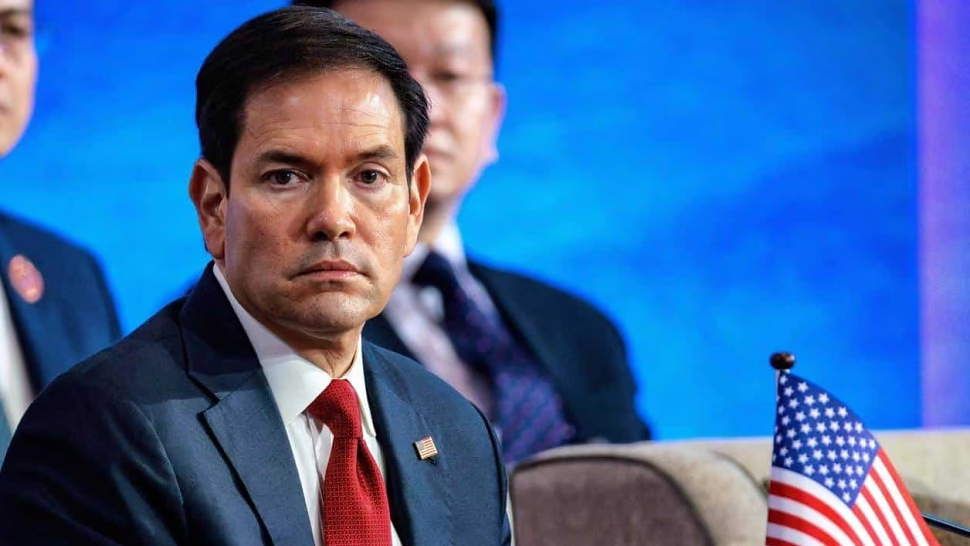
US Secretary of State Marco Rubio participated in the 33rd ASEAN Regional Forum. During the meeting, he addressed the conflict in Ukraine with his Russian counterpart, Sergei Lavrov. Rubio assured that his country remains willing to collaborate to end the war, although he acknowledged that there is no quick solution. He stated that new diplomatic alternatives are required to reach an agreement acceptable to both parties.

Previous attempts at mediation have had limited results, the official admitted. However, Washington will continue to promote negotiations if favorable conditions exist. Russia, for its part, reiterated its willingness to seek a political solution, but insisted on rejecting the shipment of more Western weapons to Ukraine. Rubio responded that it will be necessary to present new proposals that can be accepted by both Moscow and kyiv, without modifying US military support for the Ukrainian government.

Regional tensions

As part of the summit, Rubio also met with Chinese Foreign Minister Wang Yi. He described the recent incident between Chinese and Philippine vessels in the South China Sea as “escalatory.” Despite the simultaneous conflicts in Ukraine, Iran and other regions, the Secretary of State affirmed that the United States maintains its strategic commitment to Asia. He stressed that diplomacy will continue to be a priority to reduce international tensions.

Continue reading

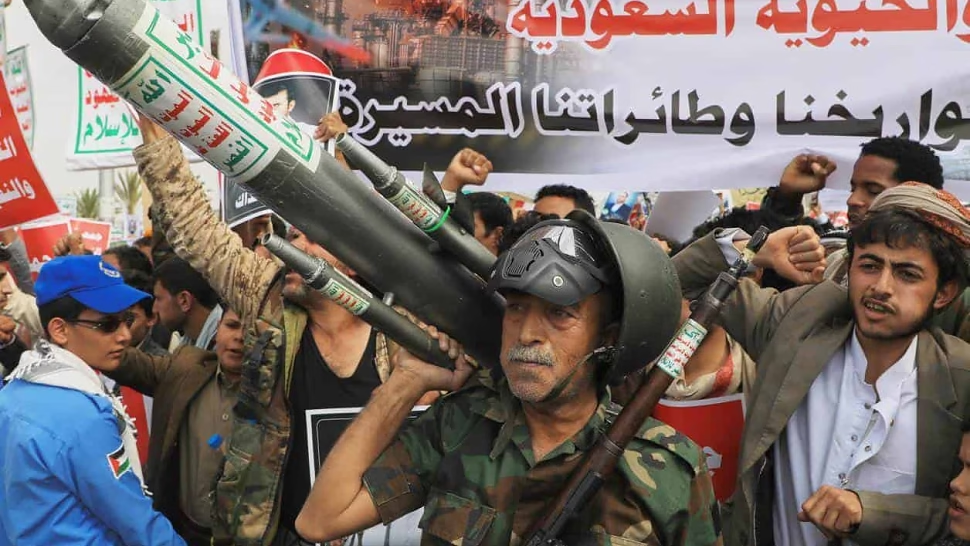
Houthis attack Saudi oil tankers in the Red Sea and raise regional tension

Houthi rebels hit two Saudi ships in the Red Sea; There are no deaths reported.

Attack in the Red Sea

Yemen’s Iran-backed Houthi rebels claim to have hit two Saudi oil tankers in the Red Sea. The action raises tension in the Middle East and threatens to extend the regional conflict.

According to the Houthis, the ships Encelia and Layla were hit and caught fire. No deaths were reported.

The incident occurs while the international price of oil exceeded $100 per barrel. Fear of new interruptions in energy supply intensifies.

It is the first hit against Saudi vessels since the rebels announced a maritime blockade in the Bab el-Mandeb Strait. This route is strategic for world trade and the transit of oil to various regions.

This attack could have significant repercussions on the global energy market. The Bab el-Mandeb Strait is crucial for the flow of crude oil. The international community is closely watching the Houthis’ next steps and Saudi Arabia’s response.

Continue reading