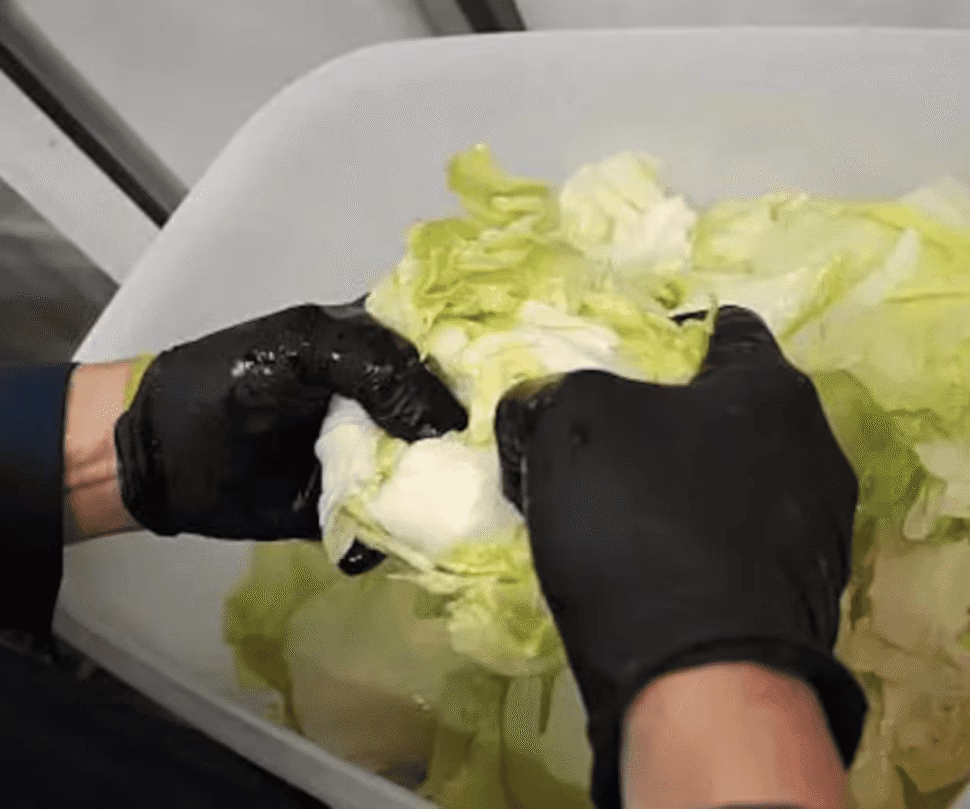
The false positive for Cyclospora in Mexican lettuce, reported by the FDA and later denied, revived the debate about the resources allocated to agri-food health in Mexico.
The budget of the National Agri-Food Health, Safety and Quality Service (Senasica) went from 6,884 million pesos in 2018 to 5,086 million in 2026. This represents a reduction of 26.1%, without considering inflation. The sector warns that this trend compromises the ability to respond to health alerts.
A week ago, the FDA flagged Taco Bell’s chopped lettuce, produced by Taylor Fresh Foods in Guanajuato, for allegedly containing Cyclospora. Hours later, he retracted it: the sample gave a false positive. Mexican lettuce exports—97% of 153 thousand tons annually go to the US—come mainly from Guanajuato, Zacatecas, Puebla, Aguascalientes and Sonora.
Authorities from the Ministry of Health and Senasica analyzed 14 samples of lettuce and water, and ruled out the presence of the parasite.
The Agricultural Market Consulting Group (GCMA) described the situation as worrying:
“While health risks, commercial exchange and international demands increase, the resources allocated to Senasica have been reduced.”
He added that health and safety should be treated as matters of national security, not subject to insufficient budgets.
Jorge Esteve, president of the National Agricultural Council, pointed out that in the last ten years the health budget was reduced by more than 50%, while agricultural and livestock production grew. “You cannot provide complete surveillance,” he stated.
The sector demands that health alerts be handled with rigor and proportionality to avoid harm to producers. Bilateral coordination based on scientific evidence made it possible to clarify this case, but the lack of resources remains a latent risk.