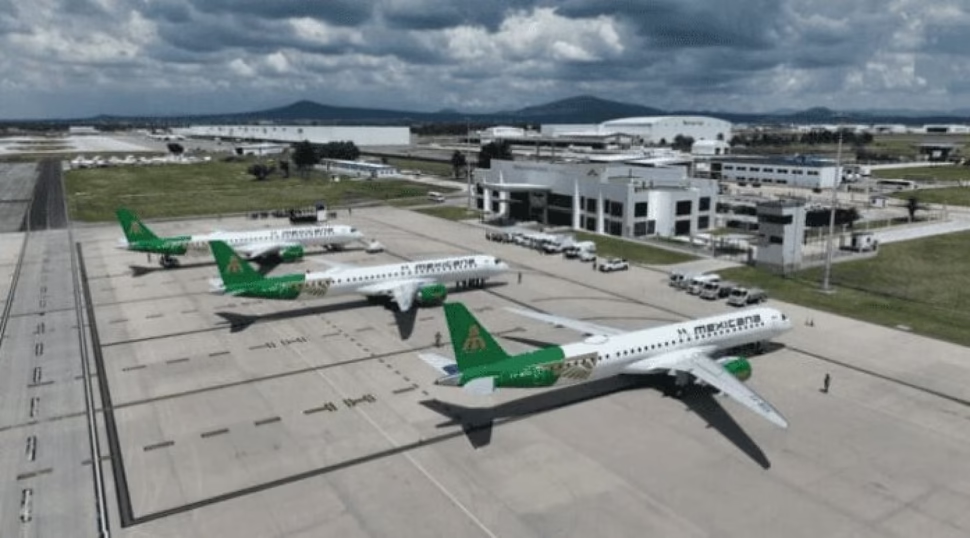
Concanaco warns that the AIFA needs real connectivity to take off

The business chamber points out that the success of the airport depends on a reliable transportation network without setbacks for users.

The “great success” that needs connectivity miracles

It seems that we have discovered gunpowder, but without a fuse. For the Felipe Ángeles International Airport (AIFA) to stop being that place where you arrive by adventure and faith, and become a real airport, we need something revolutionary: infrastructure that works and can be predicted. Who would have thought? The Confederation of National Chambers of Commerce, Services and Tourism (Concanaco-Servytur) has had an epiphany worthy of a Nobel Prize in Logistics: an airport needs to be well connected. Its statement, a paragon of solemnly stated truisms, declares that with predictable connectivity “better conditions” open up for moving operations to the AIFA. That is, so that the transition is not a leap into the void, but rather a walk across a bridge… that is still in plans.

The jewel in the crown, the Buenavista-AIFA suburban train, is described as a “decisive step.” One step, just one. Because according to these visionaries, the train does not replace other minor details such as fare integration, signage, security or operational coordination. Unimportant things, of course. Why do we want the trip to be “truly frictionless” if we can have an adventure full of surprises and unexpected procedures? Of course, the president of the organization, Octavio de la Torre de Stéffano, assures with an optimism that a smoke seller would envy, that doing 45 minutes on that route with trains every 15 minutes will make it competitive. Because, evidently, what the international traveler craves is a railway experience “comparable to international standards” in the middle of the metropolitan area. No pretensions.

RelatedSheinbaum announces that the Lechería-AIFA train will be ready in 2026

The train: magic solution or glorified patch?

They tell us, as if it were a state secret, that having this train is a “strategic success“. Take it now! It will reduce the uncertainty of the transfer because, attention to the argument, it will avoid traffic. A revelation that leaves you breathless. So the master plan to strengthen the mobility of an airport built in a controversial location is a train. It’s not a luxury, they preach to us, it’s “enabling infrastructure.” What makes an airport functional for the economy, apparently, is not flights, routes or airlines, but a punctual train. Because nothing says “economic power” like depending on a single transportation corridor so that your air terminal is not a white elephant.

The official narrative wants to sell us the idea of an efficient metropolitan airport system, where the AIFA is a key piece with “greater room for growth.” It sounds nice, like a campaign slogan. Reality, seasoned with the acid humor of the situation, suggests that the cart is being put before the horse, the train before the plane, and the promise before the finished work. Multimodal connectivity and feeders are requested, when the basic connection is still a matter of debate. It is like promising a botanical garden on land that does not yet have drinking water. The irony is so dense that the route to the airport itself could be paved with it.

Deep down, the business chamber’s message is an elegantly packaged cry: it is not enough to inaugurate pharaonic infrastructures with great fanfare; They must be provided with the transport and logistics network that makes them viable. Otherwise, the risk is creating an air connection node disconnected from the city it serves. The development of commercial aviation in the region requires more than good intentions and ribbon-cutting ceremonies; It requires urban and public transportation planning up to the challenge. Economic growth and Business tourism do not arrive magically on a train, no matter how punctual.

The moral? You can build the most modern airport in the world, but if you need a combination of faith, luck, and a treasure map to get there, the only ones who will use it will be crows and incurable optimists. The AIFA has potential, but it needs to stop being the recurring joke of metropolitan connectivity to become a real option. And that, dear planners, requires more than a train; requires a system.

Were you amused by this scathing analysis of our infrastructure? Share it on your social networks and start the conversation flying! Explore more content about the absurdities and successes of urban development on our site.


Jóvenes Construyendo el Futuro: 3.5 millones de beneficiarios en ocho años

Sheinbaum detalla los alcances del programa social en Xalapa, Veracruz.

La presidenta Claudia Sheinbaum informó que el programa Jóvenes Construyendo el Futuro ha beneficiado a más de 3.5 millones de personas entre 2019 y 2026. El anuncio lo hizo durante una asamblea en el Museo Kaná de Xalapa, Veracruz.

Cifras del programa

El programa ofrece un año de experiencia laboral pagada por el gobierno. Los participantes son considerados aprendices y reciben un apoyo mensual equivalente al salario mínimo, además de seguridad social.

“Ese año de experiencia a los jóvenes les ha permitido encontrar de mejor manera un empleo”, afirmó Sheinbaum.

La subsecretaria de Empleo, Quiahuitl Chávez Domínguez, precisó que la inversión total supera los 170 mil millones de pesos en los últimos siete años.

RelatedYoung People Building the Future opens 45 thousand training places

Inversión educativa

Sheinbaum también destacó que su administración trabaja en la creación de 200 mil nuevos espacios para Educación Media Superior y 330 mil para Educación Superior, a través de instituciones públicas.

A la reunión asistió la gobernadora de Veracruz, Rocío Nahle García, quien reconoció el impacto de la estrategia en la entidad. El beneficiario Diego Armando Gallardo Castillo agradeció la continuidad del apoyo económico para el sector de las artes escénicas.

Continue reading

70% de alumnas en medicina, pero solo 30% en puestos directivos

Persisten brechas de género en el sector salud pese a la feminización de la matrícula.

La matrícula de la Facultad de Medicina de la UNAM está compuesta en un 70% por mujeres. Sin embargo, en los puestos directivos del sector salud apenas alcanzan el 30%. Así lo informó la directora de esa entidad, Ana Carolina Sepúlveda Vildósola.

Al encabezar la graduación de la primera generación del Programa de Formación de Liderazgos de Mujeres Médicas, señaló que persisten barreras estructurales que limitan el acceso femenino a la toma de decisiones.

“La medicina se está feminizando”, subrayó.

El programa, impulsado junto con Aúna y Roche, capacitó a 48 médicas y profesoras de pregrado y posgrado para fortalecer su liderazgo. Sepúlveda Vildósola las invitó a proyectarse como futuras directoras de hospitales, jefas de servicio y diseñadoras de políticas públicas.

RelatedUNAM protects its Faculty of Medicine from attempted takeover

La directora general de Roche México, Mónica Palomanes Seoane, destacó la relevancia de incorporar más liderazgos femeninos en un sector donde la participación de las mujeres es cada vez mayor. Su directora médica, Maryet Pérez Barahona, señaló que el programa busca mejorar la atención a pacientes y fortalecer equipos de trabajo.

Mónica Tapia Álvarez, coordinadora estratégica de Aúna A.C., consideró que México vive un momento favorable para ampliar la presencia femenina en liderazgo, gracias a generaciones con mayor escolaridad y participación en espacios públicos.

Continue reading

Profeco advierte: no descuides tus finanzas en el Mundial 2026

Profeco emite guía para evitar deudas durante la Copa Mundial 2026.

A meses del Mundial 2026, la Procuraduría Federal del Consumidor (Profeco) lanzó una serie de recomendaciones para evitar que la emoción del torneo afecte tu bolsillo.

Compras responsables

La dependencia sugiere fijar un presupuesto antes de adquirir artículos, boletos o servicios relacionados con el evento. Comparar precios es clave. Para ello, está disponible la plataforma Quién es Quién en los Precios, donde se revisan costos de distintos productos.

RelatedProfeco demands that Sony show PlayStation prices in pesos

Evita compras impulsivas. Define cuánto puedes gastar y qué realmente necesitas.

Cuidado con el crédito

Profeco recuerda que las tarjetas de crédito generan intereses. Si usas promociones a meses sin intereses, el total no cambia. Evalúa tu capacidad de pago antes de comprometerte.

“Los pagos mensuales pueden parecer reducidos, pero el monto total de la compra permanece sin cambios”, advierte el comunicado.

Cumple puntualmente con las fechas de pago para evitar recargos.

Canales de atención

La institución mantiene su correo y líneas de atención habituales para recibir reportes, consultas o denuncias relacionadas con el Mundial.

Proteger tu economía también es parte del juego.

Continue reading