Claudia Sheinbaum: T-MEC does not end, it is only reviewed

The president ruled out the treaty ending and explained the annual review process.

Sheinbaum clears up doubts about the T-MEC

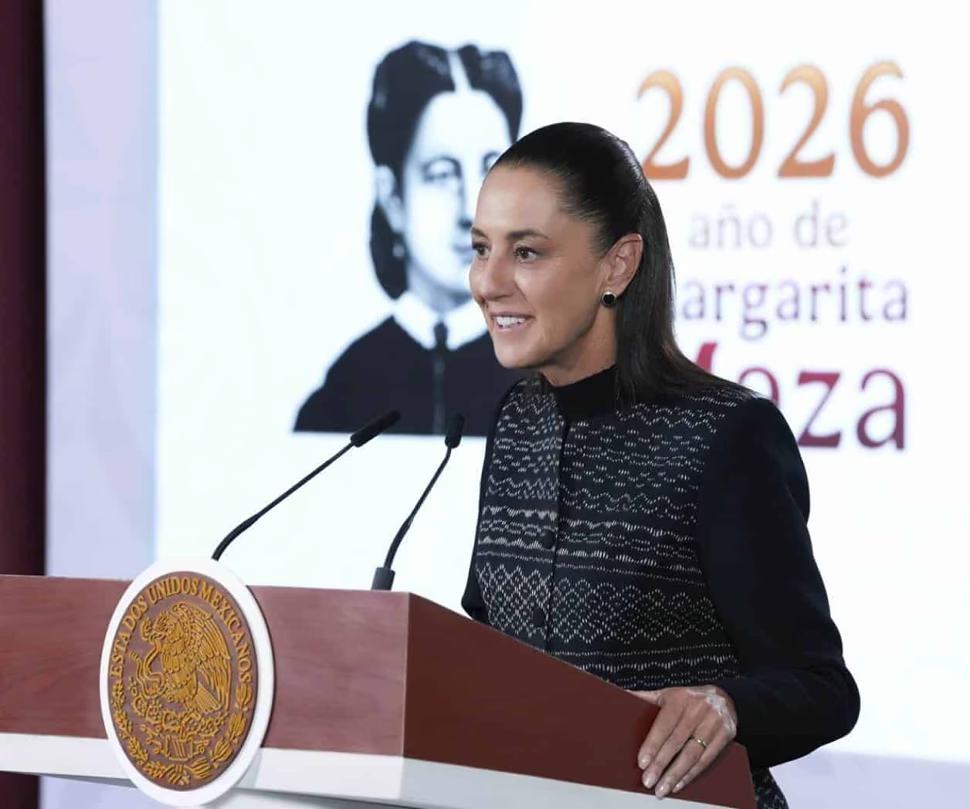
President Claudia Sheinbaum affirmed that the trade agreement with the United States and Canada remains in force. The planned review does not imply its termination, he said.

“Mexico has done everything on its part, always with the obvious limits to guarantee the development of our country, jobs and companies; always without giving up things that we cannot give up, from sovereignty to other measures.”

If the United States does not express in writing the intention to extend the USMCA for an additional 16 years, the agreement continues for the next ten. An annual review process then begins.

RelatedCanada matches US tariff exemptions in the T-MEC

Sheinbaum recalled that Washington has already imposed tariffs on vehicles, steel and aluminum beyond the treaty. He considered it feasible to seek better conditions in the review.

He stressed that the three countries can compete better if they work together. The treaty benefits the American population because it reduces prices, and Mexico because it generates jobs. It also improves access to goods in the three nations.

“Tomorrow the Secretary of the Economy is coming to talk about what was discussed today. It is not that the treaty is going to end, far from it.”

This Thursday’s virtual meeting includes Secretary Marcelo Ebrard, US Trade Representative Jamieson Greer, and Canadian Trade Minister Dominic LeBlanc.

Process details

The T-MEC was signed six years ago. The law stipulates its conclusion after 16 years of validity, that is, in 2036. It also establishes a joint review on the sixth anniversary, where the parties confirm in writing whether they wish to extend another 16 years. If not, annual reviews are carried out.

“Today is not the deadline. If the letter is not sent by the US, the treaty is maintained for 10 years, only with an annual review. In five months or three years the parties can decide to extend it.”

NATO urges its members to present defense spending plans

Rutte demands credible plans to increase military spending to 5% of GDP.

Pressure on allies

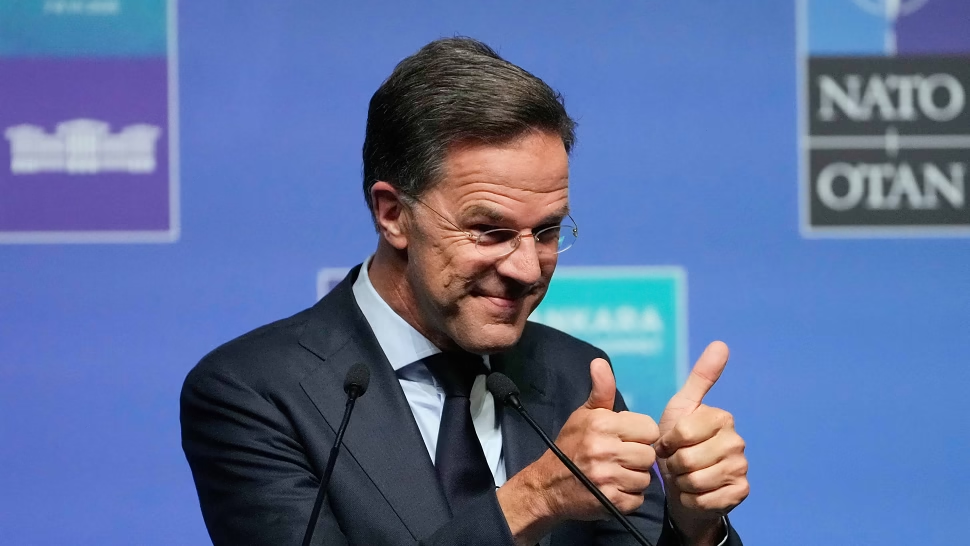
NATO Secretary General Mark Rutte urged the 32 member countries on Monday to present “clear, concrete and credible” plans to meet the new defense spending target. The annual summit begins this Tuesday in Ankara, Türkiye, in a climate of international tension and pressure from the United States for Europe to assume greater responsibility.

The figures of the agreement

Rutte recalled that the allies agreed to allocate 5% of their Gross Domestic Product to defense: 3.5% for military budgets and 1.5% for strategic infrastructure. Some countries, such as Spain, support the goal but maintain that they can meet security commitments without reaching that level.

Washington’s demands

Pressure from the Trump administration has increased. The president demands to accelerate military spending and expects an immediate commitment. In addition, it promotes the concept of a “NATO 3.0”, where Europe plays a more relevant role while the United States concentrates resources on other priorities.

Continue reading

Morena in Abasolo: call for unity for sovereignty

Senator calls to close ranks in Morena Abasolo in defense of national sovereignty.

Senator Olga Patricia Sosa Ruíz called on the Morena militancy in Abasolo to close ranks and avoid internal divisions. It was during an assembly for the defense of national sovereignty.

Accompanied by Mayor Yazmin Saldaña, the president of the Morena Tamaulipas Political Council, Rómulo Pérez, representative Silvia Chávez Garay and the COTS coordinator, Silvia Burgos, the legislator addressed about 500 people gathered in the main square.

“Sovereignty is not auctioned or sold,” said the representative of Tamaulipas in the Senate.

Sosa Ruíz highlighted the Senate’s support for President Claudia Sheinbaum, who has faced interference attempts from abroad.

“We are millions of patriotic women and men, who are convinced of working with the people, serving with humility, honesty, respect and love to the people of Tamaulipas and Mexico,” he argued.

The senator, Abasolo’s first Morenista, highlighted the importance of touring the territory to spread the message of well-being and defense of sovereignty. He assured that the governments of the Fourth Transformation are giving results both in Tamaulipas, under the leadership of Governor Américo Villarreal Anaya, and at the federal level with President Claudia Sheinbaum.

Continue reading

Cars and Nubank: signs of recovery in Mexico

Sales of new cars grow 5.3% and investment from Nubank for 4,200 million dollars drive optimism.

The Mexican economy shows signs of dynamism in 2026. Two indicators confirm this: the sale of new cars rebounded in the first half and the fintech Nubank announced a million-dollar investment.

According to Inegi, between January and June, 5.3% more vehicles were sold than in the same period in 2025. In June alone, 126 thousand units were sold, an increase of 7.6% compared to the previous year.

The government links the rebound to its programs

President Claudia Sheinbaum attributed this behavior to the strengthening of the internal market. He highlighted that the Housing for Wellbeing program, the automotive industry and the Wellbeing Programs have boosted the purchasing capacity of families.

“There is something that is moving the economic indicators a lot and it is the Housing for Wellbeing program, which has not yet even reached its peak of job creation,” he noted during his morning conference.

Sheinbaum added that Wellbeing Programs help the population have more resources to boost the economy from below.

Nubank invests 4,200 million dollars in Mexico

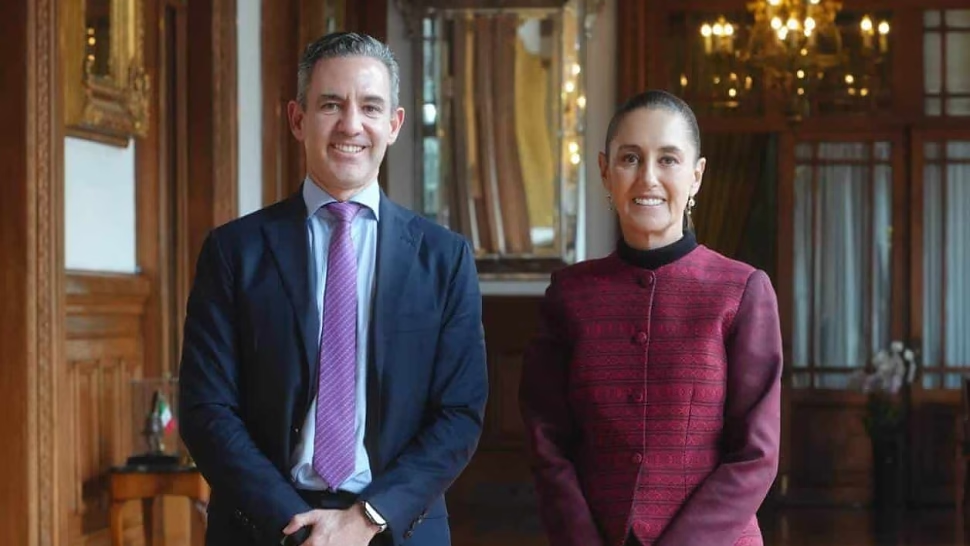
The president also reported on the visit of the executive director of Nubank, David Vélez Osorno, and his team. The financial firm will invest 4.2 billion dollars between 2026 and 2030 in the country.

Vélez was accompanied by: Armando Herrera Reyna, general director of Nu México; Romina Benvenuti, Senior Director of Corporate Affairs; and Alejandro Cruz Sánchez, director of Public Policies.

Sheinbaum stressed that Plan Mexico has strengthened the automotive industry for the domestic market and that he foresees better figures in the second half of the year.

Continue reading