Claudia Sheinbaum strengthens alliance with Guatemala on fourth international tour

The Mexican president deepens ties with Central America in a strategic visit focused on infrastructure and development.

Claudia Sheinbaum begins fourth international tour with a focus on regional integration

The president of Mexico, Claudia Sheinbaum Pardo, embarks this Friday on her fourth visit abroad since she took office in October 2024, with a key destination: Guatemala. This tour, framed within an agenda of binational cooperation, seeks to promote strategic projects such as the expansion of the Interoceanic Train, security on the southern border and joint economic development programs.

Background and diplomatic context

Since his arrival to the presidency, Sheinbaum has prioritized regional integration, evidenced in his three previous trips: participation in the G20 Summit (Brazil), the CELAC meeting (Honduras) and the G7 Meeting (Canada). The choice of Guatemala as the fourth destination underlines the geopolitical relevance of Central America for Mexico, particularly in logistical infrastructure projects and management of migratory flows.

RelatedThe Mayan Train now wants to conquer Guatemala and Belize

Details of the agenda in Guatemala

The central meeting will take place on the island of Flores, Petén, where Sheinbaum will talk with President Bernardo Arévalo about:

  • Extension of the Interoceanic Train: Project that seeks to extend the Mexican railway network to Guatemala, connecting the ports of Salina Cruz (Pacific) and Coatzacoalcos (Gulf) to compete with routes such as the Panama Canal.
  • Border security: Coordination against illicit trafficking and strategies to regulate migration, including police training and intelligence sharing.
  • Productive investments: Joint programs to generate employment in border communities and reduce structural causes of migration.

Economic and logistical implications

Railway interconnection could transform the commercial dynamics of the region, according to experts. A study by the Inter-American Development Bank (IDB) estimates that it would reduce the costs of transporting goods between Mexico and Central America by 30%, in addition to promoting tourism and industry in marginalized areas. For Guatemala, it would mean expedited access to Mexican ports and attraction of foreign direct investment.

Trilateral meeting with Belize

Later, in Calakmul (Campeche), Sheinbaum will hold a dialogue with Arévalo and the Prime Minister of Belize, John Briceño, focused on:

  • Sustainable energy: Exploration of agreements to share renewable technology.
  • Tourist connectivity: Creation of integrated circuits that take advantage of the shared Mayan heritage.
  • Regional positioning: Alignment of positions in international forums such as the UN and the OAS.

Strategic Analysis: Why does this tour matter?

Beyond diplomatic symbolism, this visit reflects a geoeconomic calculation. Mexico seeks to consolidate itself as a logistics hub between North America and Central America, diversifying its alliances in the face of trade uncertainty with the United States. Data from the Secretary of Economy reveal that trade with Guatemala grew by 12% in 2024, exceeding USD 9,000 million, which justifies the commitment to physical integration through the train.

What’s next? The success of these negotiations will depend on the ability to harmonize regulatory frameworks and guarantee financing. Sheinbaum has indicated that the project will require an initial investment of USD 2.5 billion, with mixed participation of public and private capital.

Share this analysis on your social networks and discover more content on foreign policy and infrastructural development on our platform. #RegionalIntegration #SheinbaumInGuatemala

They demand location of two CFE workers in Hidalgo

Two CFE employees disappeared in Acaxochitlán; Family members protest lack of attention.

They demand actions for the disappearance of CFE employees

PACHUCA, Hgo.— Relatives and colleagues of two workers from the Federal Electricity Commission (CFE) demand that the authorities locate them. Adolfo López Saldaña, 40, and Marco Antonio Sarmiento García, 60, were last seen on February 26 in the municipality of Acaxochitlán, Hidalgo.

They were going to carry out work in Huauchinango, Puebla. During the transfer all contact was lost. Given this, his relatives went to the representation of the Attorney General’s Office of the State of Hidalgo (PGJEH) in Tulancingo to report the alleged forced disappearance.

They initially filed the complaint with the Attorney General’s Office (FGR), but they claim that they did not receive timely attention, so they turned to the state authorities. After that, search cards were issued. The last registration of the van in which they were traveling was in Acaxochitlán. Later, the unit was found without license plates and without the CFE logos.

His whereabouts are unknown at this time. Yesterday, Saturday, relatives held a demonstration to demand immediate action.

The CFE issued a statement:

“We have a commitment to our workers: we will fully monitor this event, endorsing our responsibility with the integrity of those who make up and are the driving force of the Federal Electricity Commission.”

The company indicated that it collaborates with the authorities and maintains communication with the families. The investigation folder was registered with the number FED/HGO/TULB/00002547/2026 for the crime of forced disappearance. Central offices also requested information for follow-up.

Continue reading

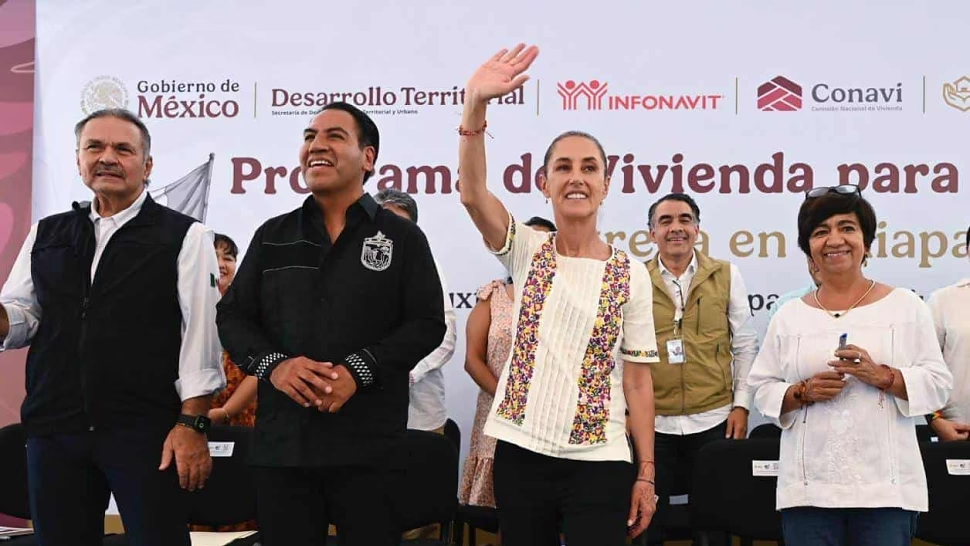
Housing for Wellbeing boosts GDP by 1%, says Sheinbaum

Sheinbaum announces that the housing program contributes 1% to the GDP and will benefit 30 million.

Housing for Wellbeing and its economic impact

From Tuxtla Gutiérrez, Chiapas, President Claudia Sheinbaum highlighted that the Housing for Wellbeing program contributes about 1 percent to the national Gross Domestic Product (GDP). This, thanks to the jobs it generates in construction and related sectors.

“There is nothing happier that can make the President and her entire team than to see the joy on their faces for receiving a home today,” said Sheinbaum during the delivery of 48 homes in the Infonavit Lacantún development.

In addition, 401 settlement certificates from Fovissste and 503 deeds from Insus were delivered. The president stated that the program will benefit nearly 30 million people during her six-year term.

“Thanks to the Housing for Wellbeing program, it is contributing close to 1 percent of GDP to the country’s economic growth. And if we consider that each home employs at least 4 people, a very important number of jobs are being generated,” he pointed out.

Investment in Chiapas

The Secretary of Agrarian, Territorial and Urban Development, Edna Elena Vega Rangel, explained that in Chiapas 42 billion pesos are allocated to build 70 thousand new homes in the six-year period. Of these, 50 percent are already hired.

The general director of Infonavit, Octavio Romero Oropeza, reported that at the national level there are 420 housing complexes in 31 states, with 475 thousand homes. Of them, 190 thousand are already under construction, and 3,600 have been delivered. In Chiapas, Infonavit contemplates 34 thousand homes with an investment of more than 20 billion pesos.

Governor Eduardo Ramírez Aguilar thanked the President for the homes delivered, while the beneficiary Miguel Ángel Ramírez Trujillo expressed his gratitude for the future it represents for his family.

Continue reading

CRT foresees 85% of registered lines before staggered cuts

The CRT estimates that between 120 and 130 million cell phones will be registered before the progressive cut.

Mobile line registration: 85% will be linked before cuts

The Telecommunications Regulatory Commission (CRT) expects that between 120 and 130 million cell phones will be registered, which represents about 85% of the total active lines in the country.

Currently there are 144.6 million lines. Ricardo Castañeda Álvarez, general director of Regulatory Policy of the CRT, estimated that between 14 and 24 million will not be registered and will be deregistered as the process progresses.

The suspension process will begin on August 15. Lines ending in 0 will be deactivated first and then in stages until the end of the year, with the aim of avoiding technical saturations.

Castañeda explained that the extension was due to the risk that millions of users would not meet the original deadline, which would have generated operational complications similar to massive saturations in emergencies. He ruled out a new extension of the deadline.

He assured that the registry does not violate privacy because the information is managed by the operators. The main objective is to combat crimes such as extortion, fraud and virtual kidnappings.

Continue reading