Sheinbaum inaugurates the Interoceanic Train in the southeast

The president witnessed the citizen euphoria during the inaugural tour, marking a milestone in the connectivity of the southeast.

The railway ‘trending topic’: Sheinbaum and the train that promises to connect more than just cities

It seems that the Mexican southeast has finally gotten on the development train, literally. President Claudia Sheinbaum Pardo, in her most recent government act, presented to us what could be the most ambitious infrastructure project seen in those latitudes. It’s not just a train, it’s a statement of intent with cars and tracks. After the inauguration of section 1 of Line K “Istmo-Soconusco”, the president could not contain her enthusiasm, highlighting that this pharaonic work is key to the mobility of people and goods. Basically, it is the wet dream of any urban planner come true, but with the added bonus of the Chiapas and Oaxacan landscape.

But wait, it’s not just a tourist trip. The cherry on the cake is the famous Poles of Economic Development for Well-being (PODECOBI), which sound like those places that promise in the speech and that we all hope do not end up being a white elephant. Sheinbaum, with the confidence of someone who has just crossed a huge item off his to-do list, connected the dots impeccably: economic development equals less migration. An equation so simple that it hurts not to have applied it before. “The best way to reduce migration is to generate poles of well-being,” he stated, while detailing the location of these new hubs of progress in Tapachula, Arriaga and six other points along Line Z. It sounds like the map of the southeast is about to have a few new and very promising *pins*.

RelatedThe Interoceanic Train advances with mornings and percentages

Connecting destinies (and hopes)

Now, citizens can plan a trip that was previously a logistical odyssey. We are talking about connecting Tonalá, Chiapas, with Ixtepec, Oaxaca; or take the trip from Salina Cruz, Oaxaca, to Coatzacoalcos, Veracruz; and even venture from Coatzacoalcos to Palenque, Chiapas. And if that were not enough, the master plan includes extending this railway network to Ciudad Hidalgo, Chiapas, and, attention, crossing the border into Guatemala. Because, apparently, the southern neighbor is also “very advanced” and what better than joining forces and ways. This is not just a train; It is the potential to redefine the commercial and social dynamics of an entire region.

The most human part, and perhaps the one that the president likes to highlight the most, was the inaugural tour. In an act that mixed protocol with popular spontaneity, Sheinbaum got off at stations such as Tonalá, Arriaga, Chahuites, Reforma de Pineda, Unión Hidalgo, Juchitán, Espinal and Ixtepec. His verdict: “people arrived happy.” A description that, let’s be honest, is the official equivalent of “we broke it.” He commented that people were “attracted by the arrival, the opening of the train, and also many very happy people along the way.” Translation: the atmosphere was a mix of an anticipated movie premiere and the relief that a public project is finally coming to fruition and, on top of that, being liked.

This comprehensive transportation project seems to have struck a chord. Beyond the numbers and development plans, it managed to generate palpable collective joy. In an era where bad news is the daily bread, seeing entire communities celebrating the arrival of a train is a refreshing *plot twist*. The Interoceanic Train is emerging not only as a backbone for the southeast economy, but as a symbol of a connectivity that many doubted would arrive.

Do you think this is the boost the region needed? Share this news on your social networks and make more people aware of this milestone of national infrastructure. And if you were left wanting more, explore other content about the great connectivity projects in our country.
INEHRM becomes a research and teaching center

The INEHRM is transformed into a research and teaching center under the new secretariat.

Transformation of the INEHRM

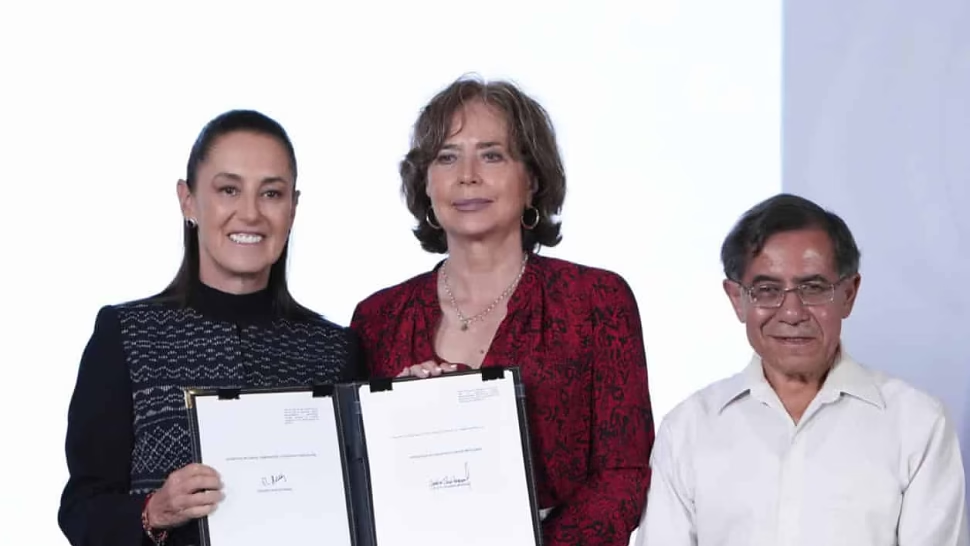
President Claudia Sheinbaum signed the decree that transfers the National Institute of Historical Studies of the Revolutions of Mexico (INEHRM) to the Secretariat of Science, Humanities, Technology and Innovation (SECIHTI). The institute becomes a decentralized public body with an academic focus.

Rosaura Ruiz Gutiérrez, head of SECIHTI, explained that the new scheme will train specialists in history to strengthen national capacities in social sciences and humanities.

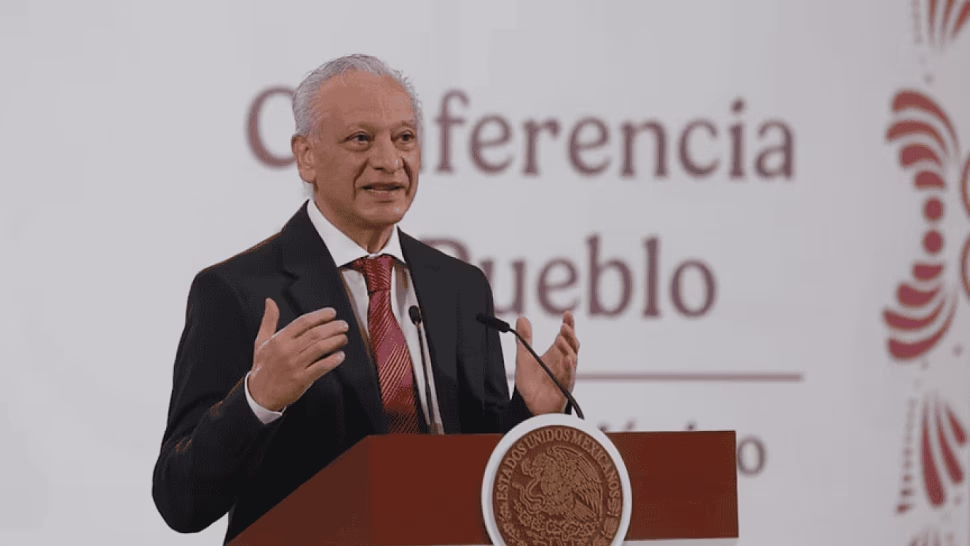
Felipe Arturo Ávila Espinosa, director of the INEHRM, explained that the study plans will link historical knowledge with social, economic, political and cultural problems of the country, and will address the needs of the Federal Public Administration.

Hybrid educational offer

The offer will include bachelor’s degrees in History, Social Sciences and Humanities, and Public Administration and Good Government. In postgraduate studies, master’s degrees will be added in Mexican Humanism, Gender and Feminism Studies, and Social Movements and Rescue of Historical Memory. There will also be specialties in Political Communication and History Teaching.

Graduates will cover topics such as agrarianism, health, migration, artificial intelligence, violence and human rights.

Headquarters and call

The new headquarters will be at 80 Guatemala Street, Historic Center of Mexico City. The first admission call will be launched in July, and classes will begin in September.

Continue reading

Prosecutor’s Office grants protection measures to victim of family violence

The Morelos Prosecutor's Office issued protection measures after a complaint of family violence against the former director of Pemex.

The Morelos Attorney General’s Office activated protection measures in favor of Felicia Jiménez Lavie, who filed a complaint for family violence against her husband, Víctor Rodríguez Padilla, former director of Pemex. This was reported by prosecutor Fernando Blumenkron Escobar.

The measures, the official explained, will be available when the victim requires them. The complaint was filed in Mexico City and the Women’s Secretariat of the Government of Mexico directly follows up on the case.

Investigation in progress

Until now, Jiménez Lavie has not gone to the local Public Ministry to contribute more elements to the investigation folder. This was initiated ex officio last Friday, June 26, after a video was broadcast with images of attacks against the woman.

Blumenkron assured that the portfolio continues its integration. “The proceedings have not stopped and we are going to continue to guarantee justice for the victim,” he said. In addition, he indicated that there is coordination with the Women’s Secretariat and the capital’s Prosecutor’s Office, under the care route for victims of family violence.

Among the actions carried out, the Morelos Prosecutor’s Office seeks to locate the address where the physical assault occurred, to carry out expert reports in accordance with the images of the video broadcast by the victim herself.

Continue reading

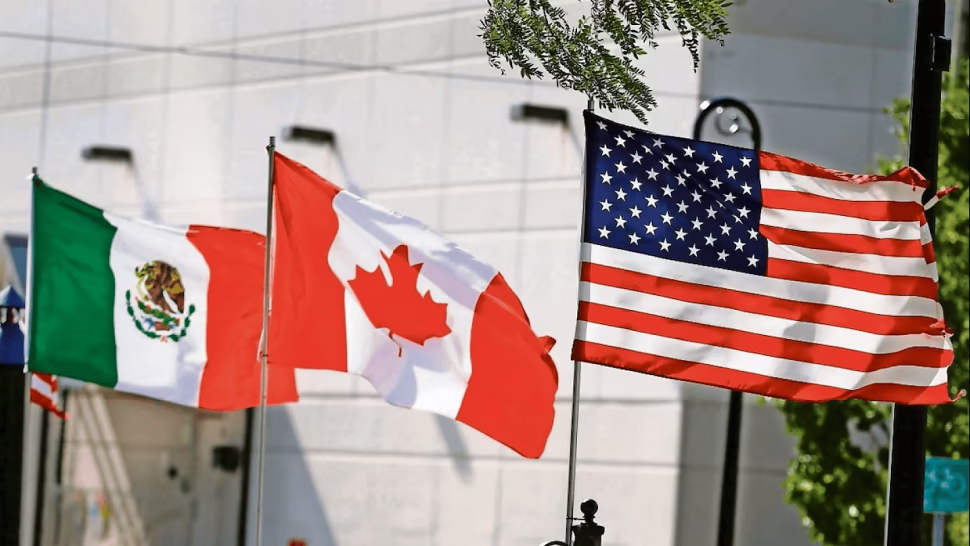
Trump does not extend T-MEC: Mexico faces annual review

US rejects automatic extension of the T-MEC; validity is reduced to 10 years with annual review.

Rejection of automatic extension

The United States decided not to automatically renew the Treaty between Mexico, the United States and Canada (T-MEC) for 16 years. This reduces its validity to a decade with an annual review. The measure generated concern among Mexican legislators.

Ricardo Monreal, coordinator of Morena in San Lázaro, explained that the treaty remains in force for another 10 years, but subject to evaluation each year. He noted that the United States presented 54 observations, including issues such as the vaquita porpoise and piracy. Mexico, for its part, raised 13 points, including clause 232 on tariffs.

“Only it will be reviewed year after year, but the Treaty is not finished, it continues for another 10 years because that is how it was signed six years ago,” declared Monreal.

The legislator warned that Donald Trump has been a constant critic of the USMCA and called for considering the benefits it has brought to the three nations.

Reactions of the opposition

Héctor Saúl Téllez, vice economic coordinator of the PAN, considered that the US position shows a lack of strategic anticipation on the part of the federal government.

“The US decision not to automatically extend the USMCA for 16 years in today’s review is not the end of the treaty, but it does reveal a lack of strategic anticipation by the federal government,” he stated.

Téllez recalled that Article 34.7 of the agreement had been known since 2018. Reaching July 1 without a clean extension represents a risk that, he said, should have been avoided.

The annual review will allow adjustments, but uncertainty about the future of regional trade persists. Mexico and Canada will seek to maintain the stability of the agreement for the next ten years.

Continue reading