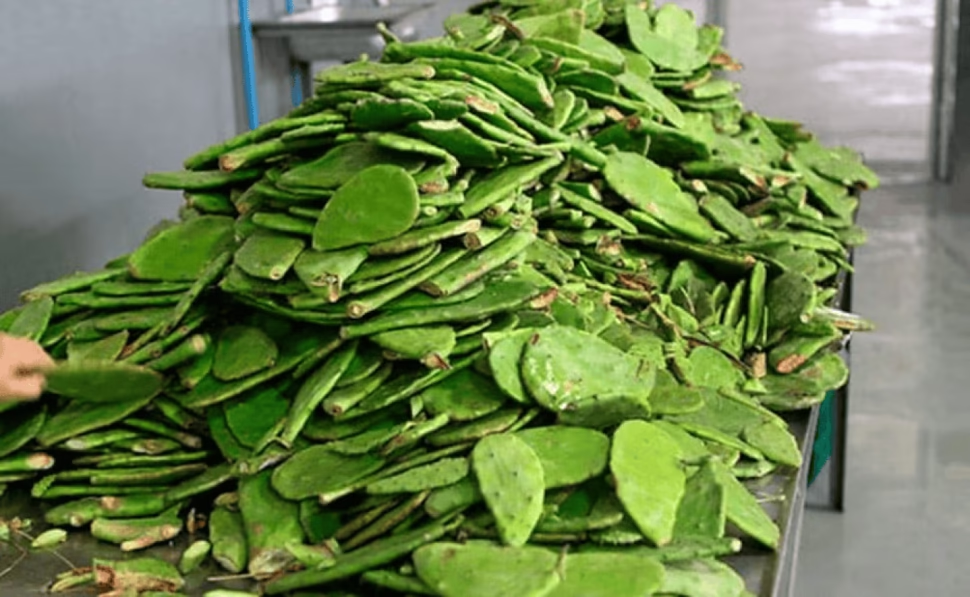
Nopal fertilizer accelerates crop growth

UNAM cactus fertilizer increases biomass by 20% and accelerates crop maturation.

The cactus waste that is usually discarded could be transformed into a tool for sustainable agriculture. UNAM researchers developed an organic fertilizer from the thorns and edges of this cactus that increased the biomass of the crops by up to 20% and accelerated their growth.

Results in Milpa Alta

The project was led by Bruno Chávez Vergara, from the UNAM Institute of Geology. Nopal digestate, a byproduct of the anaerobic digestion of organic waste, was evaluated. The research, funded between 2018 and 2020 by the Ministry of Education, Science, Technology and Innovation of Mexico City, seeks to promote sustainable practices in volcanic soils in the south of the basin.

RelatedMilpa Alta promotes its transformation with greater investment and innovative projects

Between 15% and 20% of the nopal processed for consumption is discarded as thorns and edges. This material is used to generate biogas and electricity, but it also produces a liquid waste that works as organic fertilizer. The tests were carried out in agricultural areas of Milpa Alta, Xochimilco and Tláhuac, in collaboration with Sustainability in Energy and Environment (SUEMA).

Chávez Vergara explained that digestate provides mineral nutrients to plants and feeds beneficial bacteria and fungi in the soil, recovering biological functions affected by years of chemical fertilizers. Unlike synthetics, this product promotes the microbial activity necessary for soil fertility. Its liquid presentation allows better use of water and faster absorption of nutrients.

In forage oat crops in Milpa Alta, the results were immediate. Since the first agricultural cycle, a 20% increase in biomass and a reduction of up to one month in maturation time was recorded. The researcher pointed out that these benefits would be especially useful for hillside and rainfed farmers, where lack of irrigation and erosion make production difficult.

Following the results, the UNAM team plans to expand the tests to corn and carrots, in addition to determining the minimum dose necessary to make the use of this fertilizer based on cactus residue profitable.


Satellite Internet, the bet to close the digital divide in Mexico

Mexican geography limits fiber deployment, but low orbit satellites are emerging as an alternative.

Satellite internet as a solution to the digital divide in Mexico

Mountains, jungles and deserts make Mexico one of the countries with the most complex orography in Latin America. Bringing fiber optics to isolated communities implies an investment that is difficult to recover with few users. As a result, one in five households still lack internet access or receive poor service.

Faced with this scenario, low orbit (LEO) satellite internet is emerging as a strategic alternative. “Deploying physical infrastructure in Mexico is expensive due to geography. In many cases, satellite internet represents the most viable option to connect areas where fiber will not reach in the short term,” explains Ernesto Piedras, director of The CIU. Companies like Starlink, with more than 10,300 active satellites, already operate in the country. Since May 2021, it obtained a concession and closed 2024 with 160,631 subscriptions, making Mexico its second Latin American market, only behind Brazil. Starlink has signed contracts with CFE Telecomunicaciones for up to 1,556 million pesos to connect remote communities.

However, cost remains a barrier. While a fiber optic plan costs an average of 544 pesos per month, satellite internet starts at 899 pesos, plus equipment and installation. “Commercially it is still not as viable because it is still more expensive and requires purchasing an antenna whose price remains high,” says Fernando Esquivel, from The CIU. The service makes economic sense when it is shared between communities or companies, and with the support of public policies.

Experts agree that this technology will not replace fiber optics, but will complement it. “Terrestrial services are faster and have lower latency. Satellite communication reaches areas that fixed internet would not reach,” says Hugo Simg, from MediaTek. Deployment also requires regulation and coordination between governments and companies. The race to connect Mexico is no longer only being fought underground, but from space, where a new generation of satellites promises to reduce the digital divide that keeps millions out of the digital world.

Continue reading

Banks prepare for biometric facial controls in October

Banks claim to be ready for facial biometrics in branches since October.

The main banking institutions in the country claim to be prepared for the new regulations on facial biometric controls when opening accounts, which will come into force next October.

What did the banks declare?

Marcos Ramírez, general director of Grupo Financiero Banorte, pointed out that the institution has made progress to reinforce the identification and security of its users. “We are in time and form with everything established by law and a little ahead, with the prudential limits of the law,” he indicated.

These measures will strengthen control over customer identification. Since 2018, by regulation, fingerprint biometrics are already required to open accounts.

Implementation details

On July 1, the National Banking and Securities Commission (CNBV) incorporated facial biometrics into the regulation for multiple banking in customer identification and authentication. Institutions that opt ​​for this mechanism must comply with technical, operational and security requirements.

Continue reading

AI detects breast cancer with 90% accuracy

An autonomous model analyzes thermographs and classifies tissues without human intervention.

An artificial intelligence model developed by Raúl Castro Ortega, a researcher at the Polytechnic University of Tulancingo, manages to identify breast cancer with an accuracy of 90%. The results were presented during the SPIE Photonics Europe 2026 International Congress, in Strasbourg, France.

How the system works

The system uses convolutional neural networks with attention mechanisms to analyze breast thermographs. Unlike traditional methods, the model autonomously learns the patterns of healthy and diseased tissue, without a specialist previously defining the characteristics of the images. This reduces processing time and improves consistency of results.

The study, titled “Breast thermography analysis using convolutional neural networks with attention mechanisms,” uses an algorithm based on the heat diffusion equation. This approach focuses analysis on thermogram regions of interest and classifies tissues with high levels of sensitivity and specificity.

Impact on early detection

The accuracy achieved represents a significant advance for the early detection of breast cancer, which can improve survival rates and facilitate timely treatment. The researcher highlighted that the system does not replace the specialist, but rather works as a support tool for faster and more consistent diagnoses.

Continue reading