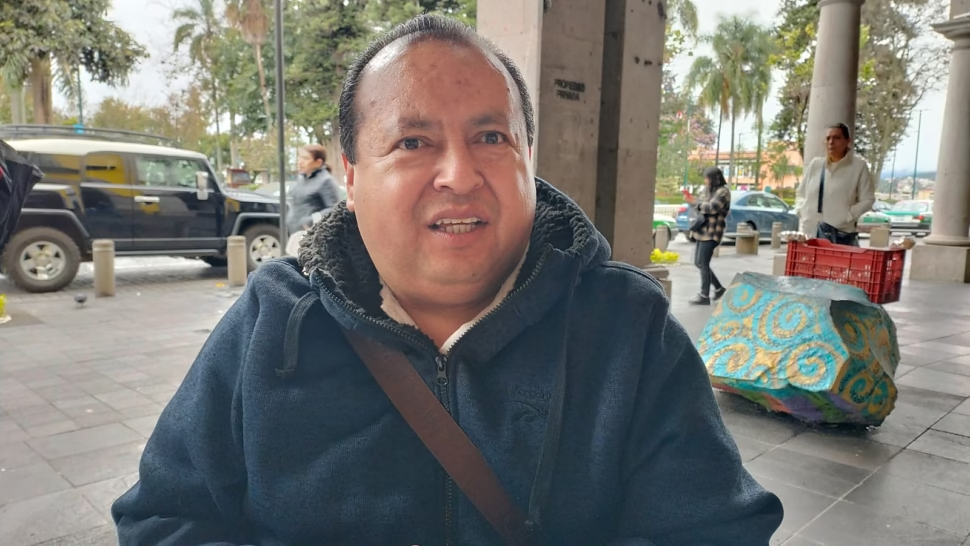
The general secretary of the Urban Solidarity Union of Municipal Workers, Guillermo Caballero de Jesús, recognized partial progress in the garbage collection service in the state capital; However, he warned that underlying problems continue due to the lack of timely maintenance of the collection units and the lack of continuity in the waste separation programs.
The union leader, a member of FATEVCAT, explained that meetings have recently been held with the mayor of Xalapa, Daniela Griego Ceballos, who has begun to intervene to rehabilitate collection trucks that were out of service, some in external workshops and others in the internal workshop of the Public Cleaning Directorate.
Caballero de Jesús stressed the need to strengthen the municipal workshop, which has trained personnel such as paileros, talacheros, welders and electricians, which would allow the units to be repaired in a period of two to three days. This, he said, would avoid sending them to external workshops where they remain inactive for up to 20 days, in addition to generating savings of between 50 and 60 percent in repair costs.
He indicated that the lack of trucks directly impacts the service to the neighborhoods, where in some cases the collection stops being daily and is reduced to twice a week, a situation that seeks to be reversed by strengthening the vehicle fleet.
Setback in waste separation
Regarding the separation of organic and inorganic waste, the union leader pointed out that Xalapa faces a significant setback. He recalled that in previous years there were six green trucks destined for the collection of organic waste, a figure that was reduced in past administrations to two units, of which currently only one is in operation.
He explained that some of these units were transferred to the Environment Directorate, where – he assured – they are used for tasks outside their original function, such as the collection of leaves and branches, which dismantled the scheme that Clean Public operated.
Likewise, he rejected official versions that estimate a collection of only 800 kilograms of organic waste per day and stated that in reality around 15 tons per day are collected, mainly from the Central de Abastos, municipal markets, restaurants and businesses that do carry out adequate separation.
Lack of culture and continuity
Caballero de Jesús considered that one of the main obstacles to consolidating waste separation is the lack of institutional will in past administrations, as well as the absence of permanent citizen awareness campaigns.
He pointed out that many projects remain isolated attempts and are abandoned with each change of government, which discourages both workers and citizens and merchants who do comply with the separation. He added that, although several units still have compartments to separate garbage, currently the waste ends up mixing, nullifying the effort of households that separate their waste.
Operational capacity and future challenges
Currently, the Public Cleaning Directorate has 70 collection units, 600 workers, 70 morning routes and 22 evening and night routes, with coverage in around 580 regular neighborhoods, in addition to irregular areas where the service is supported by cart drivers due to the lack of vehicular access.
Regarding the landfill, the union leader warned that the recently expanded cell could have a useful life of just a year and a half, which represents an immediate challenge for the current municipal administration.Finally, he reiterated that garbage management is a daily problem that does not allow delays, which is why he urged continuity of the projects, strengthening the infrastructure and reinforcing the culture of waste separation to avoid a major crisis in the city.