Blow to crime in Guanajuato: thousands arrested and homicides drop

Authorities report thousands of arrests and tons of illicit substances seized in Guanajuato, with a 65% drop in homicides.

The theater of security in Guanajuato: an act with results

The figures released by Omar García Harfuch this Friday in Irapuato are the script of an operation that seeks to change the course of a besieged state. From October 1, 2024 to February 15 of this year, authorities have arrested 4,400 people and seized more than 5 tons of narcotics, including a thousand lethal fentanyl pills.

But cold numbers only tell part of the story. The other is written with more than 6,400 weapons removed from circulation and a methamphetamine laboratory dismantled by the Army and Navy. As if it were the first act of a play, the head of the SSPC was clear about the objective:

“These actions represent a direct impact on the operational and financial capabilities of criminal organizations.”

The main cast: the detainees who changed the plot

The official narrative maintains that after a reinforcement ordered by President Claudia Sheinbaum in February, the violence began to subside. The star test is six simultaneous operations last March in Querétaro, Guanajuato and Yucatán.

RelatedSheinbaum boasts a reduction in homicides in his first year

Nine members of a group linked to kidnapping, theft of hydrocarbons and homicides fell there. Among them, figures with cinematographic aliases: José Francisco N, ‘Alfa 1’, cell leader accused of the attack on a bar in Querétaro; and Sandra N, ‘La Patrona’, operational liaison for the sale of drugs.

The most compelling argument came later. García Harfuch assured that after these arrests, the script changed:

“It is very notable that with the arrest of these subjects… since that date, a decrease in the number of intentional homicides of 65% began to be recorded compared to February 2025.”

The pending chapter: Salamanca

The plot has a dark episode that still requires resolution. The attack on January 25 on a football field in Salamanca, where 11 people died, remains an open wound.

However, the investigations led to the identification and capture of Moisés N, alias ‘Moi’, indicated as the perpetrator and cell leader in several municipalities. Three other members of the Santa Rosa Lima Cartel fell with him, two directly accused of surveillance work during the attack.

The strategy against the ‘floor charge’

In parallel, the National Strategy against Extortion has added its own arrests in Guanajuato: 16 people, seven considered ‘priority targets’. The list sounds like a villainous cast:

  • Cristian Alejandro N, cell leader responsible for distribution and ‘floor collection’.
  • Genaro N, ‘El Silencio’, linked to homicides and extortion between Michoacán and Guanajuato.
  • Edgar Eduardo N, related to the mass homicide of seven young people in San Bartolo Berrios.
  • Gustavo N, ‘The Old Man’, criminal operational leader.

The network expanded with arrests in Celaya (such as Luis Francisco N, ‘El Piolín’), León (Marco Antonio N, ‘El Flaco’, linked to the murder of prison officers) and Santa Cruz Juventino Rosas (Norma N, ‘La Italiana’, leader of a group dedicated to hydrocarbons and weapons).

My final analysis: This is the type of political play where the figures are the scenery, but the names and aliases are the actors. The promise is a sustained reduction in horror. The public—the citizens—hopes that the third act is not another tragic twist but an ending where calm is permanent. For now, the numbers give hope; maintaining it will be the real challenge.


Court analyzes whether decree on Frida Kahlo violates private property

The SCJN will review whether the 1984 decree that protects Kahlo's works is constitutional.

The SCJN reviews the decree that protects Frida Kahlo

The Supreme Court of Justice of the Nation (SCJN) will analyze the legality of the 1984 presidential decree that prevents the definitive export of works by Frida Kahlo. The plenary session admitted an injunction from the Ve por Más bank, owner of the oil painting Self-portrait with medallion, painted in 1948. The dispute pits the protection of cultural heritage against the right of private property.

Magistrate Giovanni Azael Figueroa promoted the case to establish whether the restrictions exceed the powers of the Executive. The Court will determine if the decree is constitutional.

Background: the Gelman collection

The review occurs in the midst of the debate over the Gelman collection, which includes 11 works by Kahlo loaned to Banco Santander. The Court’s resolution will set limits for future disputes over cultural property.

The ruling will be key to defining to what extent the State can intervene in the ownership of works considered national heritage.

Continue reading

IMSS and Fonacot update agreement to improve services for workers

IMSS and Fonacot renew their alliance until 2030 to streamline procedures and protect labor rights.

Strategic alliance for labor rights

The Mexican Social Security Institute (IMSS) and the National Fund for Workers’ Consumption (Fonacot) signed a collaboration agreement that updates their exchange of information and services. The objective: respond to the current operational, technological and regulatory needs of both agencies.

The agreement was signed by Wendolyne Retana Alarcón, general director of Fonacot, and Luisa Obrador Garrido Cuesta, director of Incorporation and Collection of the IMSS. It will be valid until September 30, 2030, with the possibility of extending it for two more years.

The relationship between both institutions dates back to 2007. Since then they have maintained a constant flow of data to facilitate procedures and guarantee better credit and social security conditions for working people.

With this update, the aim is to streamline processes, reduce response times and strengthen the protection of the rights of the country’s formal workers.

Continue reading

Energía Costa Azul makes first shipment of LNG in the Pacific

First shipment of liquefied natural gas from the Mexican Pacific marks an energy milestone.

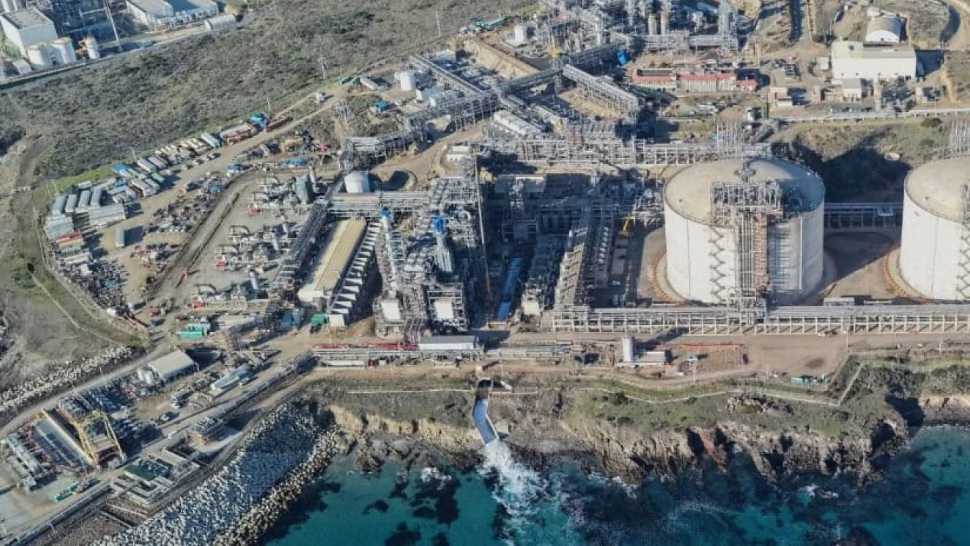
The Energía Costa Azul project, in Ensenada, Baja California, completed the first shipment of liquefied natural gas (LNG) from the Mexican Pacific coast. The Sempra Infrastructure company confirmed that the shipment is part of the tests prior to the start of commercial operations.

International context

This movement occurs in a context of high demand for energy security. Tensions in the Strait of Hormuz, through which nearly 20% of global LNG trade passes, have accelerated the search for new supply routes.

Strategic advantage

Sempra Infrastructure noted that phase 1 of the project will connect North American gas with Asian markets, taking advantage of the strategic location of the Mexican Pacific coast. Researcher Adrián Duhalt highlighted that the proximity to the gas-producing basins of the United States represents a competitive advantage for Mexico.

Continue reading