Audit reveals massive flaws in federal internet program

An ASF report reveals serious deficiencies in satellite connectivity, leaving thousands of communities isolated and in uncertainty.

A dream of connection that fades into silence

In a twist that seems taken from a high-impact thriller, the long-awaited program Internet para Todos finds itself on the brink of the abyss. An investigation by the Superior Audit of the Federation (ASF) has uncovered a truth that shakes the foundations of national connectivity: CFE Telecomunicaciones and the avant-garde Starlink, the company of tycoon Elon Musk, are failing miserably in their mission to bring the digital network to the most remote communities in the country. What promised to be a bridge to the future has become a labyrinth of silent teams and unfulfilled promises.

The report from the auditing entity displays a Dantesque scenario. In the last quarter of 2024, the provider reported the installation of seven thousand five hundred ninety-five sites. However, in an act that tears credibility, two thousand nine hundred and ninety of those computers, a scandalous 39.4%, lay in the most absolute inactivity, either out of service or pending activation. These instruments of connection, mute and inert, betrayed the fundamental objective of their acquisition. To make matters worse, the fog of misinformation reigned, making it impossible to distinguish between completely inactive terminals and those that suffered intermittencies due to technical failures. The most disconcerting detail, the straw that breaks the camel’s back of indignation, is that the authorized payments were made considering the sites reported as active, a financial enigma that cries out to heaven.

RelatedThe CFE sells mobile internet from 95 pesos per month

The millionaire contract and the shadow of uncertainty

The plot dates back to October 2023, when in a move that promised to revolutionize digital infrastructure, the CFE awarded the contract CFETEIT-CA0069-2023 to Starlink Satellite Systems México. The mission was titanic: to provide low-orbit satellite Internet connectivity service and acquire the associated equipment. Part 1 of this pharaonic project had a maximum authorized amount of one thousand eight hundred and five million pesos, of which, during 2024, the astronomical sum of two hundred and fifty-four million pesos was exercised. The audit, which could only scrutinize that year’s fiscal year, leaves a question floating in the air, a mystery that poisons transparency: the current situation is an absolute unknown.

The response from the authorities was immediate, full of the solemnity that a case of this magnitude demands. The Superior Audit of the Federation, in a report that shakes the desks of power, communicated the formal Promotion of Sanctionary Administrative Responsibility. This crucial movement forces the Responsibilities Unit of the CFE, or its equivalent, to initiate the pertinent investigations and, if the evidence dictates it, begin the corresponding administrative procedure against the public servants accused of alleged irregularities.

The document is forceful and points an accusatory finger towards the management of these officials. In the management of the million-dollar contract, the formulation, design, administration and establishment of the essential control mechanisms for monitoring the progress and compliance of the connectivity project were flagrantly omitted. The absence of a formal technical analysis that defined the number of beneficiary sites and communities plunged the initiative into a planned chaos from its origin, leaving the public points of priority attention in the rural communities of the national territory to their fate.

The consequences: a landscape of ghost teams and isolated communities

The outcome of this failed epic is as tragic as it is predictable. As the curtain closed on 2024, of the ten thousand pieces of equipment acquired with public funds, one thousand seven hundred and seventy-six remained in a safekeeping limbo, stacked in a warehouse, without a concrete plan for their activation and deployment. These terminals, which should have been beacons of digital hope, became monuments to abandonment, systematically failing to comply with different laws and regulations in the sector. Each inactive team represents a disconnected community, a family without access to knowledge, a development opportunity that disappears into the ether.

This is not just a story of numbers and contracts; It is the story of a dream of digital inclusion postponed, of a country that struggles to extend its networks in an increasingly interconnected world. The fate of Internet for All hangs in the balance, and its resolution will mark a before and after in the fight to close the digital divide in Mexico.

Are you outraged by this situation? Help bring these realities to light. Share this article on your social networks and explore more research on transparency and technology to stay informed.
Sheinbaum announces increase in sugar export quota to the US

Sheinbaum highlights the increase in export quota to one million tons and support for producers.

Benefits for the sugarcane sector in Morelos

President Claudia Sheinbaum affirmed that sugar cane producers in Morelos have received support from the federal government. During his morning conference in Cuernavaca, he highlighted the increase in the sugar export quota to the United States, which went from 250 thousand to one million tons.

“Practically all sugarcane growers had access to the Production for Wellbeing program and received other support,” said the president.

Sheinbaum indicated that this measure will give greater certainty to the price of cane and sugar in the market.

Agenda in Morelos and state support

After the conference, the president held a meeting with sugarcane producers and inaugurated a housing project in Jojutla. Then he will continue his tour in Guerrero.

Governor Margarita González Saravia welcomed Sheinbaum and recognized the coordination with the federation. He reiterated his administration’s commitment to promoting development, including agricultural strengthening.

The federal government thus maintains its support for the sugarcane sector, combining social programs with access to international markets.

Continue reading

Sheinbaum and Greer hold key meeting on T-MEC

Meeting at the National Palace advances in the review of the T-MEC and bilateral agreements.

Meeting at the National Palace

At the National Palace, President Claudia Sheinbaum Pardo received the United States trade representative, Jamieson Greer, this Thursday. The meeting lasted an hour and a half.

According to Sheinbaum, they made progress in the review of the T-MEC and in bilateral agreements. “At the National Palace, we met with the United States trade representative, Jamieson Greer; we advanced in the review of the T-MEC and bilateral agreements for the benefit of both peoples,” he wrote on social networks.

For Mexico, the Secretaries of Economy, Marcelo Ebrard, attended; of Foreign Affairs, Roberto Velasco; Undersecretary Luis Rosendo Gutiérrez; the coordinator Julio Berdegué; and the coordinator Altagracia Gómez. The U.S. delegation included Deputy Representative Jeff Goettman, Ambassador Ronald Johnson, Chief Negotiator Julie Callahan and Chief of Staff Sam Mulopulos.

Sheinbaum stated in his morning conference that his government has done “everything humanly possible” so that Mexico faces the trade review in the best conditions. He added that they will continue to defend national interests against unilateral decisions by Washington.

“We don’t know exactly what the United States is going to do; what we do is our best work to find the best conditions for our country,” he said.

He recalled that the United States unilaterally imposed tariffs on various countries and that a new round is approaching under Section 301. Therefore, Mexico remains attentive.

The president also rejected statements from US legislators about an alleged failure to deliver water. He described that statement as false.

The meeting is part of the T-MEC negotiation rounds, in a complex trade context due to Washington’s protectionist measures.

Continue reading

México Canta 2026: 16 thousand young people seek peace through music

16 thousand participants registered for the 2026 edition of the binational México Canta contest.

A contest that bridges borders

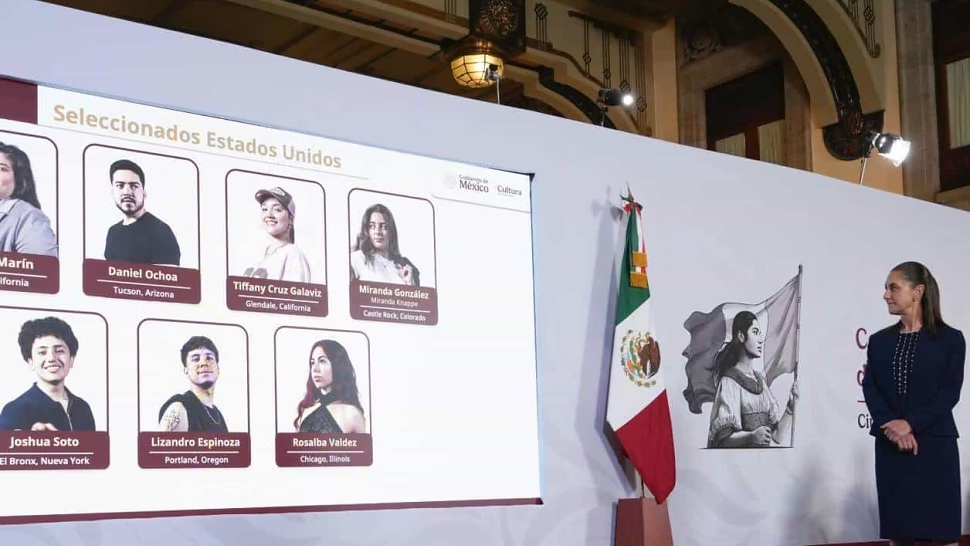
President Claudia Sheinbaum Pardo presented the seven Mexican-American semifinalists of México Canta 2026. She highlighted that the contest promotes values, love for Mexican music and the bond between families on both sides of the border.

“That bond is never broken, it is part of fraternity, love, solidarity,” he stated during the morning conference.

Sheinbaum stressed that the initiative transcends politics: it is a cultural defense that puts love above all.

Figures and stages

The Secretary of Culture, Claudia Curiel de Icaza, explained that in the first stage (May 11 to June 10) 16,289 participants were registered: 10,528 from Mexico and 5,761 from the United States. After in-person auditions, the Mexican Music Council selected 14 semifinalists: seven Mexicans and seven Mexican-Americans.

The seven selected from the other side of the border are:

  • Grecia Marín (Perris, California)
  • Daniel Ochoa (Tucson, Arizona)
  • Tiffany Galaviz (Glendale, California)
  • Miranda González (Castle Rock, Colorado)
  • Joshua Soto (The Bronx, New York)
  • Lizandro Espinoza (Portland, Oregon)
  • Rosalba Valdez (Chicago, Illinois)

The semifinals are broadcast on 45 public media on Sundays from 7 to 9 p.m. The live performances will be on August 23 at the Million Dollar Theater (Los Angeles) and August 30 at the Ángela Peralta Theater (Mazatlán). The public will choose six finalists in real time. The grand final will be on September 13 at the National Auditorium, and the winners will be presented on September 15 at the capital’s Zócalo.

The singer Armando Toledo Rosas “El Bogueto” celebrated the contest as a sign that young people can get ahead with talent and work. Grecia Marín, representing the semifinalists, thanked the president for opening spaces that carry messages of hope. Joshua Soto added that México Canta shows that music inspires and unites.

Continue reading