Venustiano Carranza Mayor’s Office strengthens security strategies with the prosecutor’s office

Inter-institutional coordination to combat insecurity Evelyn Parra Álvarez, mayor of Venustiano Carranza, and Bertha Alcalde Luján, attorney general of Mexico City, established…

Inter-institutional coordination to combat insecurity

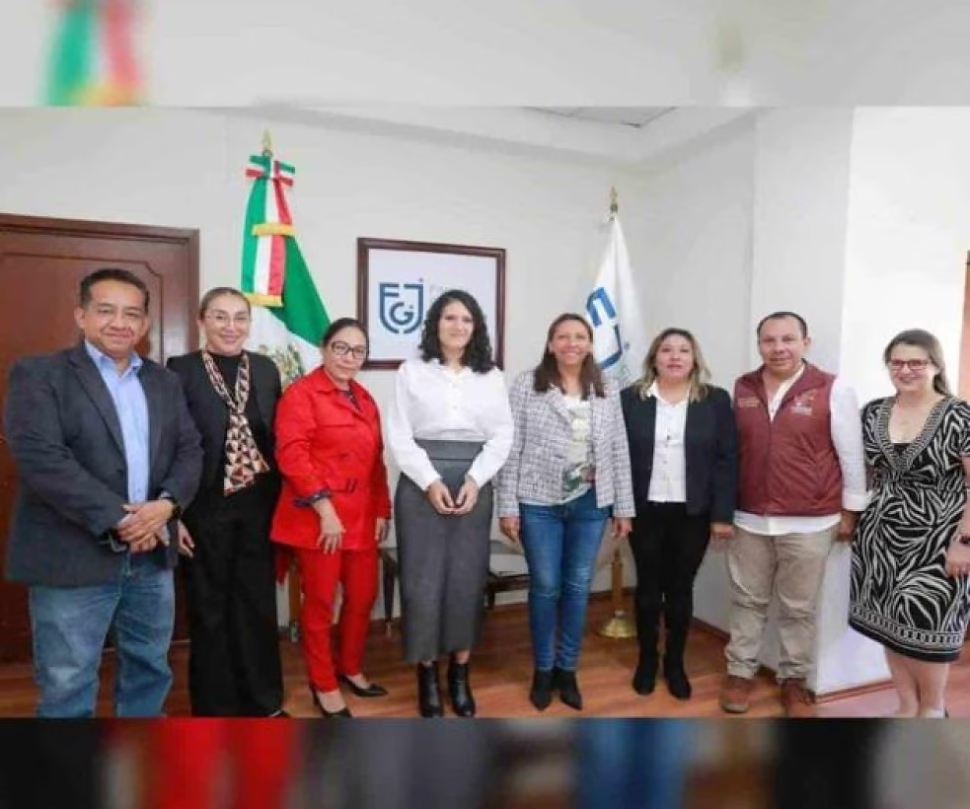
Evelyn Parra Álvarez, mayor of Venustiano Carranza, and Bertha Alcalde Luján, attorney general of Mexico City, established a joint action plan to reinforce public security in the district. During a meeting at the facilities of the Attorney General’s Office, both authorities defined mechanisms for strategic collaboration, including the exchange of information, the identification of high-risk areas and the optimization of resources.

Commitment and tangible results

The mayor highlighted the prosecutor’s willingness to work as a team, highlighting that this synergy will allow for safer environments for residents and visitors. “Coordination with institutions such as SEDENA, National Guard and Navy demonstrates our comprehensive approach,” stated Parra Álvarez, referring to the operations implemented since March with 600 elements deployed in the area.

RelatedJulión Álvarez conquers Reynosa with a historic concert

For her part, Prosecutor Bertha Alcalde emphasized that inter-institutional cooperation is key to reducing crime rates: “Only through articulated work will we achieve sustainable results”. Both officials agreed to prioritize the protection of vulnerable groups and the modernization of action protocols.

Are you interested in learning more about security initiatives in your area? Share this article on your social networks and explore other content related to public policies and crime prevention.

After four deaths, they call to avoid challenges in celebrations

Four dead after Mexican victory. Authorities issue warnings about risky behavior.

After the death of four people in the vicinity of the Angel of Independence after the victory of the Mexican National Team against Ecuador, the Secretariats of Security and Citizen Protection (SSPC) and Citizen Security (SSC) issued recommendations to prevent more tragedies.

Recommendations to avoid risks

Through a statement, the authorities warned about behaviors such as the “He wants to fly” challenge, jumping from bus stops or elevated structures, and simulated fights with traffickers. They also mentioned sudden crowds under expressions like “We will swim.”

They noted that collective euphoria, combined with alcohol or other substances, reduces the ability to identify risks and make timely decisions. This can lead to fractures, trauma, permanent injuries, or even death.

“It is recommended not to accept alcoholic beverages or any other type offered by unknown people, as they could be altered with substances that cause drowsiness, disorientation, memory loss or reduced reaction capacity.”

The SSPC and the SSC, with the support of the Cyber Police, also asked to avoid sharing content that normalizes dangerous behavior. Recommendations include:

  • Do not climb on bus shelters, pedestrian bridges or street furniture not designed to support people.
  • Refrain from games, pushing or fighting that could lead to injuries.
  • Celebrate responsibly, respect instructions and stay only in permitted areas.

Spreading these acts on social networks favors imitation, they warned. The authorities reiterated the call for caution during sporting events.

Continue reading

Plan Michoacán achieves historic low in intentional homicides

Federal strategy reduces homicides by 46% in Michoacán in eight months.

Eight months after its implementation, the Michoacán Plan for Peace and Justice shows concrete results. The federal government reported a sustained reduction in intentional homicides and other high-impact crimes in the state.

The strategy was launched after the death of the mayor of Uruapan, Carlos Manzo. During the morning conference, President Claudia Sheinbaum and the head of the Executive Secretariat of the National Public Security System, Marcela Figueroa, presented the figures.

Decrease of 46%

The daily average of intentional homicides went from 4.32 victims in January 2025 to 2.33 in June 2026. This represents a drop of 46%. Figueroa detailed that June 2026 was the month with the lowest incidence since 2015. Compared to June 2025, the reduction was 43%.

The annual trend is also positive. After reaching their highest level in 2021, homicides began to decline. The preliminary data for 2026 is the lowest in the historical series. Compared to 2025, the daily average went from 3.5 to 2.2, a reduction of 37%.

High impact crimes

The daily average of high-impact crimes fell 3% compared to 2025: from 18.1 to a preliminary figure for 2026. If the trend continues, this year would close with the lowest average in eleven years.

Beyond security

Governor Alfredo Ramírez Bedolla affirmed that the plan gives “very evident results” in security, education and infrastructure. He thanked the federal support and highlighted programs such as the Gertrudis Bocanegra scholarships and road works: the expansion to four lanes of the highway towards Lázaro Cárdenas and the export highway between Uruapan and Zamora.

“It is clear to us that we are not alone, we are well supported by our president,” said Ramírez Bedolla. Sheinbaum is on a two-day tour of Michoacán, which includes visits to communities like Cherán.

Continue reading

Mexico deploys humanitarian aid to Venezuela after earthquakes

Mexico sent more than 71 tons of supplies and rescue personnel to Venezuela after the June earthquakes.

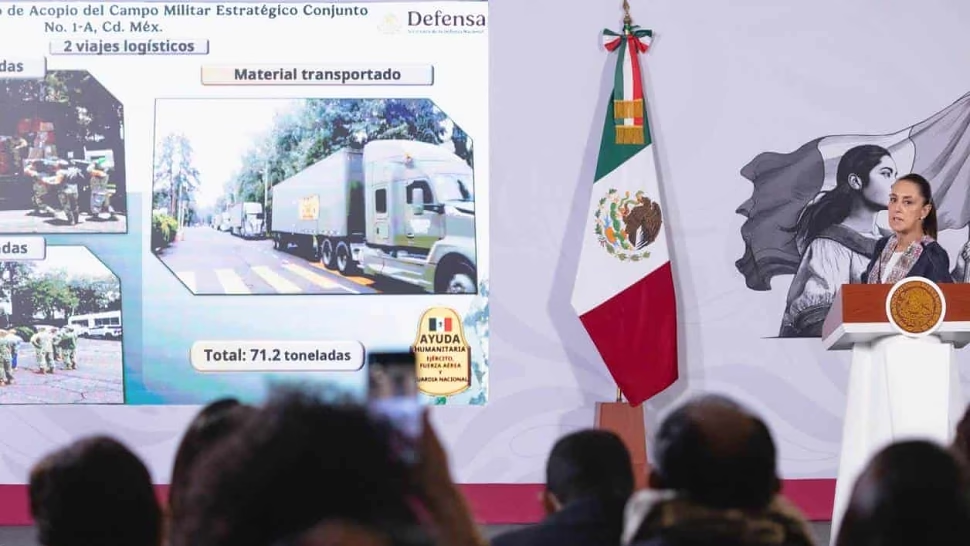
President Claudia Sheinbaum reported that the Government of Mexico, through the Ministry of Defense, has delivered 71.2 tons of supplies, eight electric power plants, 80 kilograms of Red Cross equipment and 13.1 million medications to the people of Venezuela. This, after the earthquakes that occurred on June 24.

Results of the rescue mission

Between June 26 and July 1, the Yumare Defense group rescued two people alive and recovered the remains of 40 deceased people. He also rescued a dog and provided 1,411 medical and first aid consultations. Sheinbaum added that a Navy ship will be sent tomorrow with more support.

On July 2, 28 tons of supplies were transported, consisting of non-perishable food and medicines, in response to the request of the Venezuelan government. On June 30, five power plants and 80 kilograms of Red Cross material were sent. On Wednesday, three more emergency plants with lighting systems were added.

“In total, eight plants with a lighting tower and solar panel have been transported, in addition to 80 kilograms of Red Cross material, in two logistics flights,” said the president.

Sheinbaum highlighted that the Mexican humanitarian aid team continues in Venezuela, coordinated with local authorities. He also advanced:

“A Navy ship is going to be sent, probably tomorrow, with supplies from different places to continue supporting Venezuela. This is the report.”

Assistance includes medical supplies, power plants, medications and personnel specialized in rescue and emergency care.

Continue reading