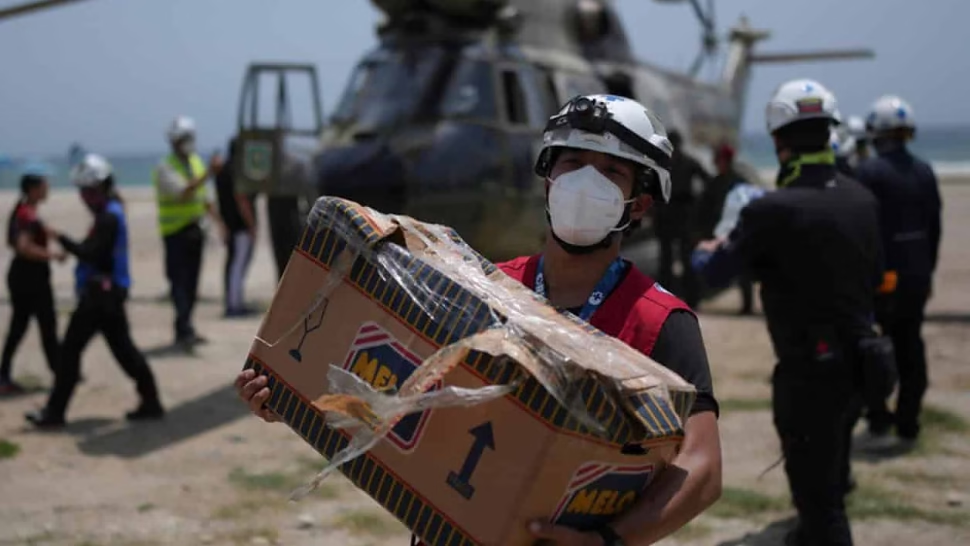
Venezuela: death toll from earthquake rises to 2,595

Interim government reports 2,595 deaths and 12,400 injuries after earthquakes on June 24.

Official balance of the earthquake in Venezuela

The interim president of Venezuela, Delcy Rodríguez, updated the figures on Thursday night from the double earthquake that shook the north of the country on June 24. The dead total 2,595 and the injured 12,400, he reported at a press conference in Caracas.

La Guaira was the most affected area, with 189 buildings collapsed. Rodríguez defended the government response and assured that the activation was immediate.

“We didn’t wait a day, two days, three days; it was immediately activated,” he declared.

He explained that three hours after the earthquake, international aid was coordinated and the transfer of rescue teams was ordered. An Emergency General Staff was declared and resources were mobilized before dawn on the first day.

RelatedDouble earthquake shakes Venezuela: more than 900 dead

Criticism and government actions

Foreign journalists questioned government management. On social networks, relatives of victims and those affected have criticized the government and those in uniform. According to Rodríguez, in the first 24 hours, 4,000 civilian and military personnel were deployed, a figure that rose to 11,000 in 48 hours and exceeds 19,000 a week after the earthquake. He highlighted the role of the Bolivarian National Armed Forces in rescues, food distribution and installation of field hospitals.

Rodríguez accused “media laboratories” of generating chaos by promoting the population to concentrate in La Guaira, which would have hindered rescue efforts. He described those who spread these matrices as “miserable.” He also rejected complaints of delays in aid and claimed to have received thanks from those affected.

He announced an initial fund of 200 million dollars with the International Monetary Fund for reconstruction and housing in safe areas, and the opening of an account at the CAF subject to audits. Support was requested from 72 countries. Regarding the identification of bodies, he guaranteed that no one will be sent to mass graves, and this is done through fingerprints and forensic comparisons with the Prosecutor’s Office and the Civil Registry. The victims number 12,800, according to official figures.

Rodríguez was accompanied by her brother Jorge Rodríguez, president of the National Assembly, and the Minister of the Interior, Diosdado Cabello.
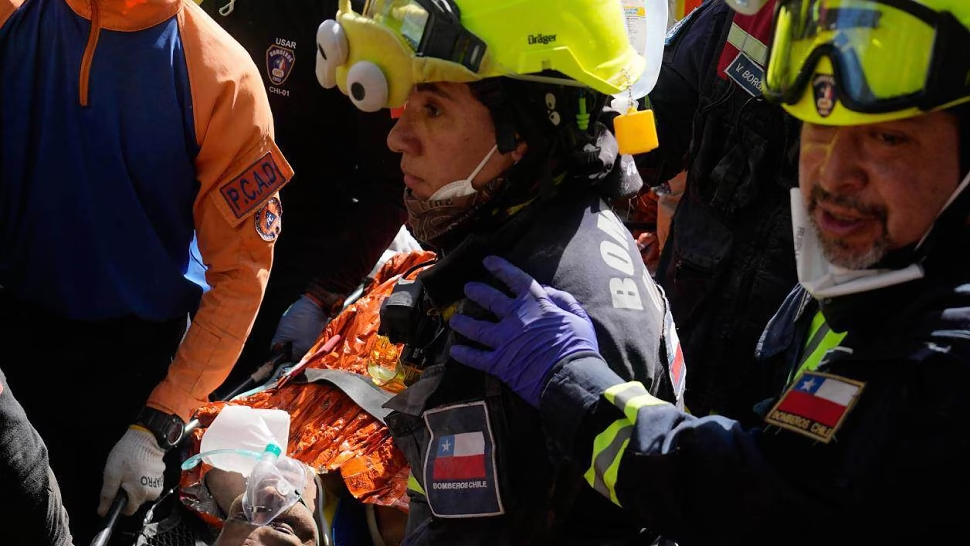
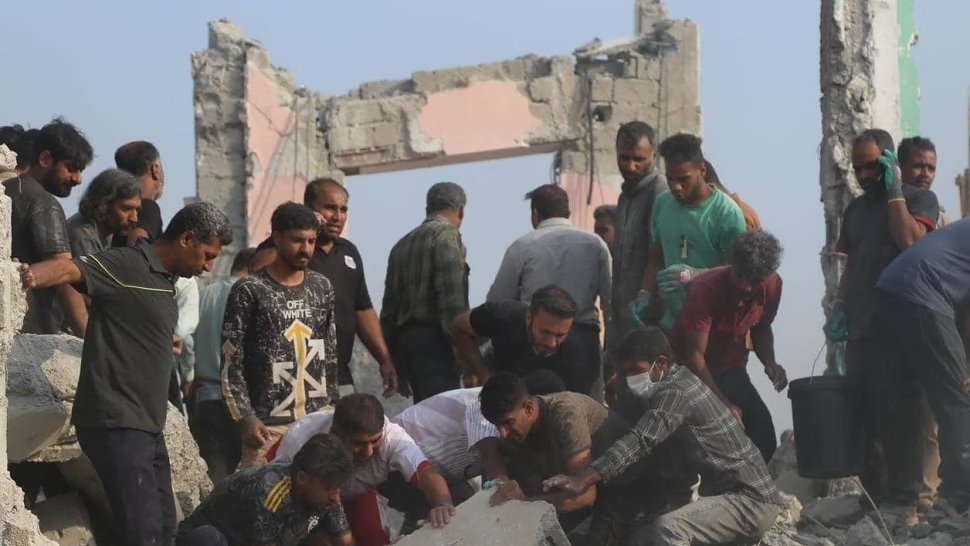
Man rescued after eight days under rubble in Venezuela

A man is rescued alive after eight days trapped under rubble in Venezuela.

Eight days after the earthquakes that devastated the state of La Guaira, rescue teams made a discovery that renewed hope. Hernán Alberto Gil Flores, 43 years old, was found alive under the remains of a shopping center in Catia La Mar.

An air pocket and the supply of water and food he received through the debris allowed him to survive. His transfer by ambulance was received with applause and emotional displays of relief among those present.

Increasing numbers and health risks

Despite the rescue, the emergency continues to leave alarming numbers. The Venezuelan government reports at least 2,295 people dead and more than 11,000 injured. Thousands remain missing or in temporary shelters. Medical personnel have warned about the risk of a health crisis due to unattended injuries and possible outbreaks of infectious diseases.

The government response has generated criticism. Various sectors consider the actions of the authorities insufficient. Meanwhile, political uncertainty persists regarding the upcoming expiration of President Delcy Rodríguez’s interim mandate, amid a lack of official information.

International support

The United States reiterated its support for humanitarian efforts and confirmed the presence of military personnel to support rescue and assistance operations. US officials indicated that they are coordinating with local authorities to facilitate aid. Emergency teams continue the search for survivors and care for thousands of affected families.

Continue reading

The forgotten school: 157 killed in attack in Iran

Attack on school in Minab leaves 157 dead, 123 are children. Doubts about responsibility.

An attack without clear answers

More than four months after the bombing of a primary school in Minab, Iran, there is no definitive official report. An Associated Press investigation reveals that most of the victims were children.

The campus was within a complex linked to the Revolutionary Guard. On February 28, staff asked parents to pick up their children because of the bombings. Minutes later, explosions destroyed the building.

Confirmed data

Human rights organizations estimate 157 identified deaths: 123 minors and 34 adults. Other sources raise the figure.

Testimonies describe scenes of devastation. Relatives and rescuers found bodies in the rubble. Hospitals received remains of numerous victims.

The investigation indicates that the US Army had indications that a school was hit. An official, speaking on condition of anonymity, said the building had been identified as an educational center years ago, but that information was not properly shared among targeting teams.

The Pentagon maintains an open investigation. The families demand answers and an official count.

The lack of access to the area, Iranian restrictions and verification difficulties prevent the complete clarification of one of the most tragic attacks of the conflict.

Continue reading

The rescue that gave hope in the midst of the tragedy in Venezuela

Rescuers celebrate the discovery of a survivor after eight days under rubble in Venezuela.

The stench of decomposing bodies spread through the streets of La Guaira as rescue brigades moved from searching for survivors to recovering remains. However, unexpected news restored spirits to the international and local teams.

The rescue of Hernán Alberto Gil Flores

Venezuelan and foreign officials celebrated the discovery alive of a 43-year-old security guard, trapped for almost eight days under the rubble of a shopping center. Television cameras captured the emotional moment when he was extracted and placed on a stretcher, while the crowd burst into applause.

Hernán survived thanks to an air pocket and the food and water that the rescuers sent him through the cracks. It far exceeded the critical threshold of 72 hours, when experts consider it most likely to find people alive.

The other side of tragedy

In other areas of the state of La Guaira, the most affected, the outlook was bleak. The port city of Catia La Mar saw officials moving around carrying body bags and stacking coffins. Equipment with seismic sensors was removed without detecting signs of life.

The government of the interim president, Delcy Rodríguez, reported at least 2,295 deaths and more than 11,000 injuries. His management has been criticized for its slowness and disorganization. Thousands of people sleep in shelters or outdoors, and doctors warn of a health crisis due to infections and untreated injuries.

Among the victims is Daniel Alejandro Núñez Ramírez, 28, deported from the United States hours before the earthquake. He had arrived on a flight with more than a hundred Venezuelans and was transferred to a hotel in La Guaira that his mother, Oswadeliz Núñez, described as a prison. Thirty minutes after a phone call, the building collapsed. His mother collected his ashes in a morgue.

“My son was not a criminal. Why do they treat people with no criminal record as criminals?” —Oswadeliz told The Associated Press.

Support from the United States

Washington supports Rodríguez and has allocated more than $300 million in assistance. John M. Barrett, US chargé d’affaires in Venezuela, assured that funds from Venezuelan oil production will be available for reconstruction. However, organizations such as the Washington Office on Latin American Affairs ask for transparency in the use of that money.

The government’s response remains under scrutiny, as the 180-day term of Rodríguez’s interim presidency expires.

Continue reading