A justice plan for the day laborers of San Quintín

The federal government launches a plan to end unfair treatment of farm workers in San Quintín.

The curtain opens on San Quentin

The setting is one of the harshest in the country: the agricultural fields of San Quintín, Baja California. There, thousands of hands—many of them indigenous—harvest berries under conditions that, frankly, should make us all ashamed. Today, the federal government takes the stage with what it calls a Justice Plan. It sounds epic. It sounds necessary. But will it be enough to change a decades-old script?

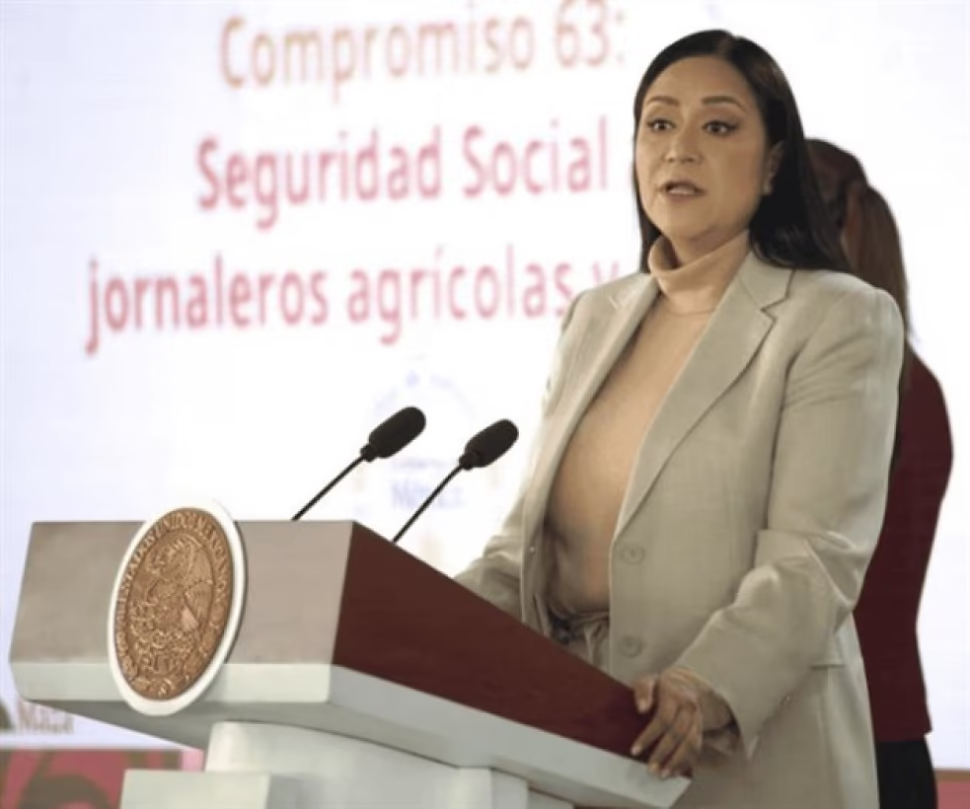
The Secretary of Welfare, Ariadna Montiel Reyes, broke down the plan from Tijuana. They are not just nice words. There are nine specific axes that range from the obvious—decent work and social security—to the urgent: addressing specific violence against women day laborers.

“When our President took office, she established in commitment 63 that we would have to work for the social security of agricultural laborers… And the Justice Plan seeks to fulfill this commitment,” expressed Montiel Reyes.

There is the key. This didn’t come out of nowhere. It is a campaign promise that now seeks to become a reality. To substantiate it, they did something smart: a house-by-house census between July and September. It is not a diagnosis from a desktop in CDMX; It is a detailed map of real pain and needs.

RelatedSheinbaum promises justice for San Quentin day laborers

Beyond the salary: your entire life at stake

What strikes me is the scope. The plan is not limited to the biweekly check. He talks about housing, urban infrastructure, health and controlling the urban sprawl. They recognize something fundamental: labor injustice is just the tip of the iceberg. Behind them are entire communities living in precariousness.

San Quentin is not just any place. It is the producing heart of strawberries and blackberries that reach our table. And those who plant and harvest are mostly indigenous people from Oaxaca, Guerrero and Veracruz. The staging is perfect for an act of historical justice.

Officials from several ministries have already visited the area. The SEP, Sedatu, Bienestar… It is a coordinated effort. But I wonder, as always: who wins from this? Beyond the humanitarian discourse, there is a clear political move: consolidate support in a key region and send a national message about who defends the most vulnerable.

My father, who was a worker, told me: “Promises are measured by what they change in the kitchen.” This plan sounds good on paper—very good—but its true drama will be written day by day, in every respected contract, in every woman who can report without fear, in every family that has a decent roof over their heads.

The curtain is already up. Now it’s time to see if the play fulfills its epic promise or if it remains just another act of the great Mexican political theater.

Cofepris alert: five beaches not suitable for swimming this summer

Five Mexican beaches not suitable for vacationers due to high bacterial levels.

Contaminated beaches: health risk in five destinations

The Federal Commission for the Protection against Sanitary Risks (Cofepris) reported that five beaches in the country are not suitable for receiving vacationers due to high bacterial concentrations.

The designated areas are: Tijuana Beach, in Baja California; Cuale Beach, in Puerto Vallarta/Bahía de Banderas, Jalisco; Main Beach, in Puerto Escondido, Oaxaca; and José Martí and Tumbao Beaches, in Veracruz.

“Cofepris recommends that bathers refrain from swimming activities or other direct contact recreational uses on beaches designated as unsuitable. Preserving these healthy environments and protecting collective health is a shared commitment,” the Commission said in a statement.

Together with the Clean Beach Committees and local authorities, prevention and intervention efforts are coordinated to implement urgent sanitation actions in these five coastal areas, in addition to placing preventive signs.

Almost all Mexican beaches are safe

In contrast, the quality of sea water on 284 beaches — 98.3% — is suitable for recreational use during the summer of 2026, Cofepris detailed.

Between June 15 and July 1, 2,279 seawater samples were collected and processed at 393 strategic verification points, distributed in 76 tourist destinations of the 17 entities with a coastline.

The authorities remember that pollution can affect the health of bathers, so they ask you to follow the recommendations to avoid problems during the holiday season.

Continue reading

Sheinbaum receives rescuers from Venezuela and a donated dog

Sheinbaum receives rescue brigade sent to Venezuela after earthquakes; They highlight donation of a rescue dog.

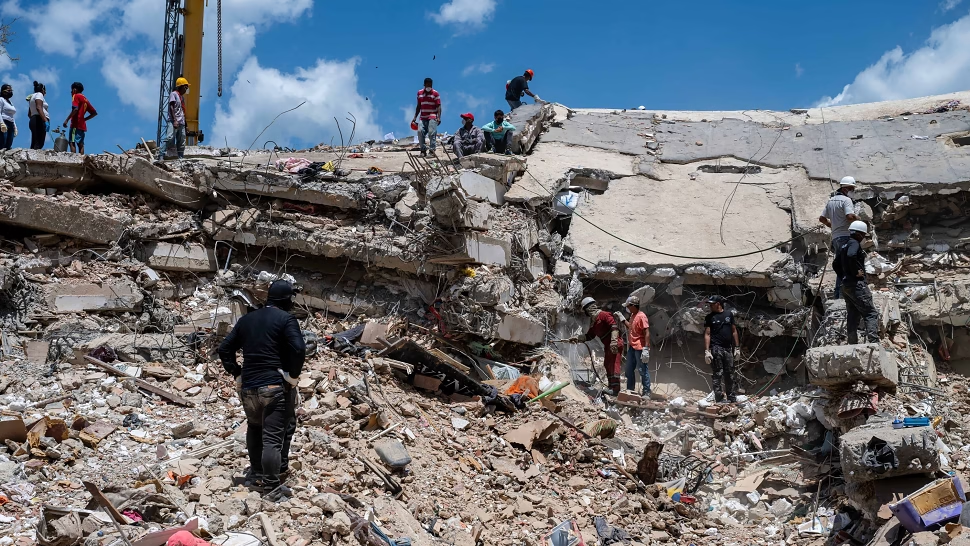
This Friday, President Claudia Sheinbaum received the rescuers who traveled to Venezuela to help the population after the recent earthquakes.

“Mexico will always be in solidarity with all the people of the world, and when there is a need to support, we will be there,” he declared.

Concrete support

In the morning conference from the National Palace, Sheinbaum explained that the first stage of rescue has practically concluded. Although the search for bodies continues, the initial emergency has already been attended to.

Mexico could send more assistance. Two ships with humanitarian aid – food and emergency electrical plants – are about to arrive in Venezuela.

A gift rescue dog

The president explained that Delcy Rodríguez, president in charge of Venezuela, donated a rescue dog to the Mexican brigade. This dog will be part of the search teams in Mexico.

Sheinbaum is preparing a reception ceremony at Military Air Base 1 for this afternoon, where the work of the rescue team will be recognized.

Continue reading

Mexico recovers 17 thousand archaeological pieces from abroad

The pace of repatriations exceeds that of Peña Nieto's six-year term by ten times.

Record repatriation and museum reopening

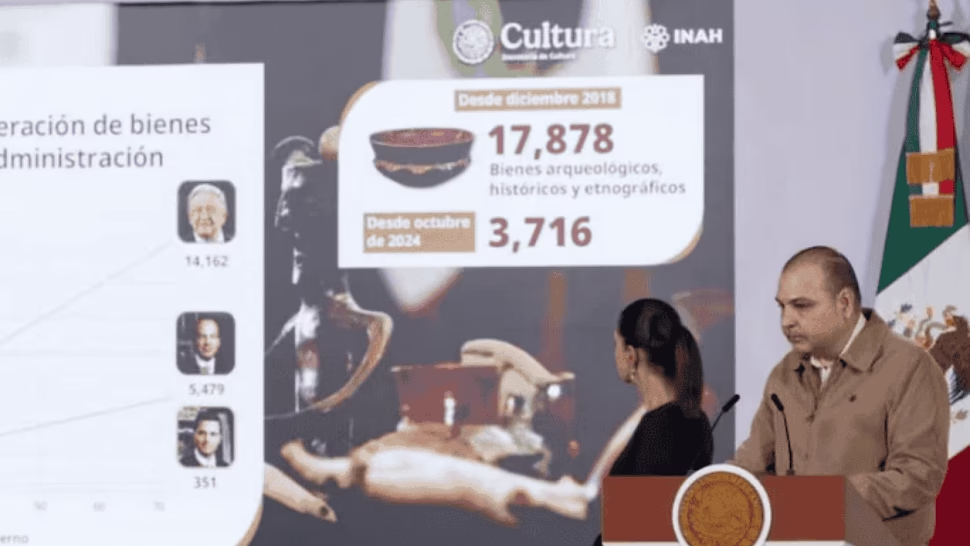
President Claudia Sheinbaum highlighted that archaeological pieces recovered abroad are being returned to their communities of origin. According to the INAH, under federal foreign policy, 17,878 cultural assets have been recovered, of which 3,716 correspond to the current administration.

The Secretary of Culture, Claudia Curiel de Icaza, pointed out that the restitution is carried out in coordination with the Ministry of Foreign Affairs through international alliances.

The director of the INAH, Joel Omar Vázquez Herrera, explained that the rate of repatriations exceeds that registered by Enrique Peña Nieto’s six-year term by ten times and that carried out under Felipe Calderón by 68 percent. From 2024 to date, the countries that have returned the most objects are the United States (3,369 pieces), followed by Italy, Canada, France and Spain.

As part of strengthening the heritage, the Museum of Teotihuacan Grandeza reopened its doors after being closed for two decades. The investment was 7 million pesos for architectural and museum restoration. It exhibits 174 pieces—80 percent never shown before—and has received more than 25,000 visitors since June.

Finally, the Undersecretary of Cultural Development, Marina Núñez Bespalova, presented the “Original Workshop” project, which will train artisans to sell their works at the Los Pinos Cultural Complex starting in November, under a fair trade tabulator designed by the communities.

Continue reading