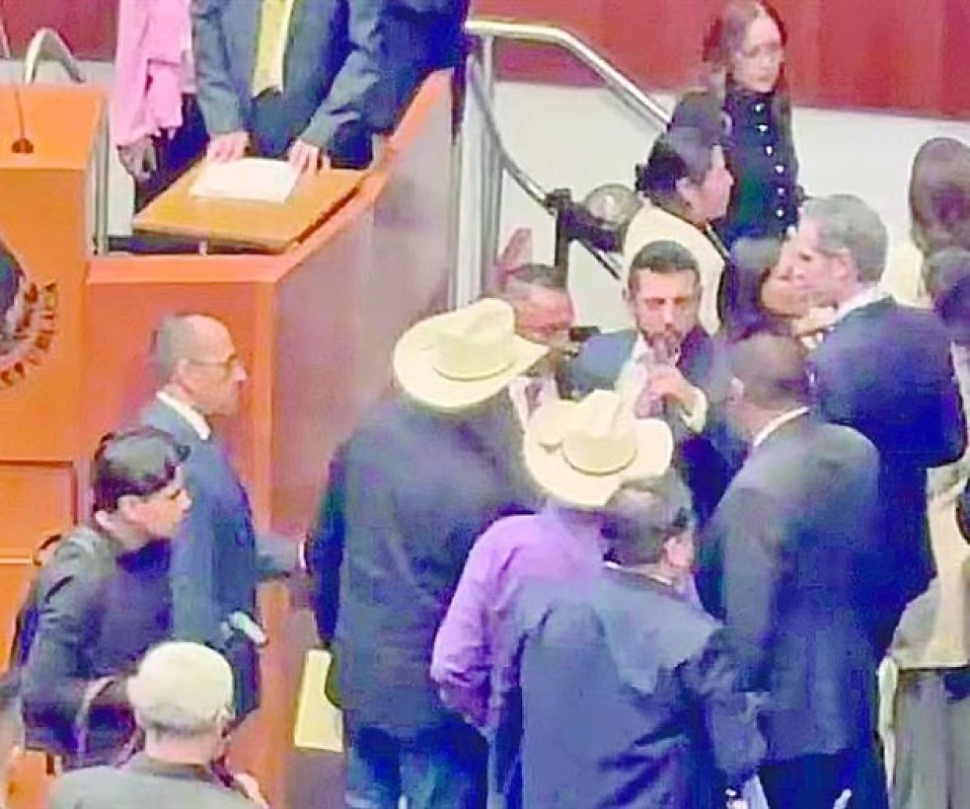
Agricultural producers break into the Senate to demand dialogue

Farmers demand a direct audience with the president after entering the legislative chamber to make the emergency in the sector visible.

Agricultural producers demand direct dialogue in the Senate

A group of agricultural producers from various states of the country made an unscheduled entry into the plenary session of the Senate of the Republic immediately after concluding the appearance of the Secretary of Welfare, Ariadna Montiel Reyes. The fundamental objective of the collective action was to establish a direct communication channel with the President of the Republic, Claudia Sheinbaum Pardo, given the lack of responses to their demands from the corresponding federal agency.

Four representatives of the sector managed to enter the parliamentary chamber with the explicit support of senators belonging to the opposition parties. The leaders remained for approximately ten minutes in the lower area of the tribune while the federal official concluded her protocol interactions with the legislators present.

RelatedAgricultural producers warn of new protests over non-compliance

Lack of institutional responses motivates direct action

The agricultural leader Horacio Gómez Carranza, representative of Baja California, explained that the decision to seek Montiel Reyes as an interlocutor was based on his political closeness with President Sheinbaum. This strategy arose in response to the apparent ineffectiveness of the Secretary of Agriculture and Rural Development, Julio Berdegué Sacristán, who according to the producers has not implemented the necessary agreements nor demonstrated political will to resolve the structural crisis of the Mexican countryside.

Representatives of the sector maintain that the current administration has left producers without effective institutional mechanisms to address critical problems such as the sustained fall in the prices of their products, the lack of access to agricultural credit and the unfair competition generated by excessive imports of basic grains. “Our hypothesis is that the President is unaware of the real magnitude of the situation, that there is a breakdown in the internal communication of the federal government in the face of this emergency in the agricultural sector, and therefore we seek to establish a new channel of dialogue,” said Gómez Carranza.

Pressure measurements remain active

The producer organization confirmed that it will keep the forty road blockades strategically distributed throughout the national territory active as a measure of legitimate pressure. These protest actions respond to the progressive deterioration of the economic conditions of the sector, characterized by the drastic drop in prices in local markets, the shortage of timely financing and the excessive increase in imports of agricultural products.

During the development of the parliamentary appearance, Secretary Montiel Reyes concluded her intervention without making any statement about the presence of the agricultural representatives in the room. Simultaneously, elements of the Parliamentary Guard implemented a security operation that prevented any type of physical approach or direct dialogue between the producers and the federal official.

Legislative continuity and institutional tensions

The Senate of the Republic continued the development of its plenary session without significant interruptions, while the agricultural representatives left the premises under the strict supervision of institutional security personnel. This episode shows the level of tension between the agricultural sector and the federal authorities, while reflecting the growing social pressure that legislators face to generate concrete solutions to the historical demands of the Mexican countryside.

The situation described represents a critical point in the relationship between the federal government and agricultural producers, who have exhausted conventional institutional avenues without obtaining satisfactory answers. The incident in the Senate constitutes a wake-up call about the urgency of meeting the demands of the primary sector, whose stability is fundamental for national food security and rural economic development.

Does this information about the situation in the Mexican countryside seem relevant to you? Share this analysis on your social networks to keep your community informed and explore more content related to agricultural policies and rural development on our specialized portal.

Rita Cetina Scholarship will benefit 9 million students

Claudia Sheinbaum begins delivery of cards for uniforms and supplies in Tijuana.

Start up in Tijuana

President Claudia Sheinbaum led the start of the Rita Cetina Scholarship card delivery in Tijuana, Baja California. The subsidy covers uniforms and school supplies for public elementary students.

The program plans to benefit nearly 9 million students nationwide. The support will be dispersed from August through the Banco del Bienestar.

Support details

Sheinbaum recalled that this scholarship complements other programs of the Fourth Transformation: the scholarship for secondary school, the Benito Juárez for high school and the Gertrudis Bocanegra for higher education. The objective is to reduce the financial impact of registration, footwear and materials at the beginning of the school year.

The Secretary of Public Education, Mario Delgado Carrillo, pointed out that more than half a million students in Baja California will receive some federal stimulus. He also encouraged parents to enroll their children in the “Live Healthy, Live Happy” program, which offers nutritional counseling, dental care and free glasses.

The national coordinator of Scholarships for Wellbeing, Julio César León Trujillo, explained that 291,036 primary school students will be added to the 292,392 current scholarship recipients in the state in August. Governor Marina del Pilar Ávila Olmeda and a beneficiary student thanked the extension of this social right, which strengthens the family economy and school permanence.

Continue reading

Sheinbaum inaugurates CBTIS 290 in Tijuana with an investment of 66.5 million pesos

The new center offers 540 spaces per shift and includes the subject of artificial intelligence.

President Claudia Sheinbaum inaugurated the Industrial and Services Technological Baccalaureate Center (CBTIS) number 290 in Tijuana, Baja California. The campus is integrated into the National Baccalaureate scheme as part of the federal goal of generating 200,000 new spaces for higher secondary education in the country.

Investment and capacity

During the ribbon cutting, Sheinbaum explained that the 2025-2026 plan includes 500 educational infrastructure actions. It includes enabling afternoon shifts in secondary schools, expanding current high schools and building new centers under the unified “Margarita Maza” model.

Governor Marina del Pilar Ávila thanked the federal administration for bringing study options closer to areas of high demand. Sheinbaum recalled that graduates can continue higher education at the Rosario Castellanos National University campus that operates in the region.

CBTIS 290 represented a total investment of 66.5 million pesos: 49.2 million in civil works and 17.7 million in technological equipment. It has two three-level buildings, 12 classrooms and a specialized laboratory. It is the only institution in the area that teaches Artificial Intelligence. It also has a multifunctional court, civic plaza and green areas. Its operational capacity is 540 students per shift.

Continue reading

Felipe Calderón demands financial support for Pato Merlín

The former president says FIFA must compensate the duck's owners for using his image.

Former president Felipe Calderón Hinojosa criticized the designation of Merlin Duck as the official ambassador of Mexico City for the 2026 World Cup. On his social media account, the PAN member pointed out that FIFA and various media make profits from the image of the bird, so its owners deserve fair payment.

“Yes, very good. It came ‘as a gift’, but we shouldn’t leave it like that: they should give it royalties or good financial support, with all the money that FIFA, many media outlets in the world and others with the image of Merlin Duck are making,” he wrote.

Merlin is a two-year-old Peking duck with white plumage and orange legs. He went viral when he was recorded wearing a National Team t-shirt while accompanying his owners – Karla Gómez and her son Christian – to sell water on the streets of the capital. The family considers him another member.

Calderón insisted that the owner, “that little guy who raised him,” should not be left without options after the World Cup. “Get out!” he added, referring to FIFA.

The popularity of duck has crossed borders. International media replicated his story, and President Claudia Sheinbaum invited him to her morning conference, calling him a symbol of Mexican culture. The controversy over the commercial use of his image remains open.

Continue reading