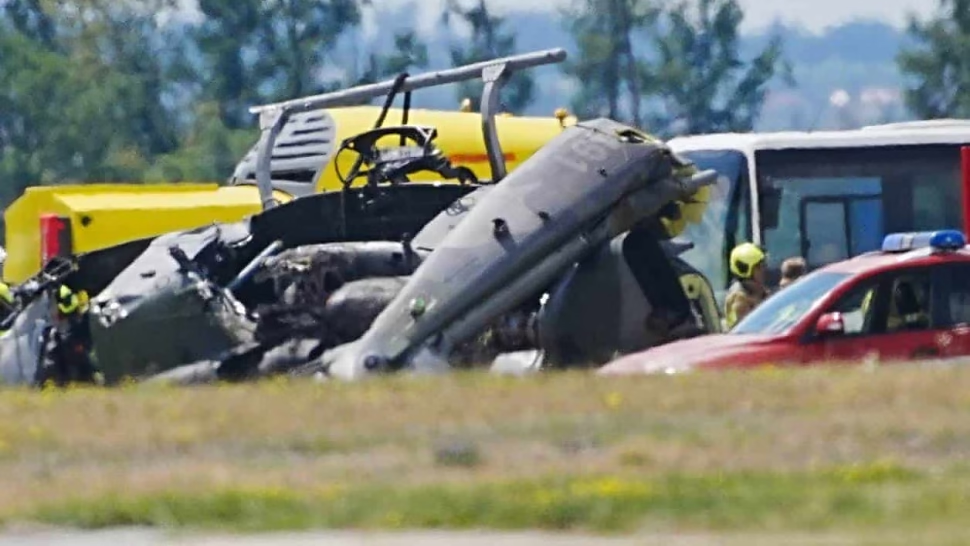
The cruel irony of forging a dream and encountering a ball of fire
It seems that the universe has a particularly macabre sense of humor. Alain Rodríguez Colina, a Cuban immigrant who, in a twist worthy of the classic American dream, had reinvented himself as a metals buyer in a Kentucky scrapyard, decided that Christmas was as good a day as any to close his chapter. The cause? The severe burns suffered in the spectacular and terrifying crash of a UPS cargo plane last month. With his death, the death count rises to fifteen, because why settle for a tragedy when you can have a saga?
The scene, worthy of a low-budget disaster movie, occurred when the device, full of fuel for an idyllic flight to Hawaii, decided that taking off from the Louisville airport was just a suggestion. After takeoff, the left engine took the liberty of detaching itself, which, surprise, is not optimal for aerodynamics. The result was an infernal fireball that crashed into businesses, including, of course, the place where Alain worked. Governor and mayor confirmed the news on social networks, because in the 21st century even death is announced with a tweet and “may his memory be a blessing.” How moving.
From buying metals to fighting for your life: a truncated promise
According to his boss, Sean Garber, Alain not only embraced the culture of the company and Louisville, but he even became a fan of the University of Kentucky team. An impeccable integration process, until an airplane engine literally fell from the sky to ruin everything. Depot colleagues described scenes of chaos and heroism in helping survivors. Alain, with luck as bitter as it was ironic, managed to escape the initial hell, but with 50% of his body burned. The doctors, those eternal optimists, did not harbor much hope.
He spent his last weeks in an induced coma, without regaining consciousness, while his family visited him. His condition seemed to improve slightly, giving a false glimmer of hope, until on Thursday his health worsened. “You should stay with us,” Garber said. But fate, that lazy screenwriter, had already decided the tragic ending. The opportunity that he valued so much in the United States was taken away from him in the most absurd and violent way imaginable.
Responsibilities, demands and airplanes that perhaps should be in a museum
While the family and the community mourn, the legal circuit heats up. There are already wrongful death lawsuits on the table, alleging that UPS continued to fly old planes (the venerable MD-11) without more than merely routine maintenance. They also point to General Electric, the engine manufacturer, who said ‘see you later’ in mid-flight. Both companies, in a joint statement of “we do not comment, but safety comes first,” do the classic dance of corporate responsibility. Of course, the Federal Aviation Administration, in an act of preventive wisdom, has grounded all the remaining MD-11s, those planes that have only been transporting cargo for a decade. Better late than… well, in this case, definitely late.
Attorney Masten Childers III, whose firm represents more than 90 victims, including Colina’s family, announced more lawsuits. “Alain’s passing must be honored by holding those responsible for his death accountable,” he declared. A noble idea, although one cannot help but wonder if the accounts rendered will bring life back to a man who only wanted to work and prosper. The National Transportation Safety Board’s investigation continues, looking for cracks in the metal and, perhaps, in the protocols.
Alain Rodríguez Colina’s story is a grotesque reminder of how life can change in an instant, not because of a personal drama, but because of a chain of mechanical failures and corporate decisions that crash into the reality of ordinary people. A man fled a reality in search of opportunity, only to have a piece of defective metal write his epilogue in flames. Irony, like the smoke from that fire, is thick and difficult to swallow.
Does this tragedy make you question the safety of cargo transportation? Share this note to keep the conversation and the demand for responsibilities current. Explore more on our aviation security investigations site.