Will the USMCA become a bilateral treaty?

Analyst warns of possible evolution of the T-MEC towards a bilateral scheme, although he considers it unlikely in the short term.

A two-party T-MEC?

The American Society Mexico issued a warning that will make more than one think. His thesis: the Treaty between Mexico, the United States and Canada could cease to be trilateral and become primarily an issue between Mexico and the United States.

The weight of commercial exchange between these two neighbors would be the driving force behind this change. But how real is this scenario?

“There is a probability close to 40% that this change will occur,” estimated Larry Rubin, president of the organization.

There is the data. Almost 40% probability. But Rubin, as a good connoisseur of the system, immediately put his feet on the ground.

RelatedThe T-MEC will shield Mexican exports from United States tariffs

He acknowledged that the political and legislative processes necessary to modify the agreement make it unfeasible for this to happen soon. Bureaucracy and politics, as always, stopping any rapid change in its tracks.

Priorities found

The US government has its sights set on other fronts. Conflicts in the Middle East monopolize its international agenda, leaving a possible reconfiguration of the T-MEC on the back burner.

Meanwhile, in the bilateral relationship there are hot issues on the table. Rubin highlighted two especially sensitive ones: regional security and openness to greater private investment in energy.

This last point is crucial. The uncertainty surrounding political reforms in Mexico generates doubts among those who put in the money. Investors look askance when the rules of the game seem to move.

Despite everything, Amsoc’s official position is clear: it is best to maintain the trilateral nature of the treaty. Although they recognize an undeniable fact.

Mexico’s economic relevance has strengthened direct dialogue with the United States. That is already a reality. A strategic relationship that is consolidated day by day, with or without formal changes in the T-MEC.

The energy sector will continue to be a thermometer of this relationship. Decisions on private investment there could tip the balance in future negotiations.

For now, the treaty remains three. But the conversation about whether it could be two is already on the table.

Semar seizes half a ton of cocaine in Manzanillo

They seize 270 kilos of cocaine in a container in Manzanillo; two migrants detained.

Operational in the port of Manzanillo

The Secretary of the Navy (Semar) secured 268 packages with 270 kilos of cocaine inside a container in the port area of Manzanillo, Colima. During the inspection, they located two men with an irregular immigration status on board the ship where the drugs were found. Both were placed at the disposal of the authorities.

The cargo was discovered by personnel from the Naval Port Protection Unit (UNAPROP) during unloading maneuvers from a container ship. Semar reported that the drugs were left in charge of the Public Ministry to integrate the investigation folder. Elements of the FGR carried out the weighing, counting and identification of the evidence.

Regarding the detainees, the agency indicated that they were in good health. They were transferred to determine their legal status due to their irregular stay in the country, although their nationality was not specified.

The operation was carried out in coordination with the National Customs Agency of Mexico (ANAM), the Secretariat of Security and Citizen Protection (SSPC) and the Attorney General’s Office (FGR), through the Criminal Investigation Agency (AIC).

Semar indicated that these actions are part of the permanent inspection, surveillance and port protection operations to prevent illicit trafficking of substances. It should be remembered that a day before, the same agency seized five packages with 139 bricks containing approximately 137 kilos of cocaine in the port of Lázaro Cárdenas, Michoacán, where five people of Ecuadorian nationality were detained.

Continue reading

Trans people take shelter in Segob to demand dialogue with Rosa Icela

Trans activists demand a direct meeting with the Secretary of the Interior after days of protest.

A group of trans and non-binary people held a day of protest this Friday inside the Ministry of the Interior (Segob) to press for a meeting with its head, Rosa Icela Rodríguez. Since Thursday, they remain in a room at the agency, in the Juárez neighborhood, Cuauhtémoc mayor’s office, Mexico City.

They demand concrete advances: a reform of articles 1 and 73 of the Constitution, a Comprehensive Trans Law and public policies in various agencies. Activist Victoria Sámano explained to EL UNIVERSAL that recommendation 42-2024 of the CNDH “has been half fulfilled.”

“They have only been simulation tables, tables to wear us down and they have not even been followed up,” he denounced.

As part of the protest, they held a “dissident sonidero” with the SoniTrans collective, where several couples danced to make their rights visible. They also called for a collection of food, batteries, blankets and presence.

The protest coincides with another CNTE demonstration. Sámano pointed out that they have already spoken with the teachers and criticized the government’s “omission” with different social groups: teachers, searching mothers and trans people.

“It is not about a single group, but about the deficiency and omission of this government,” he stated.

Faced with Segob’s initial refusal to schedule a direct meeting with the secretary, the protesters warned that they will not withdraw until they obtain one. “We’re staying here until they give us a meeting!” they concluded.

Continue reading

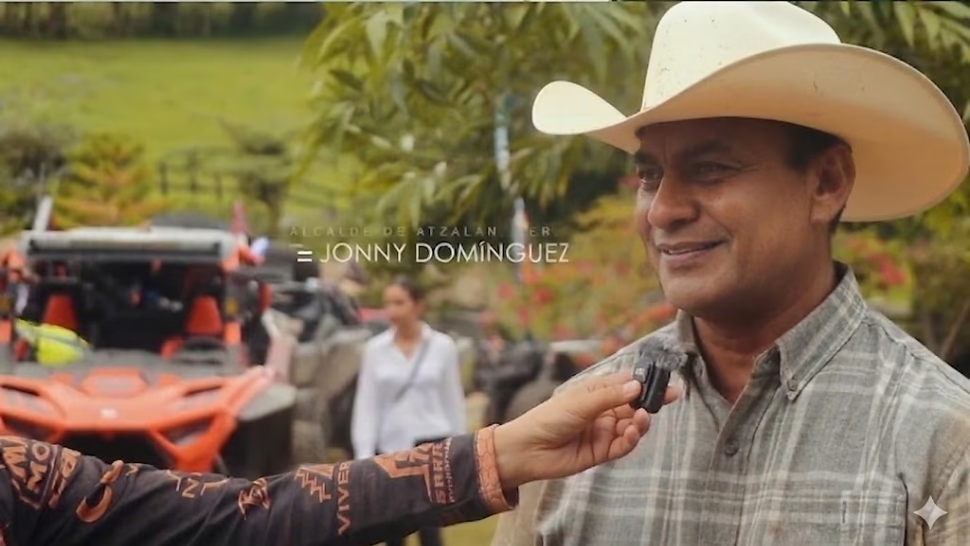
Atzalan vibrates with the adrenaline of the Citrus Route 2026

Atzalan, Veracruz. Between dirt roads, natural landscapes and great family coexistence, the 2026 edition of the traditional Citrus Route, one of the adventure events...

Atzalan, Veracruz. Between dirt roads, natural landscapes and great family coexistence, the 2026 edition of the traditional Citrus Route was successfully carried out, one of the most anticipated adventure events for all-terrain vehicle fans in the region.

From early in the morning, dozens of participants from various municipalities of Veracruz and neighboring states gathered to travel the routes designed by the organizers, crossing rural trails, forested areas and characteristic roads of this municipality located in the central mountainous area of the state. 

The activity brought together drivers of ATVs, ATVs and UTVs, who enjoyed a tour full of excitement, camaraderie and spectacular natural views. During the day, an atmosphere of family coexistence prevailed, strengthening the ties between lovers of motor sports and adventure tourism.

Participants highlighted the hospitality of the inhabitants of Atzalan and the beauty of the natural settings that the region offers, factors that have made the Citrus Route a benchmark for this type of events in Veracruz.

In addition to promoting recreation and sports, the activity represents an important economic benefit for service providers, local businesses and entrepreneurs, who benefit from the arrival of visitors during the development of the event.

Authorities and organizers agreed that the Citrus Route continues to consolidate itself as a platform to promote regional tourism, showing the state and the country the natural, cultural and gastronomic wealth of Atzalan.

With a large participation and white balance, the 2026 edition concluded, leaving a memorable experience for attendees and reaffirming its place as one of the most important off-road meetings in the Veracruz entity.

Editorial | This is Veracruz

Continue reading