Venezuela announces releases after Maduro’s capture

A gesture of "peace" comes after a foreign military operation, while family members wait with hope and skepticism.

A “peace” gesture with action movie timing

In a twist that no one saw coming (well, maybe everyone after a foreign army stormed in), the Venezuelan government announced this Thursday that it will release a “significant number” of imprisoned citizens and foreigners. The reason? A laudable desire to consolidate peace and coexistence. Of course, because nothing fosters harmony like a US military intervention and the capture of former president Nicolás Maduro five days earlier. A coincidence, without a doubt.

“These release processes are happening from this very moment,” solemnly declared Jorge Rodríguez, president of the National Assembly and brother of the new president in charge. He stated that they seek peaceful coexistence without political distinctions. What he did not specify, in a show of transparency, was how many people will actually leave. A hundred? A dozen? The guy who cut into the bread line? The mystery is part of the charm.

RelatedMaduro’s capture unleashes a wave of international reactions and criticism

Reactions: between relief and “it’s about time”

Meanwhile, the Ministry of Foreign Affairs of Spain celebrated the release of five Spaniards. For its part, the Penal Forum, a civil organization, kindly recalled that as of December there were 863 people detained for political reasons, a figure that the authorities, of course, flatly deny. To them, they’re just a bunch of disorder enthusiasts planning destabilizing picnics.

Outside the dungeons, the scene was worthy of a drama. Relatives waited anxiously in front of penitentiary centers like El Rodeo or mentioned El Helicoide, that headquarters of SEBIN that began as a temporary hotel and became a long-term residence. “We are very anxious… waiting for God to bless us,” said a family member. Because in these situations, who else to turn to?

The expectation crossed the pond to Argentina, where friends and relatives of Argentine detainees met in Buenos Aires. There was the girlfriend of Nahuel Gallo, an Argentine non-commissioned officer detained more than a year ago on a terrorism accusation that his family rejects. “If not today, let it be soon… we have fought a lot,” he declared, hugging his son. A t-shirt with a liberation message is the official *outfit* for the occasion.

The elephant in the room: a country without its “captured” leader

All this sudden clemency occurs in the surreal post-capture of Maduro context. The former president, now an involuntary resident in the United States, pleaded not guilty before a court in New York to narcoterrorism charges. Meanwhile, her former vice president, Delcy Rodríguez, was sworn in as acting president for an indefinite period of time. Elections in 30 days? No, thanks. The absolute foul was not declared, a technicality as convenient as it was timely.

The opposition, led by figures such as María Corina Machado, demands that Edmundo González Urrutia, whom they consider the legitimate president elected in 2024, takes power. On the other hand, Donald Trump has made it clear that the United States plans to administer the country, dropping pearls such as that Machado lacks the necessary “respect.” Because if there is something that defines respect, it is the opinions of a former foreign president on the internal politics of another country.

In the midst of this chaos, Jorge Rodríguez affirms that dialogue exists… but only with those who are not “extremists” and abide by the constitution. A definition so elastic that it could include anyone who doesn’t say “yes” to everything. Without mentioning Machado, of course. His whereabouts are unknown, but his opinion, expressed on networks, is clear: Maduro faces international justice for atrocious crimes.

As it is, Venezuela is navigating an absurd chapter where liberations are both a ray of hope and a political movement calculated on an international chess board. The political turmoil does not stop, and each announcement comes with a dose of skepticism. Genuine humanitarian gesture or maneuver to appease the international community and calm domestic waters? The answer, such as the exact number of those released, remains up in the air.

Are you surprised by this turn of events? Share this note on your social networks and explore more analysis on the complex political situation in Venezuela and its global impact.
Russia attacks kyiv with missiles and drones: one dead and multiple injured

Russian attack with missiles and drones leaves one dead and eleven injured in kyiv.

Night attack in kyiv

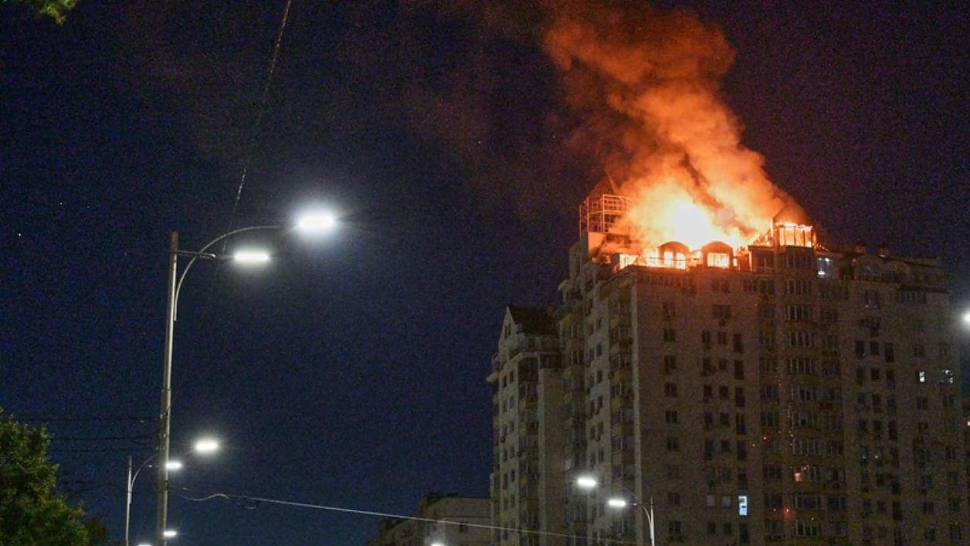
Russia launched a missile and drone attack against kyiv during the early hours of Thursday. The bombings shook the Ukrainian capital and caused damage to residential buildings.

The head of the kyiv Military Administration, Tymur Tkachenko, reported that one person died and several were injured. Mayor Vitali Klitschko said that at least 11 people suffered injuries.

The attack reached all 10 districts of the city, on both banks of the Dnipro River. The first warnings were issued by President Volodymyr Zelenskyy and other officials. Many residents took refuge in subway stations.

Recorded damages

Klitschko reported that five people were injured in the Shevchenkivskyi district, including a paramedic in critical condition. In Desnianskyi, a nine-story building was damaged and trapped people were rescued. In Holosiivskyi, a fire broke out on the roof of a multi-story building. House fires were also reported in the Sviatohynskyi and Darnytskyi districts.

Response from authorities

Tkachenko detailed that the attack partially destroyed a residential building in Desnianskyi, caused fires near homes in two parts of the Pecherskyi district, and another fire near an administrative building in Solomianskyi. Authorities also recorded damage in the Obolonskyi and Podilskyi districts.

In recent weeks, Russia has stepped up its attacks on kyiv. Meanwhile, Ukraine has deployed long-range drones against Russian military targets and energy facilities, creating fuel shortages and affecting supply lines within Russia. Klitschko urged residents to stay in shelters in the face of what he called a “furious enemy attack.”

Continue reading

Venezuela: hospital crisis after earthquakes and thousands of people affected

The earthquakes in Venezuela left more than 1,700 dead and a health crisis that overwhelmed hospitals.

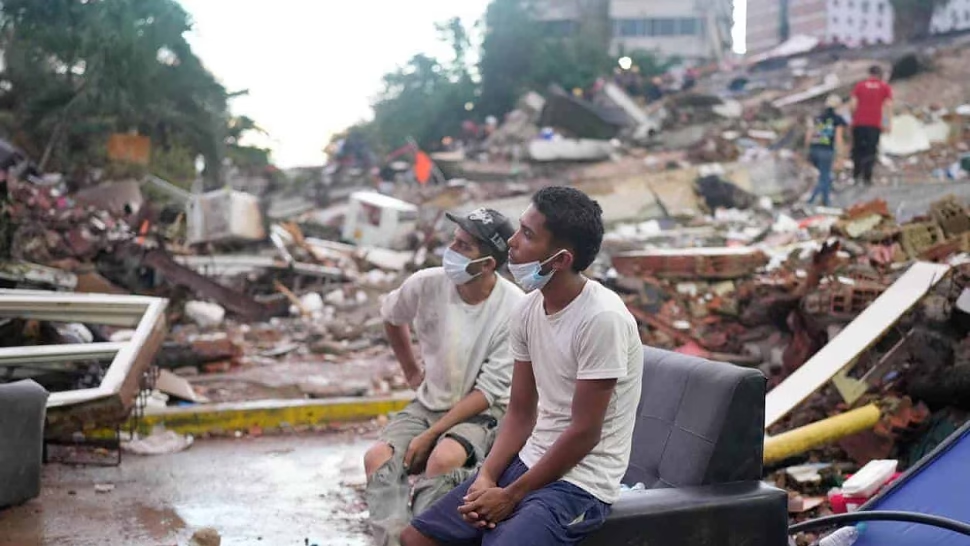
Last week’s earthquakes in Venezuela have collapsed the health system. More than 1,700 people died and thousands were injured. Hospitals operate at their limit, according to international organizations.

Hospital damage and disease risk

The WHO reports dozens of hospitals affected, several out of service. Those that work face overcrowding, lack of staff and delays in surgeries. In addition, thousands of displaced people live in makeshift shelters. The UN warns of possible outbreaks of measles, dengue, malaria and yellow fever due to overcrowding.

Figures and call for help

Venezuelan authorities count more than 15,000 affected, but the number could be higher, according to international organizations. NASA estimates that 59,000 buildings were damaged or destroyed. UNICEF estimates that 680,000 children need humanitarian assistance. While search and rescue efforts continue, national and international organizations are asking to reinforce humanitarian and medical aid. The priority is to care for the affected population, prevent the spread of diseases and strengthen the response capacity of the health system to the magnitude of the emergency.

Continue reading

The ‘Flemish Revolution’ shakes Albania against Kushner’s project

Albanian environmentalists use foam flamingos to protest a tourism project linked to Jared Kushner.

The ‘flamingo revolution’ that challenges a Kushner project in Albania

Thousands of people have demonstrated in Tirana against a luxury tourism megaproject linked to Jared Kushner, son-in-law of US President Donald Trump. The mobilizations, baptized as the “flamingo revolution”, have a peculiar symbol: figures of flamingos made of foam by the activist Natma Paja, used to make visible the rejection of development.

The project includes hotels, villas, apartments and a marina on Sazan Island and Narta Lagoon, a protected area that is home to migratory birds. Civil organizations denounce a risk to biodiversity and demand the suspension of the works.

The government defends investment

Prime Minister Edi Rama has backed the project, arguing that it will boost high-end tourism, strengthen the economy and support Albania’s aspiration to join the European Union. But the opposition does not give in.

As protests continue, the Special Prosecutor’s Office against Corruption and Organized Crime opened an investigation into the case, without revealing details. The European Union, for its part, monitors that the initiative complies with the environmental standards required of the candidate country.

Rama has reiterated that he will not stop the project, which he describes as a historic opportunity. The conflict keeps open the debate between economic growth, environmental protection and transparency in large investments.

Continue reading