US Senate approves 70 billion for immigration agencies

Funding for ICE and Border Patrol advances to the Lower House after intense negotiations.

US Senate approves millionaire immigration financing

The United States Senate gave the green light to a $70 billion bill to fund the operations of Immigration and Customs Enforcement (ICE) and the Border Patrol for three years. The vote ended with 52 votes in favor and 47 against, almost along party lines.

The initiative now goes to the House of Representatives, which will review it next week. The approval came after weeks of delays and negotiations around a $1.776 billion compensation fund tied to a legal settlement by President Donald Trump.

RelatedAudit detects 52 billion without clarification in public account

Several senators sought to prevent these resources from benefiting allies of the president who they consider victims of political persecution.

Reactions and details of the vote

Senate Majority Leader John Thune supported resources for immigration agencies and noted that disputes over the fund unnecessarily delayed the process. A proposal to redirect some of that money toward officers injured during the Jan. 6, 2021, assault on the Capitol was rejected.

Republican Lisa Murkowski was the only one from her party to vote against.

Democrats criticized the measure and demanded that any immigration funding include greater controls over the actions of federal agents.

Explosion at gas plant in Qatar leaves 13 dead

Explosion at gas terminal in Qatar leaves 13 dead and dozens injured.

Explosion in Ras Laffan: 13 dead and dozens injured

An explosion rocked the gas export terminal in Ras Laffan, one of Qatar’s most important energy facilities. The preliminary balance is 13 people dead and dozens injured.

The incident occurred while workers were trying to resume operations in the area. Work had stopped after previous clashes related to the conflict between Qatar and Iran.

Details of the accident

State-owned Qatar Energy confirmed that the explosion originated at the Barzan gas supply facility. The full extent of the damage caused by the fire is still unknown.

Ras Laffan is home to one of the world’s leading gas liquefaction plants. Disrupting its operations could lead to tensions in global energy markets, given that Qatar is a key exporter of natural gas.

Local authorities are investigating the causes of the explosion. It is not ruled out that technical problems or human failures may have contributed to the incident.

The accident adds to a context of instability in the region. The war with Iran had already affected the Qatari energy infrastructure, and this new fact complicates the recovery of the sector.

Continue reading

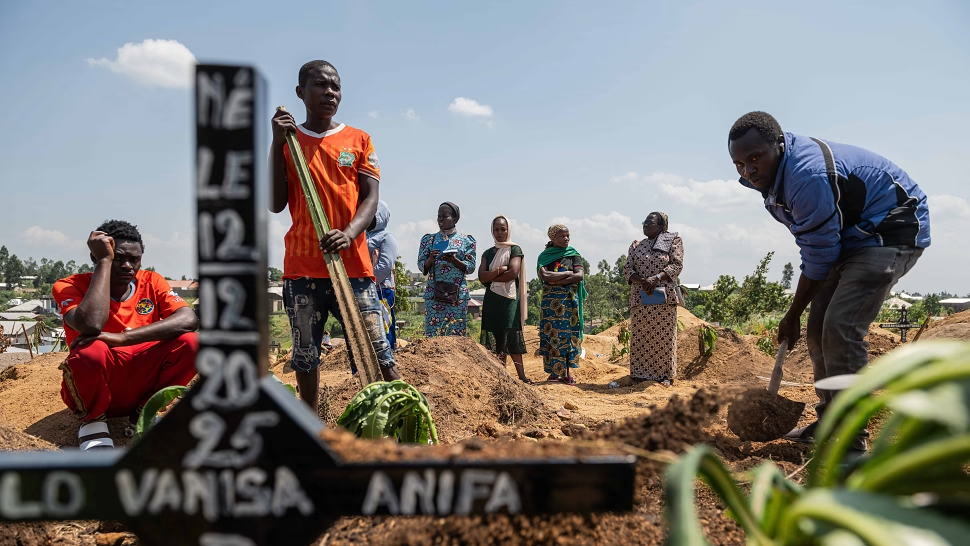
Ebola in Congo: 1,003 cases and 254 deaths from rare virus

Ebola outbreak reaches 1,003 confirmed cases in Congo. Difficulties in containing the virus.

Ebola outbreak in eastern Congo

The Ebola outbreak in eastern Democratic Republic of the Congo now has 1,003 confirmed cases. This is reported by the health authorities. Of that total, 254 people have died.

The Congo Ministry of Health indicated that since the outbreak was declared on May 15 in Ituri province, 100 people have recovered. However, 365 patients remain hospitalized or in isolation due to the seriousness of the situation.

A virus without specific treatment

Authorities warn that this outbreak is caused by the Bundibugyo virus, a rare strain. There is no vaccine or specific treatment for this variety. Therefore, they fear that the outbreak will be more extensive than what has been recorded so far. They recognize that the peak of infections has not yet arrived.

Tracing contacts of infected patients remains a challenge. This complicates the containment of the virus and the protection of the population.

Continue reading

China sanctions 10 US companies in the military sector

Beijing replicates Washington's restrictions on Chinese technology firms.

The Chinese government announced sanctions against 10 United States companies linked to the military sector. The measure responds to the restrictions imposed by Washington on Chinese technology companies accused of maintaining ties with the armed forces of the Asian country.

Companies affected and scope of sanctions

According to China’s Ministry of Commerce, American companies will be prohibited from receiving exports of dual-use products. That is, goods with both civil and military applications. The decision seeks to protect national security.

Among the sanctioned firms are manufacturers of military drones, defense technology companies and companies dedicated to the extraction of rare earths. These materials are considered strategic for the technological and military industries.

The Chinese action comes after the United States included companies such as Alibaba and Baidu on a list of companies with alleged ties to the Chinese military. That list prevents them from accessing US defense contracts.

Analysts pointed out that Chinese sanctions have a mainly political and symbolic character. They reflect the growing commercial and technological tension between both powers. However, they warn that they could intensify restrictions in strategic sectors.

Continue reading