US alert for blockades and air chaos after operation in Jalisco

The US embassy updates its alert after operations in Jalisco, with effects on flights and roads.

The security curtain rises with warnings

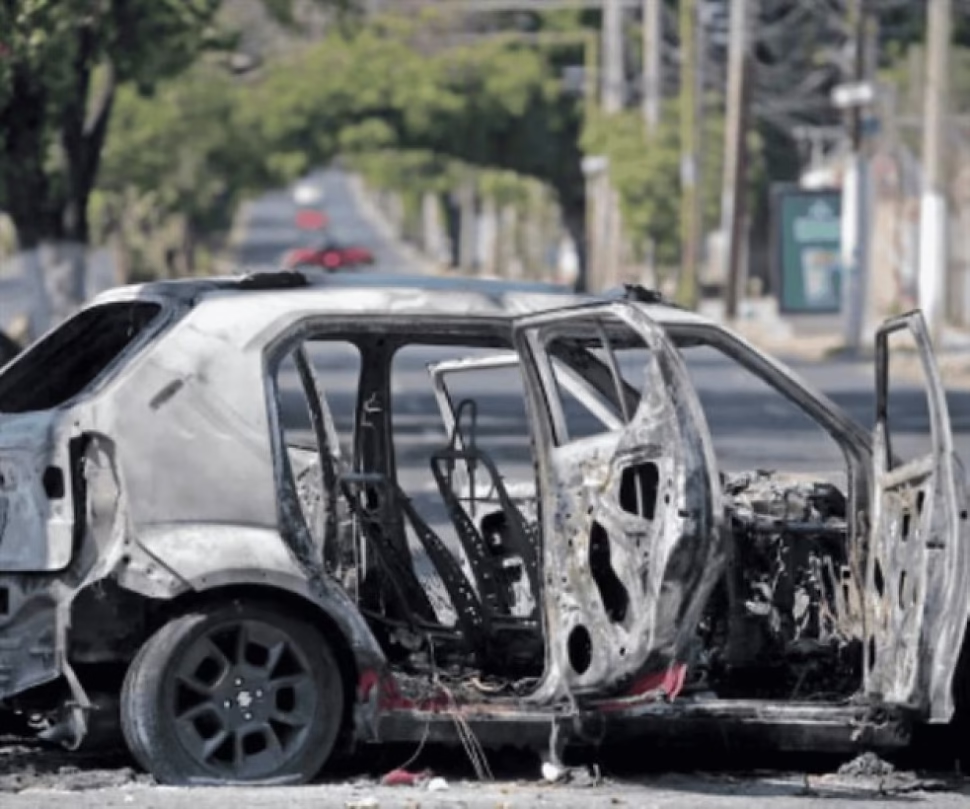
The United States Embassy in Mexico is not playing. It has just updated its security alert after the strong operations deployed for the death of Nemesio Oseguera Cervantes, ‘El Mencho’, in Jalisco. This is not a theoretical exercise: these are concrete instructions for American citizens who could find themselves in the crossfire.

The pulse of airports and roads

In Puerto Vallarta, the situation is tense. Flights remain affected “due to the availability of air crews,” according to the diplomatic statement. The embassy maintains close contact with the airlines, but normality is a relative concept.

“If your flight to the United States is canceled, it may be possible to book a connecting flight through another Mexican city”

Guadalajara also presents complications. Some scheduled flights are leaving, but not all. The recommendation is clear: consult directly with the airline before heading to the airport.

RelatedUS airports reject political video during government shutdown

On the roads, the situation is equally complex. Mexican authorities have limited operations on toll highways in Puebla, Guerrero, Tamaulipas, Nayarit, San Luis Potosí and other states due to the blockades registered this Sunday.

The embassy was direct: take shelter in a safe place, minimize unnecessary movements and avoid areas with law enforcement activity. He also suggested consulting Capufe for road closures and monitoring local media.

For emergencies, 911 remains the primary contact. But the most humane advice: keep family and friends informed about location and status. In the midst of chaos, communication can be the best lifeline.

Meanwhile, other airports in the country are operating normally according to the embassy. But when it comes to security, especially after events of this magnitude, prudence is never enough.

How to prevent illnesses and falls with low-cost changes

WEF study proposes simple changes in homes and physical activity to save billions.

Small actions, big savings

Reducing diabetes, preventing falls, and preventing dementia is possible with minimal home adjustments, physical activity programs, and accessible technology. This is stated by the World Economic Forum (WEF) in its study “The longevity dividend”.

The report estimates that shifting policies toward prevention would free up $6.4 trillion globally. These resources today are used to treat diseases that could be avoided.

Concrete strategies

To prevent falls, experts recommend grab bars and lighting on stairs. With an investment of less than 400 billion dollars, almost 400 million falls would be avoided by 2040. This would generate more than 5 trillion in health savings.

In diabetes, community physical activity programs could stop 8.5 million cases of type 2 diabetes by 2040. The cost per person ranges between one and 40 dollars, and the gains in productivity would exceed 125 billion.

Hearing loss has a direct link to dementia. Expanding access to hearing aids would prevent 2.4 million cases of dementia and save more than 325 billion in health.

Economic benefits

The study, applied in 21 countries by the WEF and Marsh, indicates that companies and governments address health, finances and work separately. If integrated, they would unlock 5.8 trillion in healthcare savings and 645 billion in productivity gains.

“Poor health strains health systems and personal finances, affecting financial resilience and generating broader economic costs,” the report warns.

Impact on women

A relevant fact: women who dedicate a year to care work see their retirement savings reduced by 24% due to absence from work and the wage gap. Institutions often treat these problems separately, despite their consequences.

The WEF concludes that there is a window of opportunity to align health, finance and employment policies. The key: allocate budgets to prevention and care for the elderly population with public-private collaboration.

Continue reading

AICM taxi drivers refuse to apply discounts agreed for the World Cup

Three AICM taxi drivers groups refuse to apply discounts of up to 18% during the World Cup.

Three groups of taxi drivers that operate at the Mexico City International Airport (AICM) refused to apply discounts of up to 18% on their rates during the World Cup. The measure contradicts previous agreements announced by airport authorities and part of the union.

The companies Nueva Imagen, Porto Taxi and Sitio 300 issued a statement to clarify their position. They argued that they have no contractual relationship with the Grupo Aeroportuario Marina (GAM), the entity that promoted the benefits for airport users.

According to permit holders, the announced discounts do not represent a direct reduction in rates. They are, they say, adjustments derived from compensation for improper charges and administrative processes for maintenance work at the AICM.

They demand transparency

The taxi drivers asked the AICM authorities to make public the documents that support these measures. They also called on the GAM to make transparent the minutes and contracts where the application of discounts had been agreed upon. They questioned the legal validity of the obligations attributed to them.

The refusal could affect users who expected more affordable rates during the sporting event. Until now, there is no certainty about the real cost of service at the AICM during the World Cup.

Continue reading

Morena opens the door to a coalition with the PVEM in San Luis Potosí

Morena conditions alliance on PVEM ruling out Ruth González for the governorship.

Morena-PVEM Coalition for 2027?

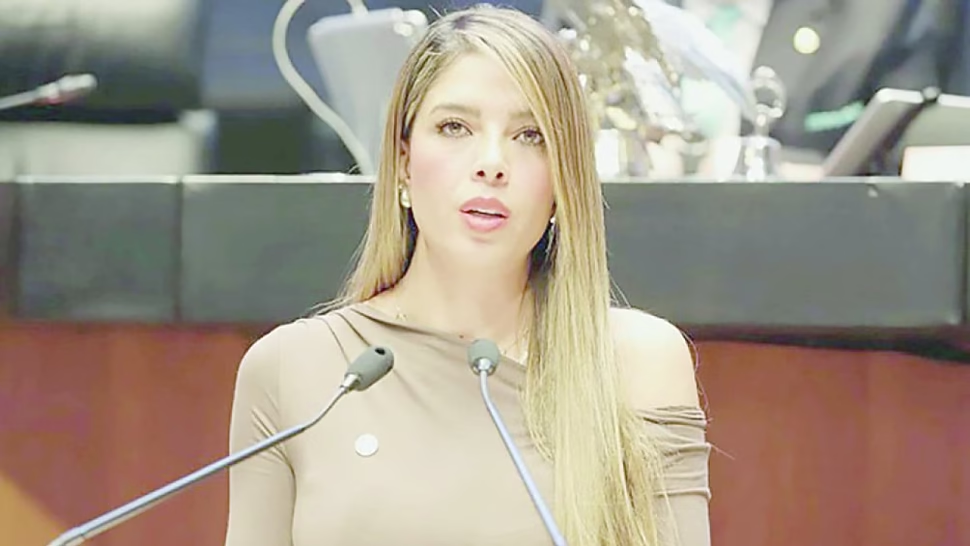
The state leadership of Morena in San Luis Potosí left open the possibility of an alliance with the Green Ecologist Party (PVEM) for the local elections of 2027. The condition: that the PVEM present a different profile from that of Senator Ruth González.

Rita Ozalia Rodríguez Velázquez, state president of Morena, explained that if the PVEM discards Ruth González—wife of Governor Ricardo Gallardo—the green party could lead the coalition, which would also integrate the Labor Party (PT).

The leader clarified that the relationship with the PVEM at the local level does not face a conflict, although she admitted that there is no direct communication between both state leaders. Decisions about alliances, he said, are made by national leaders.

The possible agreement arises in the midst of the debate about nepotism, after Ruth González’s intention to succeed her husband in the state government was questioned. Morena looks for profiles that avoid that controversy.

Rodríguez Velázquez stressed that there is coordination between the party leadership to define the electoral strategy. For now, the panorama in San Luis Potosí remains open.

Continue reading