Goodbye to parades, hello to harsh reality
It seems that in Uruapan, Michoacán, the only plan for November 20 is to survive. In a move that no one saw coming (lie, we all saw it coming), the municipal government has decided that organizing the classic Mexican Revolution parade is as good an idea as a spicy soda in the middle of gastritis. The official justification is the overflowing insecurity that the territory is experiencing, which in millennial language translates as: “the atmosphere is too heavy to party in the street.”
The decision comes with the bitter taste of an office coffee, just two weeks after the then mayor, Carlos Manzo, was shot dead. An event so traumatic that it literally broke the life of the municipality. To give an even more dramatic touch to the soap opera, the cancellation of the event is also carried out as an act in memory of Manzo. Because what better tribute than canceling the show, right?
A change in the mayor’s office worthy of a spin-off
In this chapter of “Who governs Uruapan?”, the State Congress, in a rare moment of unanimity that was surely recorded in the record books, gave its support to Grecia Itzel Quiroz, Manzo’s wife, to assume the mayor’s office. Her mission, according to the official script, is to continue her late husband’s project: “a government close to the people, transparent and aimed at rebuilding the social fabric.” It sounds nice, although rebuilding something in the middle of a firefight sounds as complicated as putting together an IKEA piece of furniture without instructions.
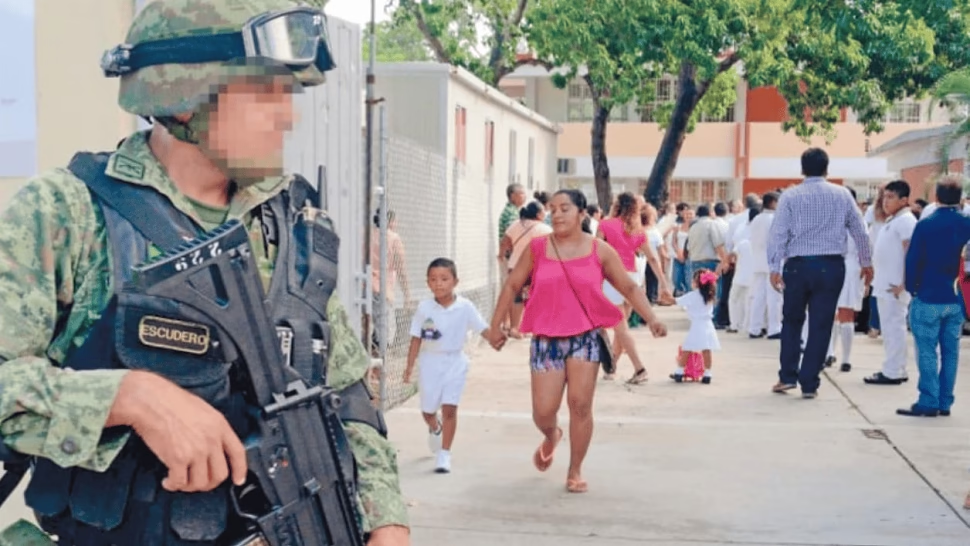
The murder of Manzo, which occurred during the Day of the Dead celebration – because irony also winks – at the hands of a 17-year-old teenager linked to the Jalisco New Generation Cartel (CJNG), put the level of violence experienced in Michoacán in the national spotlight. The impact was such that even the National Palace was alarmed. President Claudia Sheinbaum, in a “now yes” that took a week, announced a new pacification plan for the state, which includes the deployment of 5,000 soldiers and an investment of 57,000 million pesos. Basically, the government equivalent of “commanding the cavalry.” That same day, they arrested five alleged CJNG criminals, a gesture that, although symbolic, is like putting a band-aid on an open wound.
The statistics that keep you up at night
For lovers of raw data, the National Institute of Statistics and Geography (Inegi) has some numbers that are worth crying over. 82.6% of the inhabitants of Uruapan consider that their municipality is unsafe. This perception of risk places the territory as the fifth most unsafe in the country, only behind places with such emblematic names as Culiacán, Ecatepec, Cuernavaca and Ciudad Obregón. Although there was a “significant decline” from 89.5% in the previous quarter, the situation remains so complicated that this percentage remains a serious problem. Come on, going from 90 to 82% is like going from a mortal scare to constant terror: it’s appreciated, but it’s not like you can sleep peacefully.
In short, Uruapan has exchanged the horses and charros of the parade for a reality where the number one priority is staying safe. A sad decision, but one that starkly reflects day-to-day life in an area besieged by organized crime.
Does this scenario seem familiar to you in your region? Share this note to make visible the impact of violence on our traditions and explore more content about the current situation in Mexico.