Federal government reinforces security in Uruapan after murder of mayor

The federal administration establishes a concrete action plan and periodic meetings to stabilize the region after the crime that impacted the state.

Federal response to the security crisis in Uruapan

In response to the murder of the municipal president Carlos Manzo, an event that shocked the entity, the President of Mexico, Claudia Sheinbaum Pardo, has guaranteed the comprehensive support of the Government of the Republic to the municipality of Uruapan and its acting mayor, Grecia Quiroz. This commitment was formalized during the presentation of the Michoacán Plan for Peace and Justice, a comprehensive strategy designed to address security and development challenges in the region. The president emphasized that the federal presence will be constant and proactive to restore tranquility and governability.

The implementation of this operational plan included a high-level work tour headed by the Secretary of National Defense, Ricardo Trevilla Trejo, and the Secretary of Security and Citizen Protection, Omar García Harfuch. The agenda began in the state capital, Morelia, and culminated in Uruapan, the epicenter of the recent crisis. During this tour, the heads of federal agencies held substantive meetings with a broad spectrum of key actors, including municipal presidents, leaders of the business sector and representatives of organized civil society, with the aim of building consensus and aligning efforts.

RelatedGrecia Quiroz is profiled as substitute mayor of Uruapan

Concrete commitments and monitoring mechanisms

The agreements established after the meetings in Uruapan with Mayor Quiroz and local businessmen translate into specific and measurable commitments. The strategy is not limited to generic promises, but establishes a clear operational scaffolding. Among the most relevant points agreed upon are the maintenance and reinforcement of the security operations already deployed in Michoacan territory. Additionally, a specific monitoring mechanism was institutionalized that consists of biweekly evaluation meetings, which may be held alternately in Uruapan or Mexico City, thus ensuring fluid communication and constant accountability.

The priority is personalized attention to the specific needs of Uruapan, without neglecting the rest of the municipalities of the entity. President Sheinbaum was emphatic in reiterating her administration’s position: “Our support is important, both in security issues and in the needs of Uruapan and all the municipalities of Michoacán. We will continue to be present.” This statement underlines an approach of co-responsibility and close support with local authorities.

Context of vulnerability and demand for justice

The situation in Uruapan is framed in a context of high vulnerability for its public servants. Mayor Grecia Quiroz García publicly revealed that, just one day before taking office, she was the subject of threats, a situation that also affected other members of her team. These intimidations had the clear objective of destabilizing the municipal administration from its beginnings. Despite this adverse panorama, the councilor has expressed her vote of confidence towards the Michoacán Plan for Peace and Justice, while making a strong call to clarify not only the material facts of the crime, but also to identify and punish the intellectual authors behind the murder of Carlos Manzo, a demand shared by the community as a whole.

The federal administration has recognized that some more sensitive issues, raised by the authorities and the business sector during the meetings, will be detailed at a later time by the parties directly involved, thus guaranteeing the prudent management of information. However, the central message is unequivocal: the absolute priority is to accompany the region in this recovery process, combining deterrence and intelligence actions with medium and long-term strategies that strengthen the social fabric and local institutions. This multidimensional approach seeks not only to contain the immediate violence, but to lay the foundations for sustainable peace and effective justice in Michoacán.

Do you think these types of comprehensive strategies are crucial to combat insecurity? Share this analysis on your social networks and help spread verified information. Explore more content on security policies and regional development on our site.
Sheinbaum highlights record in clean energy and economic rebound

Sheinbaum reports historic growth in renewables and low inflation at 3.55%.

Economy and energy: the president’s announcements

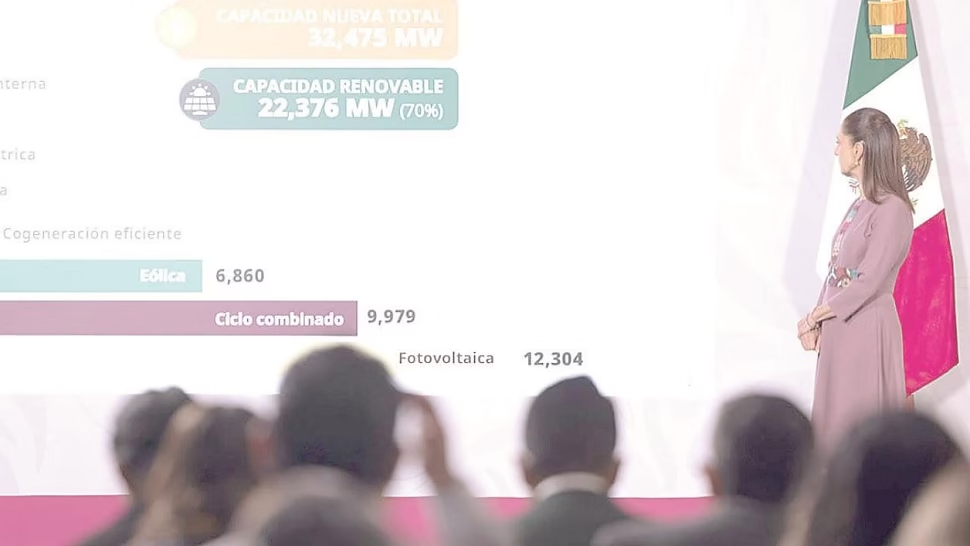
President Claudia Sheinbaum reported that, for the first time, Mexico has projects for 32 thousand megawatts of additional electrical capacity, of which 70% are renewable. “When we leave the government, natural gas consumption will decrease and energy generated by renewable resources will increase,” he stated.

Sheinbaum also highlighted economic growth. According to Inegi, the Global Indicator of Economic Activity (IGAE) rose 1.2% in April compared to March, the best advance since 2021. The annual rate reached 2.2%. The president attributed this to the boost in construction, especially the housing program.

Regarding inflation, the president pointed out that it fell to 3.55% annually in the first half of June, its lowest level since October 2025. This is due, she said, to agreements with gas stations to set maximum fuel prices and the Package Against Inflation and Scarcity (Pacic) to control the basic basket.

Energy transition with 32 thousand megawatts

The Secretary of Energy, Luz Elena González, explained that by 2030 32 thousand megawatts will be added; 22 thousand will be renewable. The goal is for at least 38% of generation to be clean to meet climate commitments. He assured that the CFE will maintain its majority participation, providing 61% of the electricity at the end of the six-year term.

The director of CFE, Emilia Calleja, explained the projects. In Baja California Sur, the Oasis System will combine solar energy, batteries and green hydrogen to supply Mulegé and 40 thousand homes. It includes a 72 megawatt plant, 20 megawatt storage and will produce 120 cubic meters of water per year, avoiding 94 thousand tons of CO2.

In Sonora, the “Rafael Galván” photovoltaic plant in Puerto Peñasco will reach one thousand megawatts of capacity and 246 megawatts of storage. It currently provides 400 megawatts. The investment exceeds 1.4 billion dollars. “They are environmental benefits that strengthen energy sovereignty,” concluded Secretary González.

Continue reading

Controversy over an interview with Monsiváis reaches the Senate and the Palace

The republication of a 1999 interview unleashes accusations between the Executive and legislators.

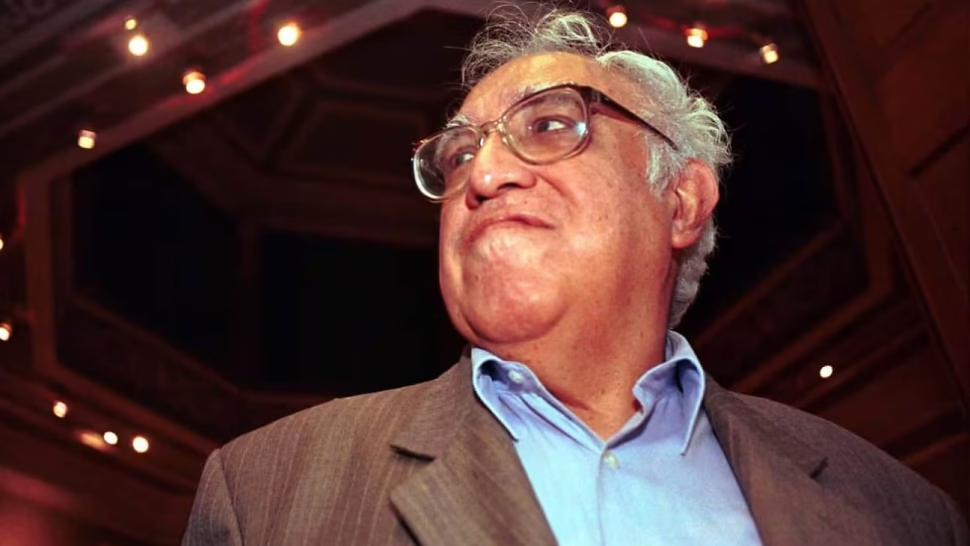
The republication of an old interview attributed to Carlos Monsiváis climbed to the center of the Mexican political debate this Wednesday. The issue was discussed both in the Senate and in President Claudia Sheinbaum’s morning conference.

The original text was written by journalist Edmundo Cázares in 1999 and recently republished by El Universal. It contains statements about the then head of Government Andrés Manuel López Obrador. Its veracity and context have been questioned, generating conflicting positions.

Sheinbaum describes the content as “grotesque”

During her conference, the president harshly criticized the publication. He described the content as “grotesque” and accused the medium of generating a controversy that distorts the tribute to the Mexican intellectual.

Reactions in the Senate

The issue also reached Congress. Senator Lilly Téllez read fragments of the text on the platform. In response, Gerardo Fernández Noroña rejected its use and maintained that it was a false publication with the intention of political attack.

The exchange reflects the polarization around the figure of López Obrador and the use of historical documents as partisan weapons.

Continue reading

PRI demands urgent action against violence in Guerrero

They denounce an incursion of armed civilians in Coyuca de Catalán; party calls for state intervention.

The national leadership of the PRI demanded that the Mexican State intervene urgently in response to the complaint by inhabitants of the Guajes de Ayala ejido, in Coyuca de Catalán, Guerrero. The residents reported the incursion of armed civilians into their community in the Sierra.

Call for safety

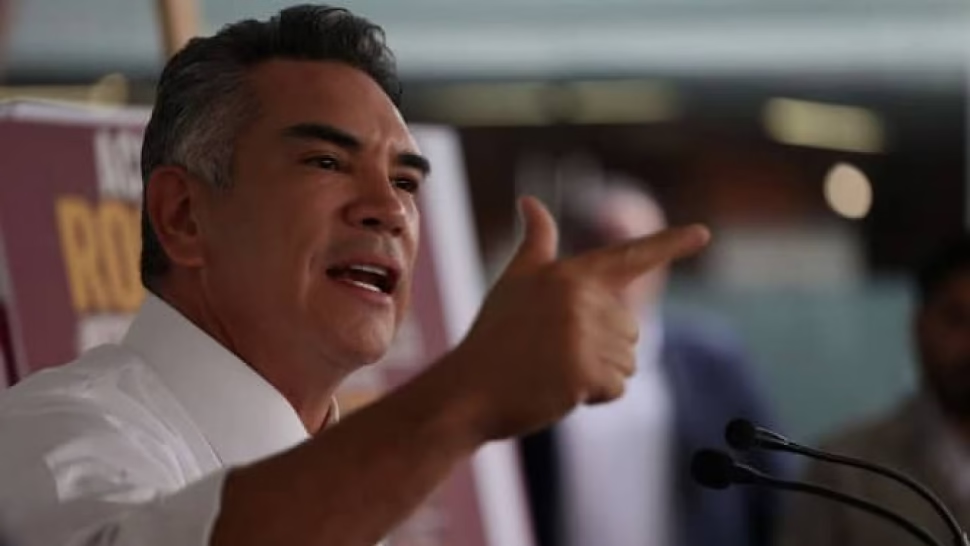
Alejandro Moreno Cárdenas, president of the party, asked the authorities to guarantee the safety of the families. He warned that these events should not be normalized due to the risk they represent for the civilian population.

The leader pointed out that in various communities in Guerrero they live under siege by armed groups. This has caused displacement, confinement of inhabitants and a constant climate of fear and uncertainty. He considered an immediate response from the State necessary.

Moreno Cárdenas also criticized the federal government for minimizing the situation of violence in the country. He affirmed that the population faces conditions of insecurity that require priority attention to restore the rule of law in the region.

Continue reading