Trump’s patriotic cell phone that was probably born in China

Ironies of globalization: the "Made in USA" device that smells like a Chinese factory.

A “Made in USA” phone with a Mandarin accent

Oh, the irony. Donald Trump, the same one who promised to “bring jobs back to the United States”, has just presented his brand new T1 phone, a device that – according to his slogan – is “cheaper, better and made by Americans”. Of course, because nothing screams “patriotism” like an Android with an iPhone design and Asian components. Does anyone else smell the contradiction or is it just me?

The farce of local manufacturing

The experts, those spoilsports with data, laugh out loud at the idea. Francisco Jerónimo, from IDC, made it clear: “It is impossible for this phone to be manufactured completely in the US.”. Come on, Trump is more likely to admit a mistake in public than for that device not to have a “Made in China” label. Blake Przesmicki of Counterpoint Research points to a Chinese ODM (anonymous manufacturer that assembles for third parties) as the true father of the invention. Surprised? Nobody is.

RelatedTrump threatens 100% tariffs on China for rare earths

And just in case there were any doubts, Jeff Fieldhack concludes: “The US does not have the capacity to manufacture smartphones locally.” In other words, the country that puts satellites on Mars cannot build a cell phone without foreign help. Isn’t that adorable?

Specifications: a technological “paper tiger”?

The T1 promises 12 GB of RAM, 256 GB of storage and a 50 MP camera. Sounds good… until you remember that MediaTek (yes, the Taiwanese company) probably lends it the processor. The AMOLED screen will surely be from Samsung or LG, and the cameras from Sony. Wow, even the 5,000 mAh battery smells like imported components. But hey, at least they put a big Trump logo on it, right?

Fieldhack sums it up perfectly: “Even if it’s assembled in the US, the components come from outside.” I mean, it’s like saying a pizza is “Italian” because you heated it in Naples… after buying it frozen at Walmart.

The moral: globalization vs. rhetoric

Here the joke writes itself: the champion of “America First” depends on China for its technological toy. Is it hypocrisy? Economic realism? Or just another chapter of “capitalism doesn’t understand borders, but politicians do”? You decide.

Do you want more news that mixes politics and technological absurdities? Share this ironic gem and discover other articles where reality surpasses sarcasm. #IronicGlobalization
NASA takes the 2026 World Cup ball into space and plays it on the ISS

NASA sent an official 2026 World Cup ball into space and opened an exhibition in Houston.

World Cup ball arrives at the International Space Station

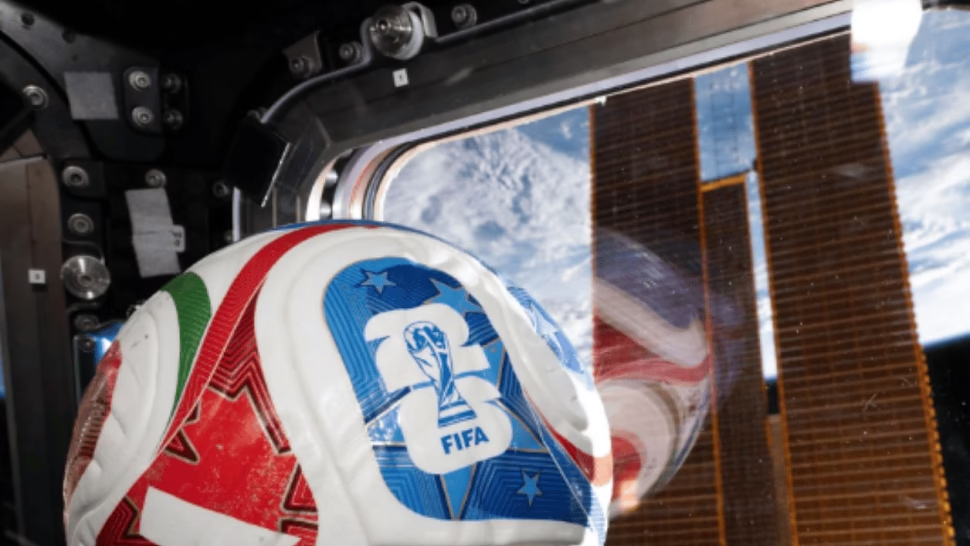
The fever of the 2026 World Cup permeated the atmosphere. NASA sent an official World Cup ball to the International Space Station (ISS). In a video shared on social networks, four astronauts are seen playing with the ball in microgravity. The message: “We work to inspire the next generation by showing how space exploration drives innovation in sports science.”

The agency seeks to disseminate how research on the ISS generates advances in science, technology and human health. Benefits that even reach the soccer field.

Exhibition at the FIFA Fan Fest in Houston

NASA set up an exhibit at the FIFA Fan Fest in Houston, Texas. It opened on June 11 at the start of the World Cup and will be available until July 19. Visitors can discover how space research improves life on Earth and learn about the Artemis program missions.

The exhibition explains how more than 25 years of studies on the ISS have helped understand the aerodynamics of the ball. According to a statement from the Johnson Space Center, previous research analyzed how internal mass, sensors and seam texture affect stability and rotation under real-play conditions.

Science applied to sports

As part of the project, NASA and Adidas present the “STEMonstration” demo. They compare how balls spin with different balance in microgravity. The objective: to show that space discoveries benefit athletes and fans of the most popular sport in the world.

Continue reading

Users report massive drop in X this Monday

Users report problems accessing social network X this Monday, June 22.

Cuts in X during Monday

Users of the social network X, formerly Twitter, reported this Monday, June 22, difficulties accessing and browsing the platform. According to data from DownDetector, a site that monitors digital failures, 1,131 people have reported problems with the application, loading the main feed and connecting to servers.

The most common issues include the inability to refresh the home page, errors when displaying posts, and crashes when using basic functions. When trying to log in, some see messages like “Something went wrong. Try loading again,” without the platform recovering.

So far, X has not issued an official statement on the origin of the failures or the estimated time to restore service.

Continue reading

How artificial intelligence transforms global security

Motorola Solutions is committed to hybrid models and agentic AI in the transformation of the sector.

Security industry: cloud migration and artificial intelligence

Security is undergoing a profound transformation. The cloud, generative artificial intelligence and video surveillance systems as decision tools are redefining the sector. This was stated by Pedro Simoes, global vice president of video security and analytics at Motorola Solutions.

“The cloud is a very strong trend, but it is not a solution for all sectors,” he explained. Prison facilities, airports and nuclear plants require hybrid models that combine local infrastructure with cloud services. Motorola Solutions is committed to unified platforms.

One of the key advances is agentic artificial intelligence. The company introduced Operator, a platform that integrates video, access controls and sensors in a single interface. The objective: reduce the time between detection and response. “It’s not just identifying. It’s being collaborative in decisions,” said Simoes.

The role of sensors in smart cities

Cameras no longer just record: they are sensors. “Today a camera produces data that can be used to optimize logistics, mobility or business decisions,” he added. Security information extends to multiple applications.

However, the growth of AI poses privacy challenges. Motorola Solutions developed “AI nutrition labels,” documents that detail capabilities and limitations of its models. “We are the first company in the sector to create and use this type of labels,” said Simoes.

Mexico and the 2026 World Cup

Mexico is experiencing a key moment for the 2026 FIFA World Cup. The arrival of millions of visitors is driving investments in technological infrastructure and security in airports, hotels and stadiums. Simoes confirmed collaboration with governments, without revealing details. “Safety is a priority; our responsibility is to develop technology that protects people and infrastructure.”

He recommended organizations think long term: “The decision should not be based only on current problems, but on the challenges of three or five years.” The combination of cloud, generative AI and unified platforms will define the next stage of the sector.

Continue reading