Analysis of Presidential Declarations and the Geopolitical Context
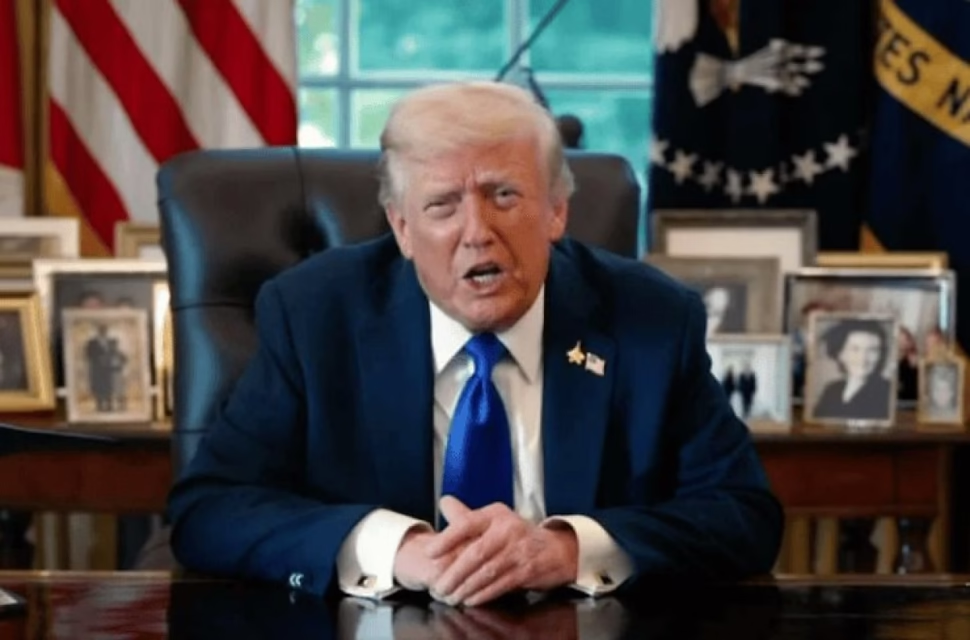
In a recent and significant statement issued through his Truth Social platform, President Donald Trump made a series of far-reaching statements about the situation in the Gaza Strip. According to his presentation, multiple allies of the United States in the Middle East region have offered, at his request, to intervene militarily in the territory and subdue Hamas in the event that this group continues with its disruptive actions and violates the peace agreements currently in force. This declaration is not an isolated event, but one more element within a complex diplomatic and security strategy that seeks to stabilize a historically turbulent area.
The American president, however, added a layer of contingency to this possibility. He claimed to have contained these allied nations, including Israel, from carrying out any immediate military action. The justification given was the persistence of a hope based on Hamas finally opting for the path of compliance and sanity. However, the subsequent warning was as explicit as it was severe: if there was no correction in the behavior of the Palestinian militant group, its end would be “fast, furious and brutal.” Trump emphasized the enthusiasm and energy with which these regional allies, whom he called “great allies,” would welcome the opportunity to act, describing the diplomatic environment as a “spirit for the Middle East” that had not been seen in a thousand years.
Vice President Vance’s Stance and the Architecture of the Ceasefire
Parallel to the president’s statements, Vice President JD Vance was on a high-level visit to Israel, where he articulated in greater detail the US government’s conditions and warnings. At a press conference, Vance was categorical in establishing the prerequisites for a lasting peace: “Hamas must hand over its weapons.” His speech outlined a stance of conditional firmness, noting that if the organization does not comply with disarmament and cease internal violence and against its fellow Palestinians, it would face annihilation. This position reflects a policy of zero tolerance towards activities that could destabilize the precarious balance achieved.
Despite the harshness of the warnings, the vice president’s tone was not exclusively belligerent. Vance expressed optimism regarding the sustainability of the truce in Gaza, although he admitted the impossibility of guaranteeing its success with complete certainty. He acknowledged the arduous nature of the process, stating that “difficult things are only achieved by trying” and that “constant vigilance” will be required. This combination of realism and hope defines the administration’s current approach: prepared for the worst, but actively working for the best.
Vance’s operational visit included a tour of the Civil Military Cooperation Center in Kiryat Gat, a key facility where US and Israeli personnel work in coordination to oversee the implementation of the ceasefire. This binational mechanism represents a tangible pillar of the United States’ commitment, not to direct military intervention—he reiterated that there will be no American soldiers in Gaza—but to supervision and logistical assistance. The stated goal is ambitious: to begin reconstruction of the devastated Gaza Strip, implement long-term peace, and establish local security forces that can maintain stability without a permanent foreign military presence.
Conditions, Deadlines and the Thorny Future of Governance in Gaza
One of the most critical and delicate aspects that Vice President Vance addressed was the issue of the disarmament of Hamas and the return of the deceased hostages. When meeting with Prime Minister Benjamin Netanyahu, Vance made the warning clear to the Palestinian organization, although he refrained from establishing a rigid and immovable deadline for disarmament. He argued that it was inappropriate to require the entire process to be completed in one week, recognizing the logistical and operational complexity of the situation. This tactical flexibility suggests an understanding of the realities on the ground, avoiding the imposition of impossible conditions that could collapse the fragile process.
Regarding the issue of hostages, the position was equally realistic. Vance noted that some of the bodies are found under “thousands of pounds of debris” or in unknown locations, making their recovery a task that will take time and patience. He stressed the commitment of all actors involved in returning the remains to their families for a dignified burial, but warned that this goal “is not going to happen overnight.” This methodical and patient approach contrasts with the rhetoric of immediate action, showing the two sides of the same policy: the credible threat of force and the patient execution of complex processes.
Finally, the issue of the future government of the Gaza Strip was deliberately postponed. The vice president stated that any discussion on the governance structure will be delayed until minimum security conditions are guaranteed for Israelis and Palestinians alike, as well as a robust and unimpeded flow of humanitarian assistance. This stance avoids premature entanglement in the thorny political negotiations over the future of Gaza, instead prioritizing immediate stability and urgent humanitarian needs, a strategic move that seeks to create the necessary preconditions for a sustainable political settlement.
Has this analysis of the complex geopolitical dynamics in the Middle East been enlightening to you? Share this article on your social networks to contribute to an informed conversation, and explore more related content in our international politics section to stay up to date on this continually evolving topic.