Analysis of the Operational and Humanitarian Situation in the Gaza Strip
A new episode of extreme violence was recorded this Saturday in the Gaza Strip, with a preliminary death toll of 59 as a result of a series of Israeli air strikes and ground operations. This escalation of the conflict occurs in a context of growing international diplomatic pressure to reach a permanent ceasefire and an agreement that allows the release of the hostages still held captive, pressure to which Israeli Prime Minister Benjamin Netanyahu has responded with a stance of firmness and defiance.
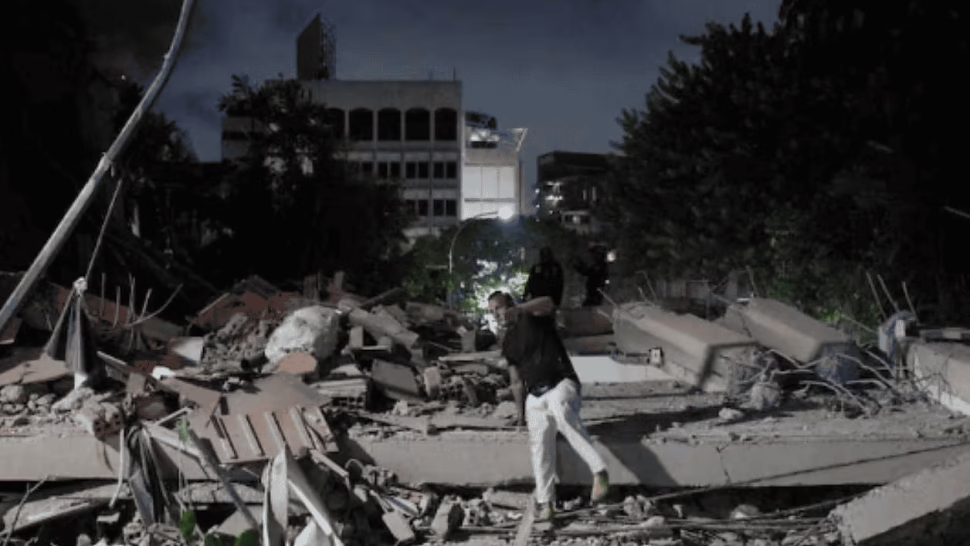
The most serious incidents were concentrated in the Nuseirat refugee camp, where two consecutive attacks caused a significant number of fatalities. The first assault affected a home, claiming the lives of nine members of the same family. Hours later, a second impact in the same location resulted in the death of at least 15 people, including women and children, as confirmed by the staff at the Al-Awda hospital, the center receiving the bodies. A third attack on a tent housing internally displaced people caused five additional deaths, according to the Nasser hospital report.
The Israeli Army has stated, in response to queries, that there is no record of operations resulting in fatalities in southern Gaza during the day on Saturday, nor of a specific attack at the location and time indicated by hospital sources in Nuseirat. This discrepancy in reports is common in the development of this type of asymmetric conflicts.
Imminent Collapse of the Gazatí Health System
The health infrastructure in the Gaza Strip is in a critical situation, on the verge of total collapse. The director of Shifa Hospital, Dr. Mohamed Abu Selmiya, warned about the proximity of Israeli tanks to the vicinity of the medical complex, which severely restricts access to the 159 people currently receiving treatment at its facilities. “The bombing has not stopped for a single moment,” declared the doctor, underlining the constant operational pressure on these vital spaces.
The situation is particularly delicate for the most vulnerable patients. Fourteen premature babies have been transferred to incubators at Helou hospital, where the head of the neonatal intensive care unit, Dr. Nasser Bulbul, reported that the main door of the facility remains closed due to the presence of Israeli drones flying over the building, making any safe movement impossible. The organization Doctors Without Borders (MSF) was forced to suspend its activities in Gaza City, describing the level of risk for its staff as “unacceptable” because the Israeli armored vehicles are less than a kilometer from its health centers.
The overall picture of the health sector is bleak: according to the Gaza Ministry of Health, two clinics have been destroyed by airstrikes, two hospitals have closed after suffering serious structural damage, and the rest are operating minimally due to extreme shortages of medicines, equipment, food and fuel. This scenario has forced the evacuation of most staff and many patients, leaving a small group of doctors and nurses caring for children in incubators and patients in critical condition who cannot be mobilized.
International Pressure and Netanyahu’s Posture
The military offensive comes immediately after Benjamin Netanyahu defended before the United Nations General Assembly the need for Israel to “finish the job” against the Hamas group. His intervention was marked by the protest of dozens of international delegates who left the room as a sign of rejection. This image reflects the growing diplomatic isolation facing the Israeli government, accentuated by the decision of an increasing number of countries to officially recognize a Palestinian state.
The pressure is not only external. From inside Israel, the voices of the hostages’ families are raised in despair. Itzik Horn, father of Eitan, one of the approximately 20 hostages estimated to be still alive (out of an initial total of 251), launched a harsh plea against Netanyahu: “You are like the last of the lepers. We promise you that, if you do not reach a comprehensive agreement and end the war, you will forever be a leper.” Doron Steinbrecher, freed after 471 days of captivity, pleaded at a protest in Tel Aviv that former US President Donald Trump, who is scheduled to meet with Netanyahu on Monday, make the release of the hostages his “top priority.”
Trump, for his part, has told the press that he believes the United States is close to reaching a ceasefire agreement that will “bring back the hostages” and “end the war.” However, these statements contrast with the reality on the ground, where Israel is advancing with a new large-scale ground operation in Gaza City.
Deepening Humanitarian and Food Crisis
Beyond the military front, the humanitarian crisis is reaching alarming levels. The UN Office for the Coordination of Humanitarian Affairs (OCHA) reports that the food situation in northern Gaza has deteriorated critically since Israel suspended aid distribution through a key crossing on September 12. Although the Israeli military agency COGAT claims that humanitarian aid to the north “continues continuously”, organizations on the ground report severe obstructions.
Testimonies from residents like Amal al-Aas, who lives in the west of Gaza City, confirm the seriousness of the moment: “Food is scarce and expensive and water is not safe to drink.” For the hundreds of thousands of displaced people fleeing south, survival depends on overcrowded charity kitchens, where staples like lentil soup and rice run out quickly. “Sometimes the food runs out before we get anything. We go home empty-handed,” says Fatima Al-Daghma, displaced from eastern Khan Yunis.
The human cost of the Israeli military campaign, launched after the assault by Hamas insurgents on October 7, 2023, is overwhelming. According to figures from the Gaza Ministry of Health, controlled by Hamas but whose data are considered the most reliable estimate by UN agencies, the conflict has left more than 65,900 dead and more than 167,000 injured. Although the report does not distinguish between combatants and civilians, it is estimated that approximately half of the fatalities are women and children, painting a picture of devastation whose consequences will last for generations.
Was this analysis useful to you? Share this content to help keep your contacts informed about this complex international situation and explore more related articles in our global politics section.