Court forces parties to stop pretending to be women candidates

A court ruling forces all parties in Oaxaca to stop pretending to be female candidates and guarantee rights. Politics is no longer an exclusive club for some.

Electoral justice brings out the heavy artillery against political “theater”

In a twist that no one saw coming (well, perhaps all the indigenous women of Oaxaca did), the Xalapa Regional Chamber of the Electoral Tribunal of the Judicial Branch of the Federation has decided that the era of “let’s pretend” is over. With a resolution that has left more than one political party in a cold sweat, the court confirmed that all political groups in the state must implement real actions to prevent practices that, surprise, affect the political participation of indigenous women. The goal? Eradicate the adorable custom of simulation of candidates, that little “structural” problem that sounds so technical but actually means: “using women as electoral decoration and then hiding them in a drawer.”

The case that uncovered the pot: Win the elections and be ignored like a ghost

All this is born from a gem of gender political violence that occurred in Chalcatongo de Hidalgo. Imagine the scene: a Mixtec indigenous woman wins the municipal elections (2023-2024), prepares for her victory speech… and then discovers that her party, in an act of pure “administrative forgetfulness”, never officially registered her. No protest, no charge, no nothing. It’s like winning the marathon and being told that you actually ran another invisible parallel race. The local court, after rubbing its eyes to make sure it was reading correctly, confirmed the facts and ordered comprehensive reparation measures. But the parties, in an outburst of corporate solidarity, contested. His master argument: “Why do we all have to pay if only one did the mischief?” The schoolyard logic did not convince the Regional Chamber, which, with two votes in favor and one against (there is always a dissident soul), said: “No, gentlemen, this is everyone’s problem.”

RelatedElectoral Tribunal endorses total vote count in Poza Rica

The presiding magistrate Roselia Bustillo Marín was in charge of giving the lesson. He clarified, with the patience of someone explaining something for the umpteenth time, that these are not sanctions, but preventive measures. Its purpose is, attention to the revolutionary concept, to guarantee rights and repair historical barriers. He said simulation requires collective solutions, which in Christian means: “Stop passing the hot ball and get to work seriously.” The resolution reinforces the obligation of the institutions to prevent, address and punish gender-based political violence, and to guarantee that internal partisan processes stop looking like a soap opera script full of betrayals and impersonations.

The impact is clear: parties will no longer be able to resort to the old trick of hiding or manipulating candidates. The substitution of real candidates for decorative figures will, in theory, have its days numbered. We seek real transparency, legality and electoral equity, not empty speeches. In the end, what this ruling screams at the top of its lungs is that the political participation of women, especially of original populations, cannot continue to be an optional annex in the parties’ operations manual. It is a right, not a favor that is granted when it suits the campaign photo.

Do you think this resolution will put an end to the theater of false candidates or will the parties find a new creative way to evade the law? Share this note and let’s make the demand for a simulation-free politics reach more people. Explore more content about electoral justice and indigenous rights on our site.
One year after the discovery in a crematorium, families march for justice

One year after the discovery of 386 bodies, families demand justice and an end to corruption.

March for justice one year later

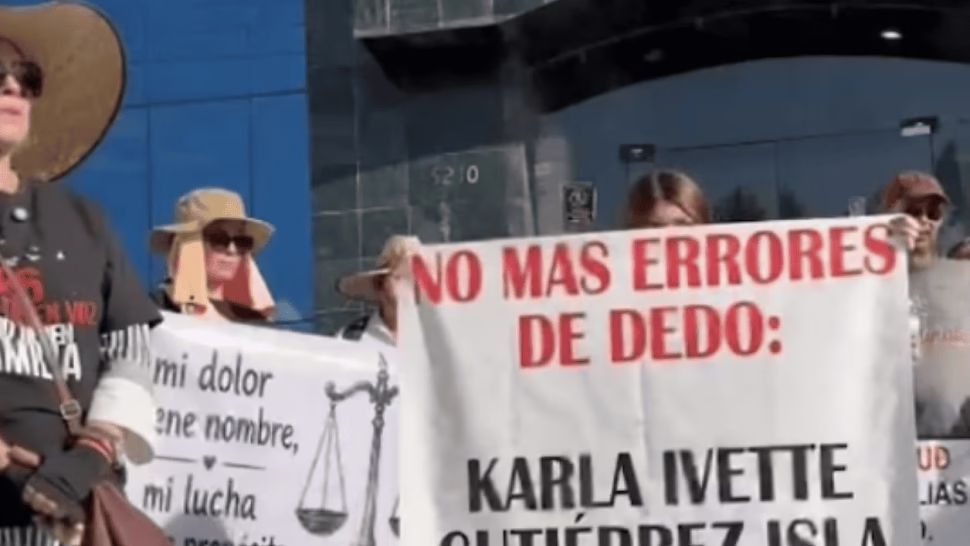
On Saturday afternoon, groups of families affected by the Plenitude crematorium case demonstrated. The discovery of 386 bodies turns one year old, and the bereaved demand answers.

The protest began at the Latinoamericana funeral home, one of those identified by family members. From there, the protesters walked towards the State Attorney General’s Office (FGE).

Dora Elena Delgado, spokesperson for the Justicia para Nuestros Deudos collective, reported that at least 1,500 families were affected. The central demand: no more impunity, no more corruption and full justice.

Actions pending by the authority

The protesters carried blankets with messages of justice. They demand action against Coespris officials involved in the case, as well as the recapture of José Luis A. C., owner of the crematorium. He was released by a federal judge, and a red card from Interpol is expected to arrest him again.

So far, of the 386 bodies found, the FGE reports that 135 remain to be identified. The identification process continues.

The collective Memory, Dignity and Justice joined the mobilization. They placed a permanent memorial in the shape of a cross outside the Prosecutor’s Office, as a reminder of the victims.

Continue reading

Sheinbaum asks to preserve native corn for national sovereignty

Sheinbaum highlights that native corn is key to food sovereignty and national identity.

President Claudia Sheinbaum Pardo reaffirmed that the governments of the Fourth Transformation defend national sovereignty in all areas. During a meeting with farmers in Pijijiapan, Chiapas, he highlighted the importance of native corn as a pillar of Mexican identity and self-sufficiency.

Defense of sovereignty through native corn

Sheinbaum presented the “Corn is the Root” program, whose objective is to improve the conditions of producers and reduce dependence on seeds controlled by large corporations.

“Conserving native corn also means defending sovereignty,” he stated.

The president warned about the risks of hybrid seeds:

“If we continue with pure hybrid corn, people will depend on buying seeds and those who sell the seeds will be a few companies.”

He stressed that preserving native varieties is essential to avoid this economic dependence.

“If we did not have native corn, we would lose a good part of food sovereignty, of what we are as Mexicans,” he said.

In addition, it extended the defense of sovereignty to the energy, cultural and food fields. She assured that the Fourth Transformation drives her “in every possible way.”

The program seeks to strengthen small farmers and conserve the genetic diversity of corn, a central element in the country’s diet and culture.

Continue reading

Mexico sends rescue team to Venezuela after earthquakes

25 specialists and 5 canine pairs travel to support search efforts in Venezuela.

Solidarity in action

After the earthquakes of magnitude 7.2 and 7.5 registered in Venezuela on June 24, which left 1,430 dead and 3,328 injured, Mexico reinforced its humanitarian support. The Ministry of Foreign Affairs (SRE) coordinated the sending of a rescue mission with the Mexican Red Cross and the Volaris airline.

“This afternoon a support team made up of 25 specialists from the Urban Search and Rescue Unit (USAR) of the Red Cross and the Cancun International Rescue Brigade (USAR BRIC) left for Venezuela, as well as a brigade element from the Azteca Topos,” the agency indicated.

Equipment and logistics

The mission includes five canine pairs and 3.5 tons of specialized equipment for search and rescue tasks in the rubble. The shipment was transported on a Volaris flight.

“With this, Mexico reaffirms its solidarity and commitment to the Venezuelan people in these difficult times,” the SRE said in a statement. Foreign Minister Roberto Velasco heads the coordination of this aid.

Continue reading