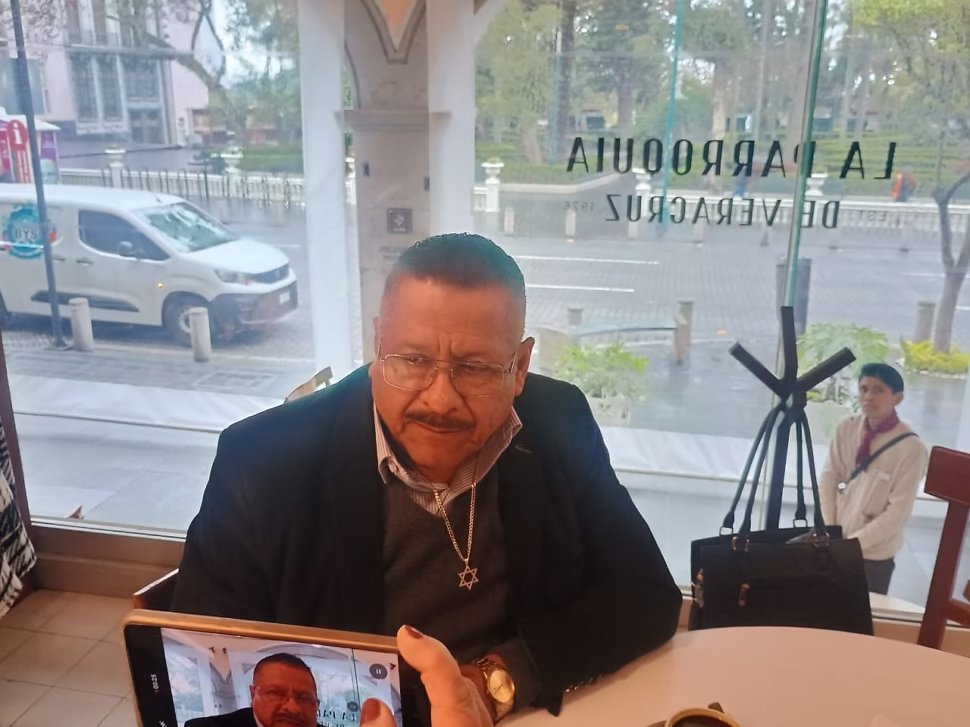
Xalapa, Ver.—The representative of the transportation sector known as Truck Man, David Estévez Gamboa, denounced that serious problems of insecurity, extortion and institutional abandonment persist on the country’s highways, despite the agreements signed with the federal government, which—he stated—have not been fulfilled. Given this panorama, he warned that new national mobilizations could be announced starting in February.
During a press conference, Estévez Gamboa explained that the union maintains an alliance with the National Front for the Rescue of the Countryside, a coalition that integrates entities from all over the country and continues to add states, with the purpose of demanding decent and safe conditions for both transport operators and agricultural producers.
He pointed out that one of the main complaints of the sector is insecurity on the roads, a problem that – he said – not only affects transporters, but the entire population that depends on the transfer of goods and people between states. Although he recognized some progress after previous mobilizations, he maintained that extortion by police corporations continues to be a recurring practice.
He explained that for years they operated irregular checkpoints in points such as San Roberto, Nuevo León, and San Blas, Nayarit, where operators were illegally detained until they paid amounts similar to ransoms. Although they were informed that these points were withdrawn, they denounced that similar practices persist in states such as Tabasco, Campeche, Yucatán, Quintana Roo and Chiapas.
In this context, he recalled that roadblocks have been prohibited since past administrations and stressed that the National Guard is the only authority legally empowered to protect road safety, in accordance with the Mobility Law. He cited article 46 of said law, which obliges the National Guard to intervene and arrest any authority that engages in acts of extortion.
Another of the union’s central complaints is the lack of safe stops on federal highways. He explained that operators are obliged to comply with rest days, but there are no adequate or safe spaces to do so. The current inns, he noted, are irregular, lack permits and do not have basic services such as medical care, toilets or security.
He recalled that in February 2024, the creation of safe stops nationwide was proposed, as well as the installation of surveillance cameras in sections without signal, where even the GPS systems of the units are lost. Although he indicated that some cameras are already authorized and in the process of being installed by Capufe, he considered that the progress is insufficient.
Likewise, he proposed the creation of a trust for the benefit of operators, which would cover medical expenses, transportation in case of accidents and financial support for the families of deceased workers. He reported that currently, when an accident occurs, there is no immediate support for either the operator or his family, which leaves them completely vulnerable.
Estévez Gamboa also warned about the deterioration of road infrastructure, pointing out that the poor condition of the roads causes constant damage to units, increases the risk of accidents and generates conditions conducive to crime.
Regarding the agricultural sector, he stated that none of the commitments made with rural producers have been fulfilled, which has caused the abandonment of land and the migration of farmers, even to the United States, due to the lack of real support.
Another critical point is the digitalization of federal licenses, a measure implemented since the last six years.He explained that the absence of the physical document has generated serious problems in regions without telephone signal, which prevents operators from accrediting their license, especially in international crossings to Central America or the United States.
In terms of security, he revealed that in January alone, between 13 and 14 missing operators were registered in states such as Colima, State of Mexico, Puebla and Tamaulipas. He mentioned the recent case of a missing operator in Colima, who has not been located for more than ten days.
He specified that the signed agreements established a compliance period during the first 15 days of January; However, at the end of the month no concrete results have been seen. For this reason, he announced that it is very likely that new mobilizations will be announced in February and did not rule out a larger protest in July, warning that prolonged blockades could generate fuel and food shortages nationwide.
Finally, he reported that the sector has requested the creation of prosecutor’s offices specialized in highway crimes and confirmed that representatives of the Ministry of Infrastructure, Communications and Transportation, as well as security and law enforcement authorities, will participate in the next meeting, scheduled for this Thursday, with the aim of advancing concrete solutions.