The Las Brujas del Mar collective warned that violence against women in Veracruz has become alarmingly “not scandalous” for society and the authorities, despite the seriousness of the events, such as the recent feminicide of Fátima Estefanía, which occurred inside an apartment in the Hacienda Sotavento subdivision, in the city of Veracruz.
Arussi Unda, spokesperson for the collective, pointed out that during 2025 more than 70 femicides have been recorded in the entity, a trend that continues without strong reactions being observed to stop the attacks. He considered it worrying that these crimes do not generate an immediate response or social rejection in line with the magnitude of the problem.
“It seems that women cannot be safe in any space, not even in our own homes,” she said, emphasizing that violence has been normalized both in public discourse and in institutional actions.
Unda described the performance of the State Attorney General’s Office (FGE) in terms of access to justice as “very poor,” even after the recent change in ownership of the agency. He regretted that the relatives of the victims continue on an “eternal pilgrimage” in search of answers and punishment for those responsible.
He argued that even a single case should be enough to activate the entire State apparatus, something that – he said – does not happen, and added that the lack of political will is reflected in the low budgets allocated to the care and prevention of gender violence.
The group’s accusation comes after the discovery, last Saturday, January 31, of the body of a woman with visible signs of violence in the Hacienda Sotavento subdivision, west of the port of Veracruz.
According to figures from the University Observatory of Violence against Women of the Universidad Veracruzana, during 2025 in the state there have been 73 femicides, 105 homicides, 753 disappearances and 263 physical, psychological and sexual attacks. In the area of femicides, the municipalities with the highest incidence are Coatzacoalcos and Tuxpan, with six cases each; Papantla de Olarte and Álamo Temapache, with five; and Veracruz, with four.
The majority of the victims were women of productive age: 54 adults, eight elderly, two minors, and in nine cases it was not possible to determine their age due to the conditions in which the bodies were located.
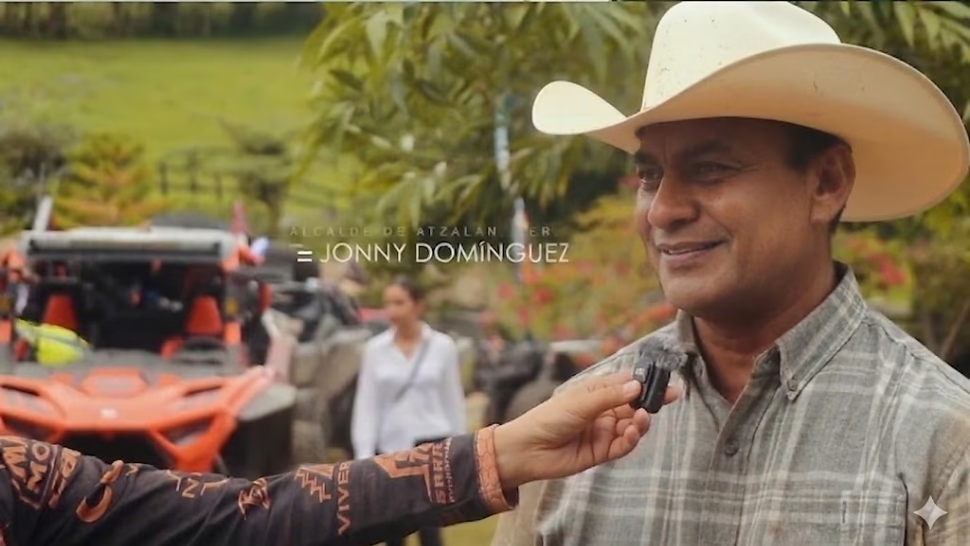

 In addition to promoting recreation and sports, the activity represents an important economic benefit for service providers, local businesses and entrepreneurs, who benefit from the arrival of visitors during the development of the event.