The Voting Rights Act faces its most crucial hour at 60 years old

Six decades after its signing, a landmark law that defined American democracy is fighting its most crucial battle for survival.

A Legacy under the Shadow of Threat

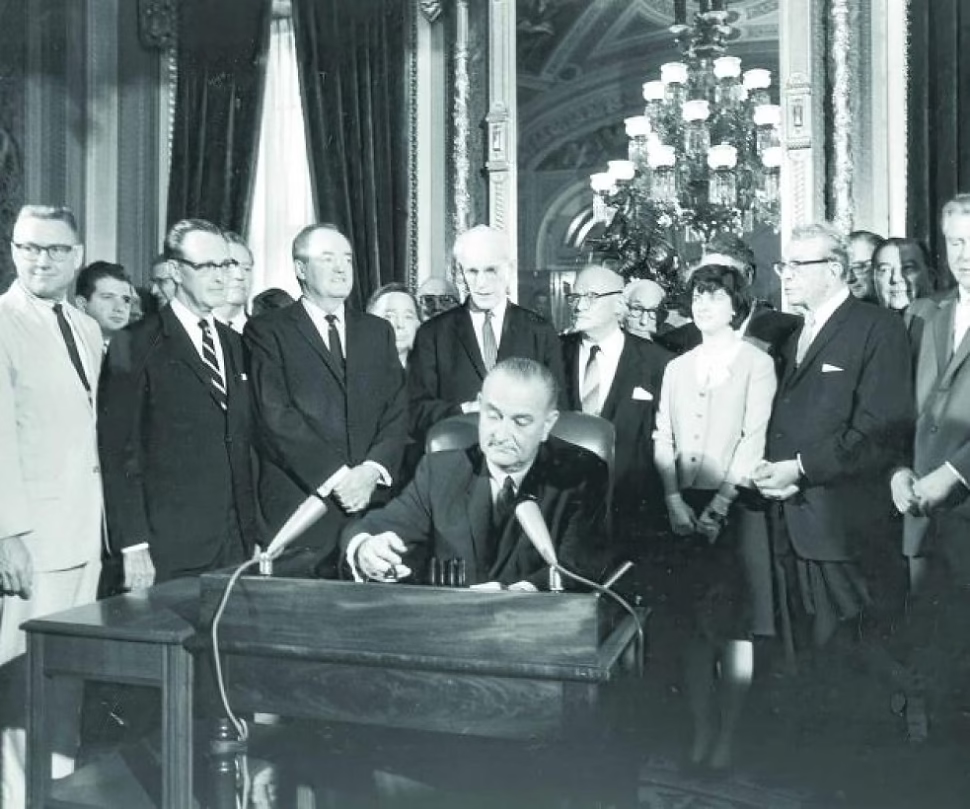
Sixty years ago, on a day that would echo through the decades, President Lyndon B. Johnson, with the titanic figure of Martin Luther King Jr. as a silent and monumental witness, traced his signature on a document that promised to change the destiny of a nation. It wasn’t just a law; It was the Voting Rights Act, a beacon of hope that swore to protect the sacred right to vote and establish the federal government as the supreme guardian against any attempt to suppress it. For millions, that was the moment when the promise of American democracy finally took its breath and began to beat with real force.

But, alas! Time, that master of irony, has woven a web of threats over that legacy. What was once an unbreakable wall has been eroding, slowly but inexorably, for more than a decade. The beginning of the end came with a blow of the gavel in 2013, when the Supreme Court, in a decision that still echoes in the halls of power, dismantled the federal preclearance requirement for fifteen states with a dismal history of voting discrimination. Almost at the same moment that the verdict was announced, those states, freed from their surveillance, began to draw up plans to implement more restrictive, harsher, more exclusive electoral regulations.

RelatedThe Voting Rights Act faces its final test after 60 years

The Battle for the Survival of a Fundamental Right

The race has escalated to a boiling point following the 2020 presidential election, fueled by unfounded accusations of massive fraud. The same highest court that narrowly saved a key provision of the law in 2023 is now preparing for its next dramatic assault. It is anticipated that he will hear a case that could not only reverse that decision, but another that, in practice, would completely neutralize the law, leaving it an empty shell, a broken promise. Civil rights experts warn with urgent voices: These cases will largely determine whether this pillar of justice will have future anniversaries to commemorate or whether it will become a mere epitaph in the history books.

“We stand at a critical moment, a precipice on which the soul of our nation balances,” declared passionately Demetria McCain, policy director of the NAACP Legal Defense Fund. “And let’s be clear, our democracy is about to turn 60 years old with the commemoration of this law. I say this because the attacks on the right to vote are brutal and constant, targeting black and brown communities with lethal precision.”

A Native American Victory Hanging by a Thread

Far from the marble halls of Washington, in the vast, frigid expanse near the Canadian border, the Turtle Mountain Band of Chippewa Indian Reservation became the scene of an epic victory that could be as fleeting as a breath. In 2024, this tribe and the Spirit Lake Tribe of North Dakota forged a historic alliance, a joint political district for the first time. They had waged a legal battle arguing that the drawing of state legislative districts was a barrier that denied them the fundamental right to elect their candidates. Federal Judge Peter Welte heard their cry and ruled in their favor, ordering a new map that gave them their voice back.

This is how Collette Brown, an unstoppable force yearning for genuine representation for Native Americans, entered the race and emerged victorious in the state Legislature. “It was surreal, a realization, a recognition finally achieved,” said Brown, a plaintiff in the lawsuit and executive director of the Spirit Lake Tribe Gaming Commission. “I felt it was time to start change, to educate from within so that our people would never be silenced again.” From her position, this Democratic-leaning legislator promoted crucial projects, from the repatriation of remains and sacred artifacts to the implementation of alerts for missing indigenous people.

Jamie Azure, chairman of the Turtle Mountain Tribe, reflected on the law’s anniversary as a moment to measure collective progress. However, that same progress now hangs by a thin thread, subject to the upcoming frightening Supreme Court ruling. The question that hovers like a sword of Damocles is brutal in its simplicity: Will individuals and groups be allowed to challenge violations of their electoral rights?

In a devastating turn, the 8th U.S. Circuit Court of Appeals overturned Welte’s decision by a 2-1 vote, ruling that tribes and private entities like the NAACP Legal Defense Fund or the ACLU lack standing to sue for potential constitutional violations. This ruling, which expands on a previous opinion, essentially silences ordinary citizens, leaving the enormous responsibility of litigating these cases solely in the hands of the Attorney General of the United States, a burden almost impossible to sustain. The battle for the vote, the fight for the very essence of democracy, has entered its darkest and most uncertain chapter.

History is being written at this very moment. The future of a fundamental right is at stake. Share this crucial story to keep the conversation about electoral justice alive and explore more content about the fight for civil rights in our era.
Two weeks after earthquakes in Venezuela, the emergency worsens

Thousands of Venezuelans seek medical attention after earthquakes that left more than 3,800 dead.

The health emergency worsens

Two weeks after the earthquakes that shook northern Venezuela, the humanitarian crisis intensifies. Thousands of victims go to mobile clinics and community kitchens in search of medical care and food. The UN appealed to raise $300 million and assist 1.3 million people.

The state of La Guaira, the most affected, concentrates the efforts of non-governmental organizations that now operate freely, in contrast to previous years of official restrictions. UN humanitarian aid director Tom Fletcher visited the area and warned of a rise in chronic and acute illnesses among survivors.

“They’re not just coming in with fractures anymore; they’re coming in with these other longer-term health needs,” Fletcher told The Associated Press.

Doctors in Catia La Mar report an increase in skin conditions and diarrheal diseases. There is also a lack of medications for diabetes and hypertension. Overcrowding and poor water and sanitation conditions aggravate the situation.

Irma Echarri, 67, went to a mobile unit hoping to restock her eye drops and painkillers. He was also looking for relief for a nose pain that appeared after the earthquakes of June 24.

“It hurts quite a bit,” he noted while waiting his turn.

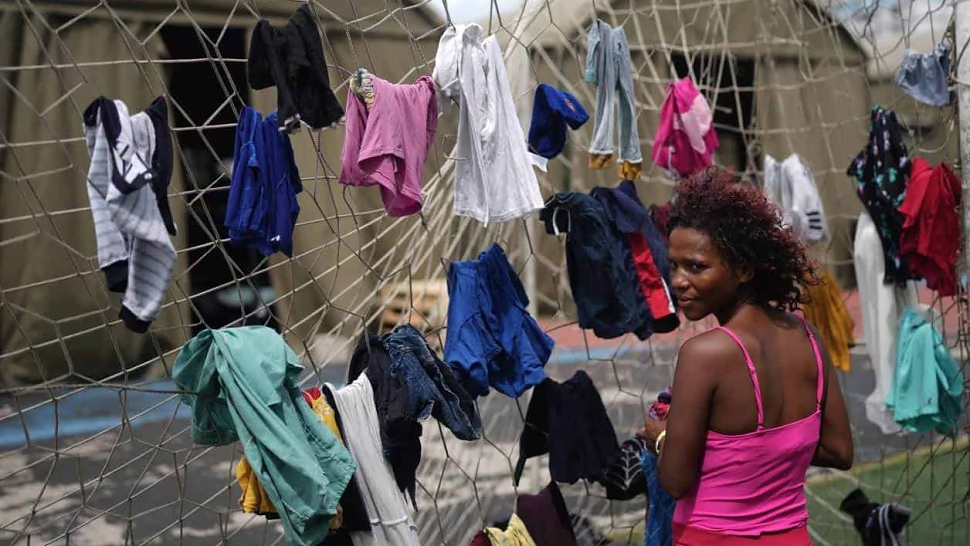
The earthquakes left 3,889 dead, 190 buildings collapsed and 856 structures damaged, according to authorities. Some 18,000 people lost their homes and live in schools, sidewalks and parks.

Zulbey Reyes, 41, lost her job as a nanny and her house. He went to a clinic run by the Paluz organization, in alliance with the International Rescue Committee, for chest pain. The diagnosis revealed a nerve inflamed by the scream on the day of the earthquake.

The Pan American Health Organization reported that 50% of health professionals in La Guaira were directly affected: some died, others disappeared or suffered family crises.

According to the UN Office for Disaster Risk Reduction, damage to homes and infrastructure amounts to about $37 billion. So far, the United States has provided most of the aid. The response contrasts with the previous persecution of NGOs under the government of Nicolás Maduro.

Fletcher concluded: “When you have a crisis of this magnitude, people put politics aside and can focus on saving as many lives as possible.”

Continue reading

Ebola expands to new areas in Congo; There are 600 deaths

Suspected cases in Tshopo and Haut-Uele raise the Ebola alert in the Democratic Republic of the Congo.

Authorities in the Democratic Republic of the Congo warned this Thursday that the Ebola outbreak could have reached new regions. Suspected cases were detected in the provinces of Tshopo and Haut-Uele. The death toll rises to 600, while confirmed infections total 1,759.

Measures and current situation

The Ministry of Health reported two possible cases in the city of Kisangani, Tshopo province. One is linked to the Nia-Nia area, in Ituri, where the outbreak began. The other has no apparent connection with previous outbreaks, so it is already being investigated.

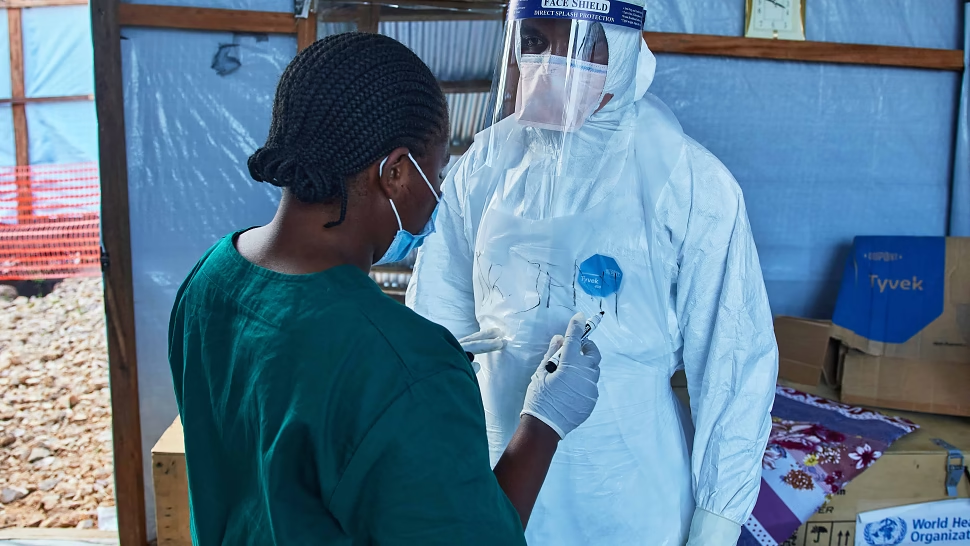
The government declared a health emergency on May 15, after the virus circulated for several weeks without being detected. The outbreak corresponds to the Bundibugyo variant, a rare strain of Ebola for which there are still no vaccines or approved treatments.

Given the seriousness of the situation, clinical trials began last week to evaluate possible treatments. It is hoped to find an effective alternative that contains the spread of the virus and reduces mortality.

Continue reading

Ukraine intensifies offensive against Russian oil infrastructure

kyiv attacked fuel depots and two ships in the Sea of ​​Azov.

Ukraine hits Russian oil infrastructure

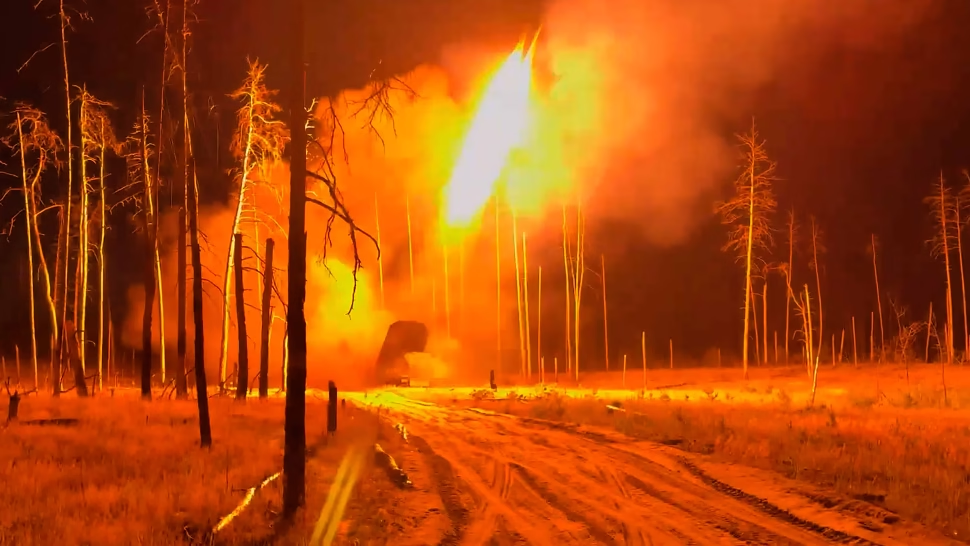
kyiv intensified its drone offensive against Russian fuel depots this Thursday. The impacts hit facilities in the Tver and Stavropol regions, as well as two oil tankers in the Sea of ​​Azov. Russian authorities reported large fires.

The escalation comes a day after US President Donald Trump announced that he will grant Ukraine a license to manufacture Patriot air defense systems. Moscow claimed its air defenses shot down 73 Ukrainian drones. For its part, kyiv noted that Russia responded with 94 attack drones and two ballistic missiles against Ukrainian territory.

Russian response and dynamics of the confrontation

The Ukrainian attacks directly affect Russia’s ability to manage its energy infrastructure. Images of the fires on oil tankers circulated widely, evidencing the impact of the offensive. Russia’s response was immediate, increasing the use of drones and missiles in its counteroffensive.

This dynamic reflects the growing tension in the region. Both countries continue to exchange blows, which makes the situation of the confrontation even more complex.

Continue reading