The UN demands that Israel stop attacks in Syria after massacres

The UN calls to stop the escalation of violence in Syria as community tensions reach critical levels.

Because peace in the Middle East is always as simple as a game of chess… with bombs

Geir Pedersen, the UN special envoy for Syria (yes, that position exists and someone has it), has raised his voice with the urgency of someone ordering a coffee at Starbucks at 8:59 AM. The reason? The “unacceptable” attacks by Israel in Syrian territory, which have turned recent weeks into a macabre reality show where the Druze and Alawite minorities are the involuntary protagonists. What a surprise, right?

The statement that no one will read but everyone will quote

In a statement as anticipated as the fifth season of *Stranger Things*, Pedersen called for “protection for civilians” and “avoiding incitement of tensions”. Come on, what anyone with half a brain would shout in the middle of this circus. But hey, at least “take note of the ongoing efforts” (read: “we know they won’t do anything, but they pay us to write it”).

RelatedIsraeli operation in Syria leaves 13 dead in clashes

And as if there was no drama, the Syrian Observatory for Human Rights—that organization that surely has more data than the FBI—reported nine deaths in Homs, because nothing unites a region more than a good massacre between neighbors. Pedersen, in a burst of originality, demanded that “those responsible be held accountable.” Spoiler: they won’t.

Israel, the neighbor you never invite to the barbecue

Meanwhile, Israel—which swore to protect the Druze as if they were legendary Pokémon—decided that the best defense is a good attack: it bombed Sahnaya, a town near Damascus, because what better way to prevent an attack on minorities than by turning the place into a crater? Impeccable logic.

To top it off, let’s remember that part of this Druze minority lives in the Golan Heights, that territory that Israel “borrowed” from Syria in 1967 and never returned, like that friend who keeps your favorite book. The UN still does not recognize the annexation, but of course, Israel cares about that as much as a cat cares about an obedience tutorial.

Conclusion? The UN asks, Israel ignores, Syria burns, and civilians pay the price. Any given Thursday in the Middle East.

Are you outraged? Share this note and spread the absurdity. Or better yet, explore more content about how the world keeps spinning while some pretend it’s not on fire.
Niger formalizes its withdrawal from the International Criminal Court

Niger accuses the ICC of applying selective justice and activates its exit from the Rome Statute.

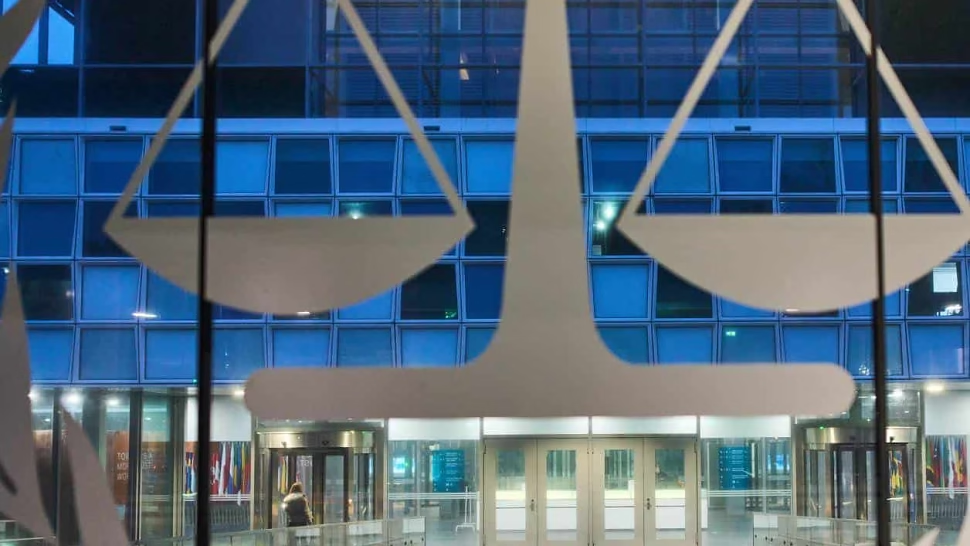
The government of Niger formally notified the United Nations of its withdrawal from the International Criminal Court (ICC), alleging that the court applies “selective justice.” The decision activates the process of exit from the Rome Statute, the court’s founding treaty.

“The ICC has been misused and exploited,” the Niger government said in the letter presented to the UN. Although the court generated expectations of international justice in its beginnings, the country considers that its application is unequal.

Niger’s withdrawal follows previous announcements by Mali and Burkina Faso, which also expressed their intention to leave the ICC. These decisions occur in a context of profound political changes in the Sahel region, after coups d’état and the arrival of military junta to power.

Since the 2023 coup that overthrew the elected government, the new Nigerien administration has reduced ties with traditional Western allies and strengthened relations with partners such as Russia. At the same time, President Vladimir Putin faces an arrest warrant issued by the ICC.

Continue reading

Thai woman prosecuted for death of diplomat in Myanmar

Pavinee Supasirivisan appears for immigration violation; He also faces a murder charge.

The judicial process

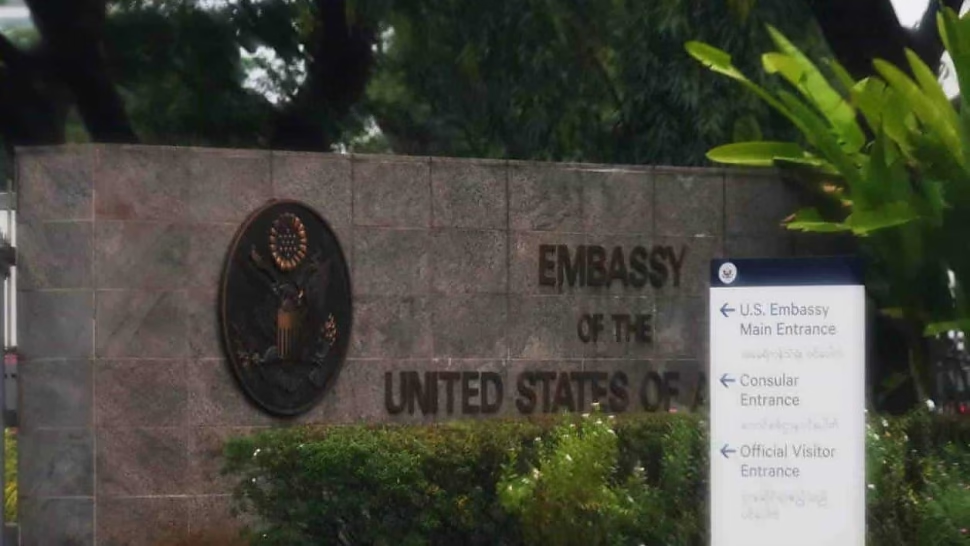
A Thai woman, identified as Pavinee Supasirivisan, appeared in court in Myanmar on Tuesday. She faces a charge of violating immigration laws, linked to the death of her ex-husband, a US diplomat found dead in Yangon in May.

During the hearing, three prosecution witnesses testified, including immigration officials. So far it has not been reported whether the accused pleaded guilty or not guilty.

Immigration crime has a penalty of six months to five years in prison. In addition, the woman is also being investigated for homicide, which could carry from 10 years in prison to the death penalty, according to local legislation.

The diplomat was found dead on May 11 at the Sakura Residence & Hotel in Yangon, with stab wounds to his head and neck. The US State Department confirmed the death, but has not revealed his identity. The Thai government has provided consular assistance to the accused.

The case is being handled secrecy. Myanmar authorities have restricted access to information, and journalists are prohibited from attending hearings, a common practice since the 2021 military coup. The lack of transparency raises concerns about due process.

Continue reading

Pezeshkian’s visit to Pakistan reactivates Iran-US negotiations

The Iranian president seeks to consolidate agreements amid tensions in Lebanon.

The president of Iran, Masoud Pezeshkian, landed in Islamabad this Tuesday to meet with Pakistani authorities. Pakistan is acting as a mediator in talks between Tehran and Washington, aimed at a permanent agreement to end the war in the Middle East.

The visit follows high-level negotiations in Switzerland, led by US Vice President JD Vance and the Speaker of the Iranian Parliament, Mohammad Bagher Qalibaf. Although Washington claimed that an agreement was reached to allow IAEA inspections of Iranian nuclear facilities, Tehran denied that there is a defined date for those visits.

Tension in Lebanon and repercussions

In parallel, violence returned to southern Lebanon. Two people lost their lives in Nabatiyeh al-Fawqa after Israeli soldiers opened fire, according to local media. The incident occurred after two days of relative calm following a ceasefire, but threatens to complicate negotiations. Iran has demanded that a truce in Lebanon be part of any comprehensive deal.

Pezeshkian was received by Pakistani President Asif Ali Zardari and Prime Minister Shehbaz Sharif. The Iranian president pointed out that the progress of the talks will depend on the actual fulfillment of the agreements. He warned that statements outside the negotiated framework could affect the diplomatic process.

Key points on the table

The negotiations address sanctions relief, nuclear issues, reconstruction and surveillance mechanisms. They also include agreements to keep open the Strait of Hormuz, a key route for global oil transportation. Differences persist over the use of possible unfrozen Iranian funds and Israel’s role in the conflict with Hezbollah. The mediators seek to avoid a new regional escalation.

Continue reading