The UAT invites its academics to publish digital books with a humanist seal

The UAT seeks to fill the digital world with academic works, because nothing says "humanism" like a PDF with ISBN.

Because the paper is no longer academic enough

The Autonomous University of Tamaulipas (UAT), in a fit of modernity that surely left more than one academic desperately searching for the “print” button, has launched a call to publish digital books. Yes, those files that no one reads but that look great on the resume. Of course, with a humanist sense, because nothing humanizes more than a PDF protected by copyright.

Are you a teacher? Congratulations, you can endure the process!

The invitation is addressed to the academic staff of the UAT, both those who have full time and those who, ironically, have “free hours” (does that exist in academia?). Of course, your proposals must be original and unpublished, because copying and pasting from Wikipedia is no longer so easy since plagiarism detectors were invented. Furthermore, they must contribute to the development of science, culture or the humanities, although no one has defined what the hell that exactly means.

RelatedThe UAT joins the national push for higher education

Those interested (or those who have no other option because their boss insisted on them) must send their masterpieces before September 30, 2025 through an institutional platform whose name seems to be taken from a random URL generator: https://sipconvocatorias.uat.edu.mx/. Of course, only with your institutional email, because if you use Gmail, you automatically lose academic seriousness points.

Requirements: more bureaucracy than in a government office

To participate, you need:

  • A approval letter from the Local Publications Committee (who, of course, no one knows who they are).
  • A similarity report, because Turnitin has become every academic’s worst enemy.
  • The endorsement of your academic direction, because at the university, even to breathe you need permission in triplicate.

Once you overcome this Kafkaesque labyrinth, your works will be subjected to a judgment process that evaluates content, originality, relevance and quality. That is, the same thing that happens on Twitter, but with fewer memes and more APA citations. If you manage to survive, your work will receive an ISBN, that magic number that turns a file into something “official”.

And the prize? Visibility in the abyss of the Internet

The approved works will be published in 2026, just in time for no one to remember them. Of course, they will be able to show off the UAT editorial seal, which will surely impress the three people who download them. The university claims that this reinforces its scientific dissemination and offers tools for academic productivity, although we all know that what really matters is adding points for the SNI.

For the brave who still have doubts (or for those who miss the sound of a landline), UAT offers technical support in extensions that look like nuclear launch codes: 2905, 2912, 2925 and 2943. They are also on social networks, where they will surely respond to your message in 3 to 5 business days.

Do you dare to publish? Share this call with that colleague who always says “I have a book in mind” but never writes it. And if you want more content just as ironic (but just as useful), explore our other notes on the wonderful world of academia!
One year after the discovery in a crematorium, families march for justice

One year after the discovery of 386 bodies, families demand justice and an end to corruption.

March for justice one year later

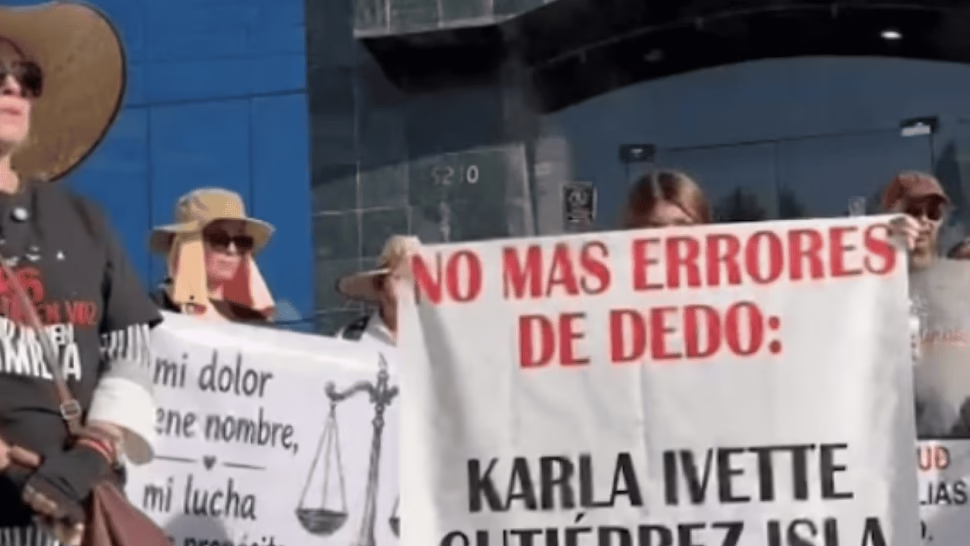
On Saturday afternoon, groups of families affected by the Plenitude crematorium case demonstrated. The discovery of 386 bodies turns one year old, and the bereaved demand answers.

The protest began at the Latinoamericana funeral home, one of those identified by family members. From there, the protesters walked towards the State Attorney General’s Office (FGE).

Dora Elena Delgado, spokesperson for the Justicia para Nuestros Deudos collective, reported that at least 1,500 families were affected. The central demand: no more impunity, no more corruption and full justice.

Actions pending by the authority

The protesters carried blankets with messages of justice. They demand action against Coespris officials involved in the case, as well as the recapture of José Luis A. C., owner of the crematorium. He was released by a federal judge, and a red card from Interpol is expected to arrest him again.

So far, of the 386 bodies found, the FGE reports that 135 remain to be identified. The identification process continues.

The collective Memory, Dignity and Justice joined the mobilization. They placed a permanent memorial in the shape of a cross outside the Prosecutor’s Office, as a reminder of the victims.

Continue reading

Sheinbaum asks to preserve native corn for national sovereignty

Sheinbaum highlights that native corn is key to food sovereignty and national identity.

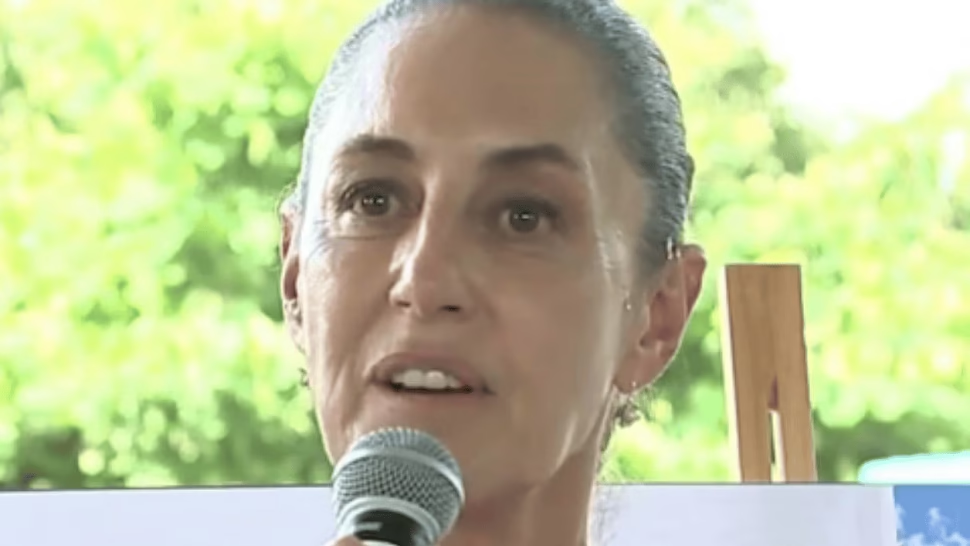
President Claudia Sheinbaum Pardo reaffirmed that the governments of the Fourth Transformation defend national sovereignty in all areas. During a meeting with farmers in Pijijiapan, Chiapas, he highlighted the importance of native corn as a pillar of Mexican identity and self-sufficiency.

Defense of sovereignty through native corn

Sheinbaum presented the “Corn is the Root” program, whose objective is to improve the conditions of producers and reduce dependence on seeds controlled by large corporations.

“Conserving native corn also means defending sovereignty,” he stated.

The president warned about the risks of hybrid seeds:

“If we continue with pure hybrid corn, people will depend on buying seeds and those who sell the seeds will be a few companies.”

He stressed that preserving native varieties is essential to avoid this economic dependence.

“If we did not have native corn, we would lose a good part of food sovereignty, of what we are as Mexicans,” he said.

In addition, it extended the defense of sovereignty to the energy, cultural and food fields. She assured that the Fourth Transformation drives her “in every possible way.”

The program seeks to strengthen small farmers and conserve the genetic diversity of corn, a central element in the country’s diet and culture.

Continue reading

Mexico sends rescue team to Venezuela after earthquakes

25 specialists and 5 canine pairs travel to support search efforts in Venezuela.

Solidarity in action

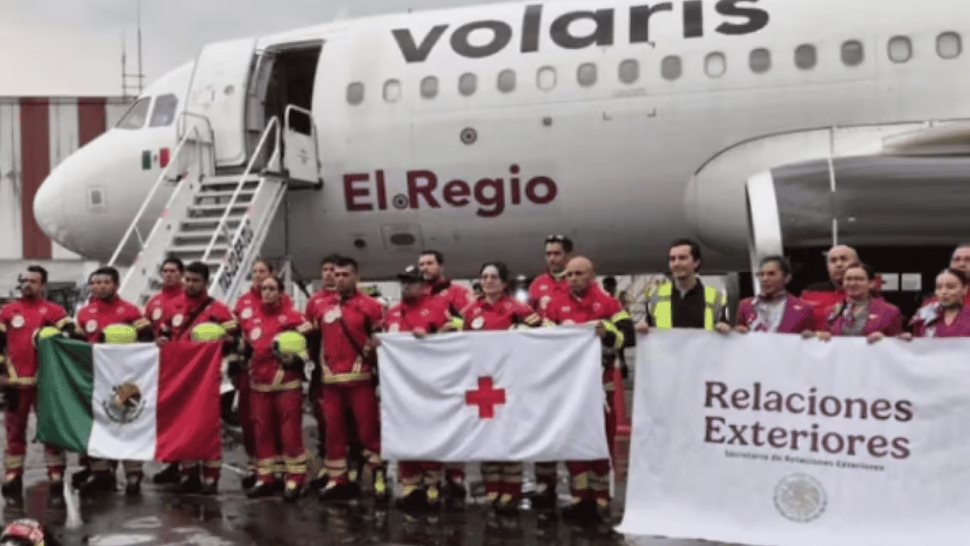
After the earthquakes of magnitude 7.2 and 7.5 registered in Venezuela on June 24, which left 1,430 dead and 3,328 injured, Mexico reinforced its humanitarian support. The Ministry of Foreign Affairs (SRE) coordinated the sending of a rescue mission with the Mexican Red Cross and the Volaris airline.

“This afternoon a support team made up of 25 specialists from the Urban Search and Rescue Unit (USAR) of the Red Cross and the Cancun International Rescue Brigade (USAR BRIC) left for Venezuela, as well as a brigade element from the Azteca Topos,” the agency indicated.

Equipment and logistics

The mission includes five canine pairs and 3.5 tons of specialized equipment for search and rescue tasks in the rubble. The shipment was transported on a Volaris flight.

“With this, Mexico reaffirms its solidarity and commitment to the Venezuelan people in these difficult times,” the SRE said in a statement. Foreign Minister Roberto Velasco heads the coordination of this aid.

Continue reading