The mandatory registration of telephone lines with CURP is here

Starting in 2026, all lines in Mexico must be linked to the CURP. We explain what it entails and how to do it.

Your mobile line needs your CURP: this is what changes

As of January 9, 2026, all telephone lines in Mexico—prepaid or plan—must be linked to the Unique Population Registry Code. The Telecommunications Regulatory Commission (CRT) promotes this measure.

Why now?

Authorities argue that it is a necessary tool to combat crimes such as extortion, fraud and kidnapping. The idea is to create an identified registry that allows illegal activities to be tracked.

According to the Center for Strategic and International Studies (CSIS), line tracing is common in other jurisdictions to dismantle criminal networks.

You have until June 30, 2026 to complete the process. If you don’t do this, your line will be suspended for conventional services: no outgoing calls or mobile data.

RelatedYour mobile line and mandatory registration: this is what applies

You will only be able to make emergency calls.

How to link your line step by step

You need three things:

  • Your CURP
  • Current official identification (INE or passport)
  • The active line you want to register

The process is done directly with your company (Telcel, Movistar, AT&T, Bait) in their physical centers or digital platforms:

  1. Enter your company’s portal or app
  2. Search for “Identity Registration” or “CURP Linkage”
  3. Provide your number to receive verification code
  4. Upload identification and CURP data
  5. Confirm and save the digital receipt

The other side: privacy risks

The Electronic Frontier Foundation (EFF) organization warns about the dangers of centralizing this data.

Various experts point out that “the centralization of this data (CURP + telephone number) carries risks if the databases are violated.”

The authorities ensure that they comply with international standards to protect personal information. But the debate about security versus privacy is still open.

The essentials: if you use a mobile line in Mexico, this procedure is not optional. It is best to do it early to avoid service suspension.
AI becomes a dating coach, but divides opinions

Users turn to chatbots to start romantic conversations, but doubts persist about authenticity.

The role of AI in modern romance

Marie Lansley recently arrived in San Francisco and, while looking for a partner, decided to try artificial intelligence. “I’ve tried everything,” says the 36-year-old engineer, who consults chatbots like ChatGPT and Claude to help her start conversations on dating apps. “I’m open to AI finding the love of my life, but I’m not totally convinced,” she says. “Chemistry is always going to be analog.”

More and more people are using chatbots to compose messages or interpret responses. Dating coach Carey Gaynes compares him to Cyrano de Bergerac: “You’re using a voice that’s not your own.” He worries about overdependence, although he recognizes that it can be useful.

Mason Naung, a 25-year-old student in Los Angeles, only turns to AI to break the initial ice. “If the messages go further, it would be a small warning sign,” he says. San Diego businesswoman Dani Cohen prefers an AI-written farewell message to being ghosted. “Anything that gets people to communicate in a friendly way is great,” he says.

Other voices are more critical. Clara Sullivan, a 22-year-old student, would not respond to a profile that uses AI. “It’s scary how dependent people are. It’s taken away the ability to think creatively,” he says. A Pew Research Center survey reveals that 53% of US adults believe AI will worsen creativity, and half think it will affect meaningful relationships.

Dating apps already integrate AI. Tinder has Chemistry, Hinge uses AI launchers, and Bumble plans to eliminate swipe to prioritize automated matching. Its CEO, Whitney Wolfe Herd, says that technology “should make love feel more human, not less.”

Mohammed Nizami, 23, does not use AI for dating. “We all crave authentic connection. If there’s a filter, it’s not a good way to start,” he says. Jake Clay, a content creator in New York, calls the situation a “vicious cycle” that bypasses sacred processes of life. “It’s sad to delegate something so fundamental to an AI that doesn’t understand emotions,” he laments.

Despite reservations, the merger between AI and dating seems inevitable. Efficiency gains ground, but authenticity remains the challenge.

Continue reading

NASA takes the 2026 World Cup ball into space and plays it on the ISS

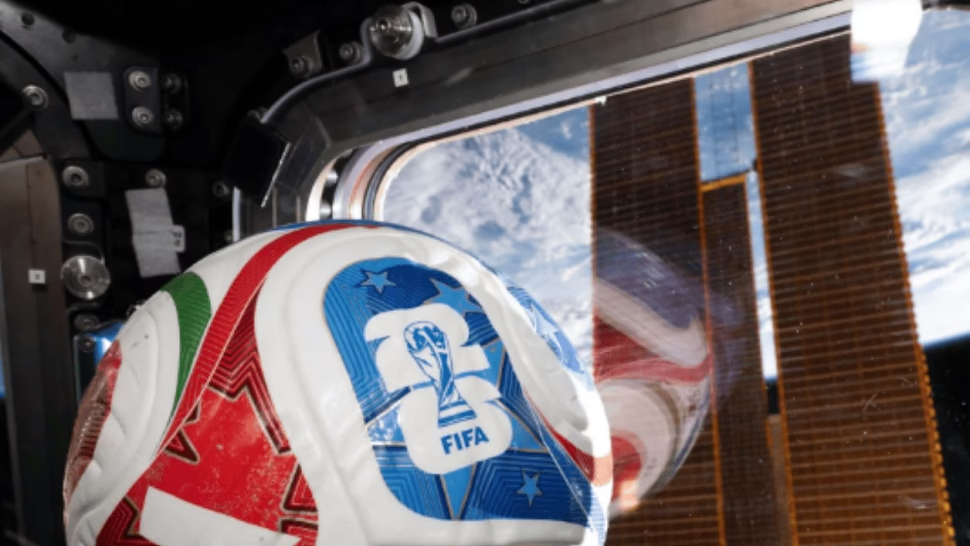
NASA sent an official 2026 World Cup ball into space and opened an exhibition in Houston.

World Cup ball arrives at the International Space Station

The fever of the 2026 World Cup permeated the atmosphere. NASA sent an official World Cup ball to the International Space Station (ISS). In a video shared on social networks, four astronauts are seen playing with the ball in microgravity. The message: “We work to inspire the next generation by showing how space exploration drives innovation in sports science.”

The agency seeks to disseminate how research on the ISS generates advances in science, technology and human health. Benefits that even reach the soccer field.

Exhibition at the FIFA Fan Fest in Houston

NASA set up an exhibit at the FIFA Fan Fest in Houston, Texas. It opened on June 11 at the start of the World Cup and will be available until July 19. Visitors can discover how space research improves life on Earth and learn about the Artemis program missions.

The exhibition explains how more than 25 years of studies on the ISS have helped understand the aerodynamics of the ball. According to a statement from the Johnson Space Center, previous research analyzed how internal mass, sensors and seam texture affect stability and rotation under real-play conditions.

Science applied to sports

As part of the project, NASA and Adidas present the “STEMonstration” demo. They compare how balls spin with different balance in microgravity. The objective: to show that space discoveries benefit athletes and fans of the most popular sport in the world.

Continue reading

Users report massive drop in X this Monday

Users report problems accessing social network X this Monday, June 22.

Cuts in X during Monday

Users of the social network X, formerly Twitter, reported this Monday, June 22, difficulties accessing and browsing the platform. According to data from DownDetector, a site that monitors digital failures, 1,131 people have reported problems with the application, loading the main feed and connecting to servers.

The most common issues include the inability to refresh the home page, errors when displaying posts, and crashes when using basic functions. When trying to log in, some see messages like “Something went wrong. Try loading again,” without the platform recovering.

So far, X has not issued an official statement on the origin of the failures or the estimated time to restore service.

Continue reading