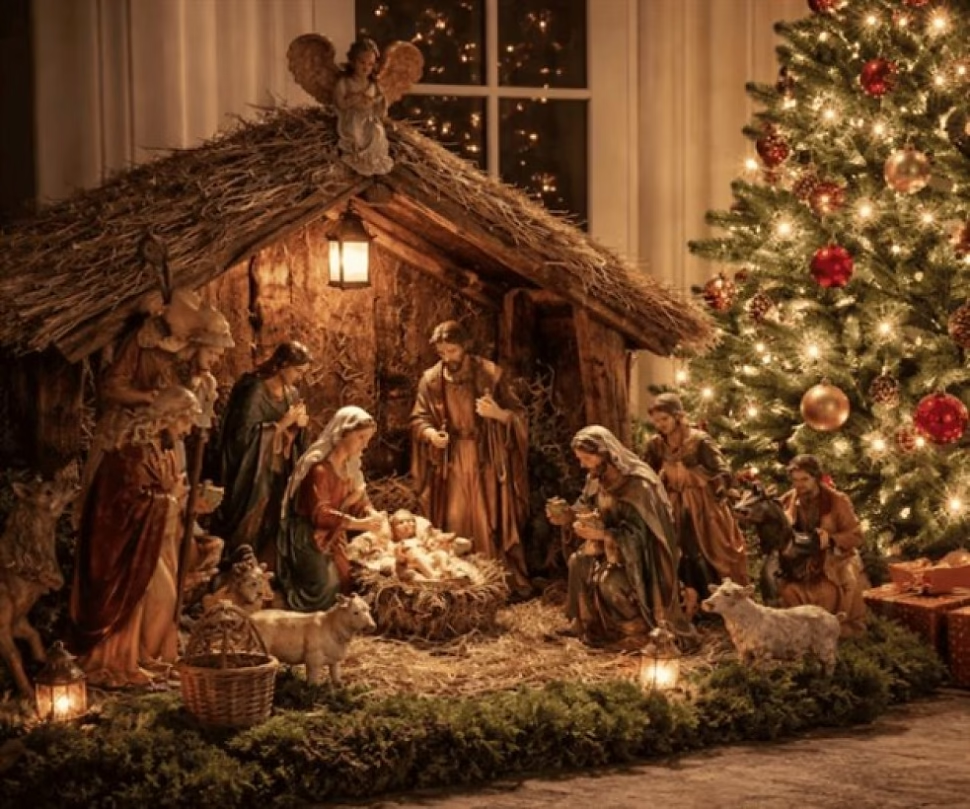
The fusion of traditions that defined a global holiday
Christmas, celebrated every December 25, is much more than a religious commemoration; It is the result of a complex historical process of cultural syncretism. Its establishment on this specific date does not respond to an exact biblical fact, but rather to a deliberate ecclesiastical strategy to absorb and Christianize pagan festivities deeply rooted in the Roman Empire. Understanding this origin requires an analysis of the social and religious context of the first centuries of our era.
Before the institutionalization of Christianity, the month of December was marked by the winter solstice in the northern hemisphere, an astronomical event loaded with symbolism. The Romans celebrated Saturnalia, festivals dedicated to Saturn, god of agriculture. These festivities, which occurred between December 17 and 23, represented a period of social investment: wars and work were suspended, slaves were temporarily freed, and gift exchange and community banquets were promoted. It was, in essence, a celebration of the light returning after the longest night.
The ecclesiastical decision that consolidated the date
The early Christians did not commemorate births, focusing on death and resurrection. However, as Christianity grew within the empire, its leaders faced the challenge of persistent pagan festivals. The solution was strategic. Between the years 320 and 353, Pope Julius I officially decreed December 25 as the date of Jesus’ birth. This decision was not arbitrary; it allowed to superimpose a Christian narrative on a period already invested with great social and festive significance, facilitating conversion and cultural assimilation.
By assigning the Nativity to December 25, the Church provided a religious alternative to Saturnalia and the festival of Natalis Solis Invicti (Birth of the Unconquered Sun), celebrated on the same day. Gradually, symbols and practices were reinterpreted: the light of the unconquered sun was transformed into the light of Christ, and the spirit of community and generosity was channeled into the Christian message. This process of adaptation and reinterpretation is key to understanding how a local Roman celebration evolved into a central holiday of Christianity and, subsequently, into a secular cultural phenomenon of global reach, transcending its purely religious origin.
Therefore, Christmas on December 25 is a testament to how traditions evolve. Its current essence fuses the memory of Jesus’ birth with ancient rituals of winter renewal, creating a layer of meaning that encompasses the spiritual, the familial and the cultural. This historical hybridization explains the power and permanence of the holiday, resonating with universal concepts of hope, renewal and light in the darkness.
Were you surprised by this historical origin? Share this analysis on your social networks to discover with your contacts the fascinating layers of history behind our traditions. Explore more content related to cultural history in our articles section.