The fury of the Cazones River, a tragedy foretold

An announced tragedy that exceeded all official forecasts, leaving a trail of devastation in the Huasteca.

The Omen of an Imminent Catastrophe

Twelve days ago, the sky over the Huasteca of Veracruz was torn by inconsolable tears. Near the majestic Cazones River, a region accustomed to humidity and the dance of its river currents, witnessed how the rainfall transformed into a disproportionate nightmare. What began as a whisper of rain became an incessant roar, a deluge that defied all logic and preparation. On Friday, October 10, the river, enraged, broke its chains, rising about four meters above its usual level in a brutal demonstration of force that took with it dreams, vehicles and human lives. The ravages of that fateful day continue to resonate with bitter intensity.

The National Water Commission had launched its warning from the shadows of the month of August, projecting intense rainfall that would reach the terrifying figure of 400 millimeters. This projection was not a simple fact; It was an omen that surpassed all recent records of Poza Rica. Collective memory revived the ghost of October 2007, when the accumulation of more than 300 millimeters unleashed a flood of mud and debris, forcing the eviction of hundreds of families. For years, residents clamored for changes to infrastructure, their voices forming a chorus of pleas that, in 2019, were answered with a promise that, once again, vanished into thin air. History, implacable, was about to repeat itself.

RelatedFlood of the Cazones River plunges Poza Rica into emergency

An Ignored Danger Map

The previous year, the collector had recorded a rain of 96.3 millimeters during the passage of a storm, an event that had already set off alarms among the citizens of Veracruz. The ancestral fear of the river overflowing and the forced evacuation of their homes took hold of the families. The authorities, in response, solemnly affirmed that they knew the risk map of the territory and promised to act accordingly. To put the magnitude in perspective, during the June 2024 rainy season in Mexico City, a record was set with 211.6 mm of water falling. That figure, which paralyzed a metropolis, was barely half of what was projected for the most affected areas of Veracruz, Puebla and Hidalgo!

The result of this climatic fury has been a human tragedy of Dantesque proportions: 76 confirmed deaths and at least 27 souls that fate has not yet returned, considered as not located. Nearly 39,000 homes exhibit structural wounds in different degrees, a landscape of devastation that eclipses even the shadow of Hurricane Otis, whose surprise passage through the national territory claimed 68 lives and left 31 missing. Official calculations predicted that the region would exceed regular rainfall by 75%, placing it as one of the few points on the map with such extreme anomalies, along with the south of Veracruz, Chiapas and Querétaro.

The evidence was there, recorded in the risk map that compiled data until 2023. This crucial document, a modern oracle, already projected that the points that are today epicenters of population suffering were at severe risk of damage. The so-called “flood-susceptible areas”, meticulously identified by the National Civil Protection Coordination, the National Disaster Prevention Center and the Government of Veracruz, pointed an accusing finger at the surroundings of the Cazones River and the area near Álamo and the border with the State of Puebla. Since 2024, the Secretary of Civil Protection, Guadalupe Osorno, had warned that landslides could occur in the mountain areas of Veracruz. Knowledge of the vulnerability existed; forceful action to neutralize it, no.

This is not just the chronicle of a natural disaster; It is the epic story of a tragedy foretold, where the indomitable force of nature collided with the fragility of prevention systems. A dramatic lesson in the consequences of underestimating climate warnings.

This story of resilience in the face of adversity should be known. Share it on your social networks to raise awareness and help us get more people to explore our content on climate emergency preparedness.
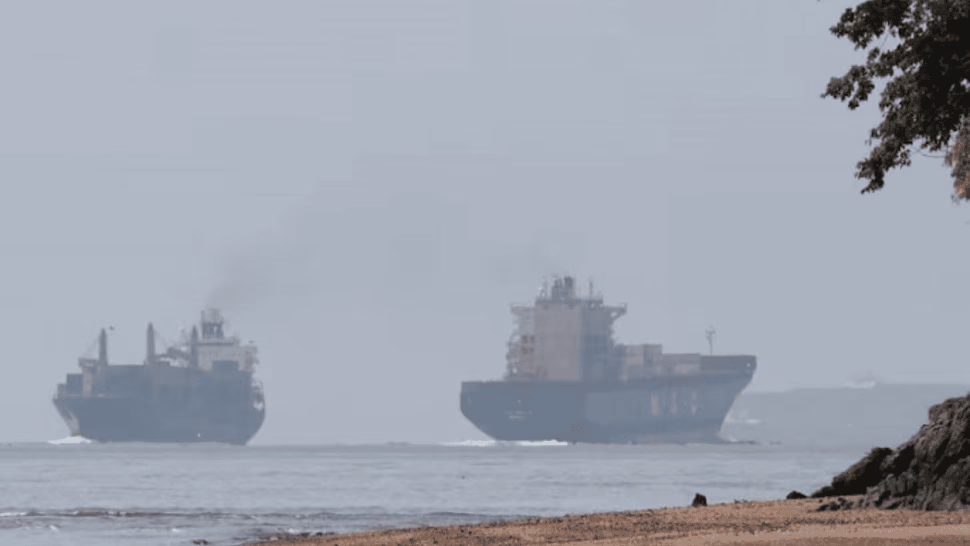

El Niño will intensify and hit Mexico in 2026

Intensifying El Niño between July and September will bring heat waves, droughts and torrential rains globally.

The World Meteorological Organization (WMO) predicts a rapid evolution of the El Niño phenomenon towards a strong episode between July and September 2026. This will increase the probability of extreme events such as heat waves, droughts and intense rains in several regions of the world.

What implications does it have for Mexico?

The WMO monthly bulletin indicates that El Niño will continue to strengthen during the northern hemisphere autumn, extending its influence to many areas. In the equatorial Atlantic, temperatures will remain above average.

“We are already observing conditions typical of an El Niño episode, and they are expected to intensify until they become a strong episode,” warned Celeste Saulo, Secretary General of the WMO.

The National Oceanic and Atmospheric Administration (NOAA) explains that El Niño occurs when temperatures in the tropical Pacific rise more than normal. The name, used by Peruvian fishermen, arose because the warming of the sea coincided with Christmas, affecting fishing.

Experts foresee uneven but clear impacts for Mexico:

  • Increase in extreme rains in the central-north.
  • Increased risk of intense hurricanes in the Pacific.
  • Possible periods of drought in some regions.
  • High risks for agriculture, water and security.
  • Intensification of forest fires and effects on fishing.

The WMO insists that the international community must prepare for these events, as the probabilities of extreme events increase significantly in the coming months.

Continue reading

Sheinbaum congratulates Isaac del Toro for victory in the Tour de France

The Mexican won the second stage in his debut in the Tour.

President Claudia Sheinbaum celebrated the triumph of Mexican cyclist Isaac del Toro in the second stage of the Tour de France. Through her official account, the president wrote:

“Congratulations to Isaac del Toro for his victory in the second stage of the Tour de France.”

Victory on the hill of Montjuïc

Del Toro, 21, crossed the finish line first in Barcelona, beating his UAE Team Emirates teammate, Tadej Pogacar, who gave way to give him the win. The Slovenian Remco Evenepoel came third and the Dane Jonas Vingegaard, fourth, maintaining the yellow jersey. Mattias Skjelmose, also Danish, came within three seconds.

The Mexican participates for the first time in the Grande Boucle and his performance generated enthusiasm among national fans. The victory reinforces his projection in international cycling.

Sheinbaum highlighted the achievement at a key moment for Mexican sport, where cyclists gain visibility in high-level competitions.

Continue reading

World Cup piracy grows in the heat of 2026

World Cup fever triggers the sale of pirated items in CDMX.

The piracy boom at the 2026 World Cup

The 2026 World Cup fever has boosted the sale of pirated merchandise in Mexico City. Informal merchants offer t-shirts, trophies and mascots at prices well below the official ones. In the Historic Center and markets like La Lagunilla, a Mexican National Team shirt costs around 250 pesos, while an official jersey exceeds 2 thousand pesos.

Specialists point out that the phenomenon is intensified by impunity, corruption in customs and the growth of informal trade. The high cost of original items leads thousands of consumers to opt for unauthorized products, both in markets and on digital platforms.

Francisco Rivas, general director of the National Citizen Observatory, warns that piracy is a growing problem. He points out that, in addition to the lack of controls, organized crime has found a source of income in this market, even putting pressure on formal merchants through extortion.

“Piracy not only affects brands, but also fuels illegal networks,” said Rivas.

According to the report Mapping Global Trade in Fakes 2025 by the OECD and EUIPO, Mexico ranks seventh in the world as a buyer of counterfeit merchandise. This situation is strongly reflected during events with high commercial impact such as the World Cup.

Given this, sports product companies have reinforced their promotional strategies and digital campaigns to encourage the purchase of official merchandise. The federal government has made seizures and promoted reforms to protect intellectual property. However, specialists consider that the fight against piracy requires comprehensive actions: strengthening surveillance, combating corruption and raising consumer awareness about the economic and social impact of this illegal market.

Continue reading