The FGR challenges the conditional freedom of Julio César Chávez Jr

The federal justice system does not sit idly by and appeals the controversial judicial decision that surprised everyone.

The FGR Does Not Take the Glove and Appeals the Controversial Decision

It seems that the party for the freedom of Julio César Chávez Carrasco, better known as Chávez Jr., has just encountered a bigger obstacle than a 12-round fight. The Attorney General’s Office, in a move that no one saw coming (lie, we all saw it coming), decided that the early departure of the son of Mexico’s most famous boxer was not exactly what they had in mind for “social rehabilitation.” So, with the determination of a fan looking for tickets to Canelo, the FGR challenged the conditional freedom that a Sonora judge had granted him. Because, apparently, the alleged links to the Sinaloa Cartel aren’t exactly a “misdemeanor” to let go with a pat on the back.

Federal sources, those anonymous heroes who keep us up to date with the drama, confirmed that the Specialized Prosecutor’s Office for Organized Crime (FEMDO for the guys) has already notified the review appeal. Basically, it’s the legal equivalent of saying, “Hey, judge, what were you thinking?” Now, the matter will go to a Collegiate Court, which will have to decide if Judge Hernández Miranda’s play was a masterstroke or an epic own goal. Spoiler alert: informal preventive detention for weapons crimes is something of a golden rule in the penal code, not a suggestion.

RelatedJudge expands criminal investigation against Julio César Chávez Jr.

A Stained White Glove and Telenovela Precautionary Measures

Last week, Judge Enrique Hernández Miranda, from his headquarters in Hermosillo, Sonora, made one of those moves that leaves everyone scratching their heads. On the one hand, it linked Chávez Jr. to proceedings for the crime of arms trafficking. Until then, everything is normal. But then, in a plot twist worthy of a Netflix series, he was granted release under conditions. Yes, you read that right. The same guy accused of a crime that, according to Article 19 of the Constitution, deserves automatic preventive detention, walked out of Cefereso No. 11 with precautionary measures that sound more like the terms of the probation of a problematic influencer than those of someone allegedly linked to organized crime.

Among the conditions for his freedom, he was prohibited from leaving the country without judicial authorization, because clearly, an express trip to Las Vegas would be the most normal thing in the world in this situation. The measure, although necessary, has that air of “we already know you are going to try it, but please, don’t do it.” The question we all ask ourselves is: can you really believe that someone accused of these charges is going to stay calmly at home, as if waiting for an Amazon delivery?

This entire media-legal circus only reinforces the perception that there is one justice for the famous and another for the rest of us. While the penal code would have been applied to the letter to any ordinary citizen, Chávez Jr. managed, at least temporarily, to avoid preventive detention. The FGR’s appeal is a reminder that, although fame can buy certain privileges, it cannot always stop legal processes… at least not completely.

The case continues its course, and with it, the attentive gaze of a public that no longer knows whether to follow the legal thread or wait for the next season of this judicial soap opera. The only thing that is clear is that Chávez Jr.’s most important fight will not be in the ring, but in the courts.

Are you surprised by this turn in the case? Share this story on your social networks and tag those who follow the judicial drama. Explore more content related to high-profile legal proceedings on our site.

Sheinbaum asks FGR for information about Lozoya’s sister

The president requests information about the Agronitrogenados case and the role of Gilda Lozoya.

Sheinbaum requests clarification on the Agronitrogenados case

President Claudia Sheinbaum asked the Attorney General’s Office (FGR) for detailed information about the participation of Gilda Lozoya Austin—sister of the former director of Pemex, Emilio Lozoya—in the Agronitrogenados fraud. Gilda Lozoya recently obtained parole.

“I asked the Prosecutor’s Office to report in more detail the participation of this person, of Lozoya’s sister, in this fraud that was the purchase of a company, which at the time had been privatized for an amount much greater than what it was actually worth, to benefit the owner of Altos Hornos and some other people,” said the president from the National Palace.

Sheinbaum also recalled that Alonso Ancira, former president of Altos Hornos de México, has not finished paying the debt derived from that case. For this reason, the arrest warrant against him was revived. He indicated that he hopes that the FGR, headed by Ernestina Godoy, clearly explains the details of the process.

The purchase of Agronitrogenados occurred during the administration of Emilio Lozoya at Pemex. The operation was carried out for a value much higher than the real value, according to investigations. The case has been one of the most emblematic in terms of corruption in the Mexican energy sector.

Continue reading

Flood prevention in Edomex: 90% progress

Anti-flood works in eastern Mexico are 90% complete and four projects are already operating.

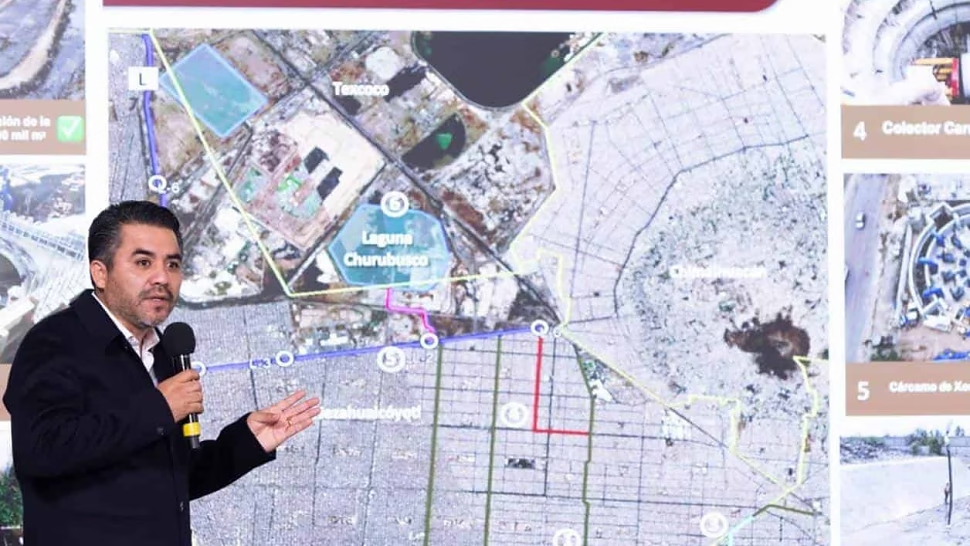
President Claudia Sheinbaum reported that the works to prevent flooding in the Eastern Zone of the State of Mexico are 90% complete. They will be ready in a maximum of 15 days, just before the peak of the rainy season.

Sheinbaum highlighted the effectiveness of the work. Four of the six projects are already operating and have reduced impact times. For example, after recent rains in Ciudad Nezahualcóyotl, the system evacuated a body of water in approximately an hour and a half.

Budget and key works

The director of Conagua, Efraín Morales, explained that 2.2 billion pesos of a national budget of 11.2 billion pesos are spent in the region that includes La Paz, Nezahualcóyotl and Iztapalapa.

Among the completed works are the expansion of the El Salado Lagoon (from 300 thousand to 400 thousand cubic meters), the Teotongo Collector, the Carmelo Pérez Collector and the Cárcamo de Xochiaca, which increased its pumping capacity to 16 thousand liters per second.

The pending works for the next two weeks are the Los Pinos Collector (88%) and the expansion of the Churubusco Lagoon channels (85%).

In addition, construction of the Chalco de Díaz Covarrubias Collector continues to resolve historical flooding in Chalco and Valle de Chalco. The microtunneling maneuvers have already advanced 3 kilometers and are expected to conclude in October.

Continue reading

Older adults: more than 1.2 million already have a health credential

Sheinbaum reports that more than 1.2 million older adults have registered for the Universal Health Service.

Advance in credentialing for the new health system

President Claudia Sheinbaum reported that the credentialing process for the Universal Health Service is advancing. More than 1.2 million older adults have already registered.

The program is scheduled to begin in January of next year. “It starts next year. There are more than one million 200 thousand older adults who have registered,” said the president during her morning conference.

Sheinbaum explained that the objective is that those who register can receive care at any IMSS, ISSSTE and IMSS Bienestar health center. Regardless of your current entitlement.

“Remember that we started with adults and older adults in the credentialing of the Universal Health Service and it is moving forward. In January this possibility of being able to share services in the three main health institutes would begin,” he said from the National Palace.

The federal government seeks to guarantee universal access to medical services. The first phase focuses on the population aged 65 and over. Authorities hope to expand coverage gradually.

Continue reading