The core of Mars is solid as a rock according to new data

Seismic results reveal that the heart of the red planet is more complex and fascinating than initially thought.

The heart of Mars: harder than we thought

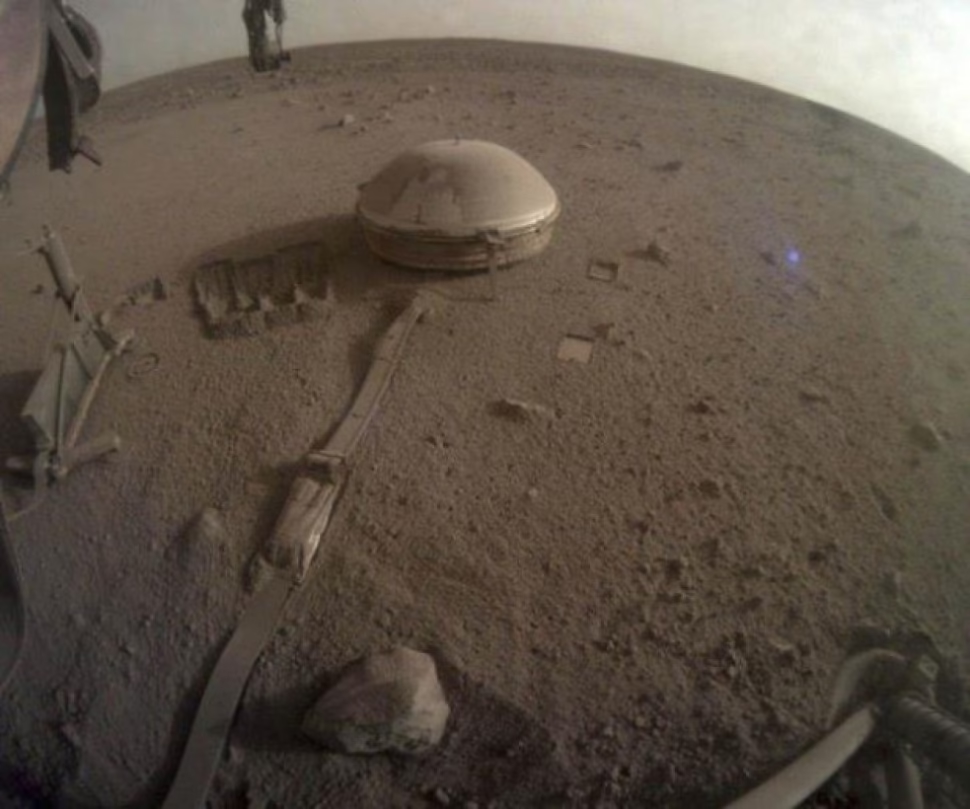
It seems that our red neighbor is not as soft inside as some believed. In a plot twist worthy of a scientific soap opera, a team of researchers, led by China, has come to tell us that the core of Mars is, in reality, a massive block of solid metal. Remember all those previous studies that talked about a liquid and emotional heart? Well, throw them in the cosmic recycling bin. The revelation, published in the prestigious journal Nature, is based on the last seismic rattles captured by NASA’s InSight module before it hung up its gloves in 2022. How appropriate that it decided to send this data just before its retirement, right? Almost as if he had planned it.

Poor InSight, stuck on a boring equatorial plain since 2018, spent its last days listening to the planet growl. He recorded more than 1,300 Marsquakes, of which 23, mostly of low intensity (because even when it comes to shaking, Mars is mediocre), were chosen to dethrone the previous theory. The epicenters of these planetary sobs were at a respectable distance from the lander, between 1,200 and 2,360 kilometers. Because, of course, the most crucial data always comes from afar, making the work of scientists even more… interesting.

RelatedNASA’s Perseverance finds possible signs of ancient life on Mars

A metal cake with solid filling

The delicious new theory suggests that Mars is like a cosmic bonbon: an outer shell of molten metal surrounding a solid inner core. This hard heart extends from the very center of the planet to a radius of approximately 613 kilometers. The liquid outer core surrounds it up to about 1,800 kilometers from the center. The likely composition is iron and nickel, with perhaps a touch of oxygen for flavor, much like that of Earth. What a coincidence! Although, as lead researcher Daoyuan Sun points out, perhaps it is just that, a coincidence. Let’s not think that we are special.

Sun of the University of Science and Technology of China speculates that crystallization of this nucleus may have started in the past and may continue today. Because in planetary evolution, everything is an eternal “work in progress.” What is not so clear is whether the outer core is a pure liquid or whether it has a pasty transition zone, a kind of cosmic custard, between the solid interior and the liquid exterior. What a crucial and yet delightfully absurd detail to investigate.

But not everyone is willing to celebrate with confetti. Nicholas Schmerr of the University of Maryland, who was not part of the study, uttered one of those phrases that journalists love: the questions about the Martian core “are far from resolved.” In other words: “Guys, this is just the beginning, don’t get too excited.” And he has a point. With InSight out of action, there will be no new recordings of seismic activity. We ran out of our microphone on the Martian soil, so we have to make computer models and speculate a lot.

Schmerr insisted that an entire network of seismographic stations is needed to unravel the remaining mysteries. Because a single probe is like trying to understand a conversation by listening to only one word out of ten. Sun agreed that more detailed models are needed to get a clearer picture of core formation and, more intriguingly, what it tells us about the history of the extinct Martian magnetic field.

Ah, yes. The magnetic field. Or the lack thereof. Schmerr suggested that the current absence of this protective shield on Mars could be due to the slow crystallization of its solid core. Wow, maybe the planet took its sweet time solidifying and lost its inner magnet along the way. A lesson for everyone: procrastination has consequences, even on a planetary scale.

What did you think of this trip to the center of Mars? Share it on your social networks and cause an earthquake of opinions! And be sure to explore our science section for more absurdly fascinating revelations about the universe.
NASA takes the 2026 World Cup ball into space and plays it on the ISS

NASA sent an official 2026 World Cup ball into space and opened an exhibition in Houston.

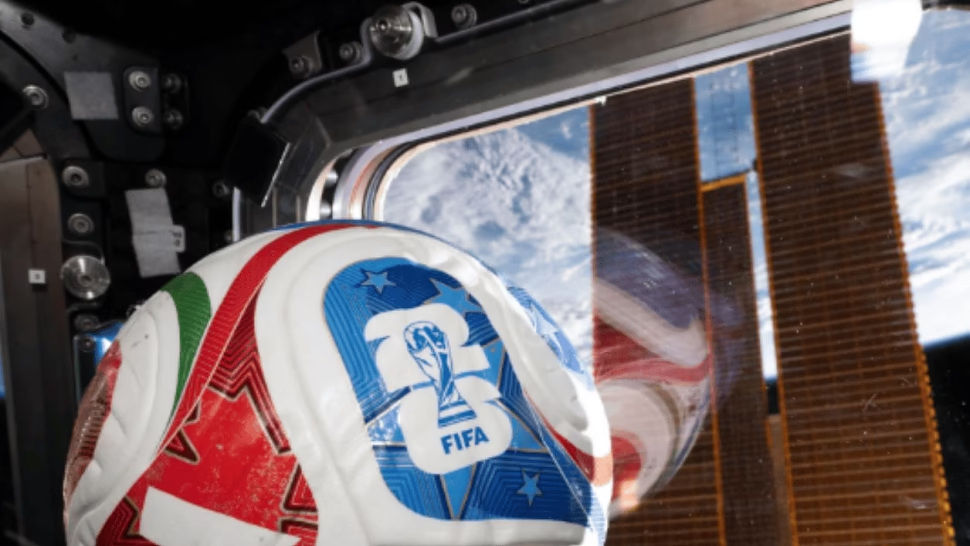
World Cup ball arrives at the International Space Station

The fever of the 2026 World Cup permeated the atmosphere. NASA sent an official World Cup ball to the International Space Station (ISS). In a video shared on social networks, four astronauts are seen playing with the ball in microgravity. The message: “We work to inspire the next generation by showing how space exploration drives innovation in sports science.”

The agency seeks to disseminate how research on the ISS generates advances in science, technology and human health. Benefits that even reach the soccer field.

Exhibition at the FIFA Fan Fest in Houston

NASA set up an exhibit at the FIFA Fan Fest in Houston, Texas. It opened on June 11 at the start of the World Cup and will be available until July 19. Visitors can discover how space research improves life on Earth and learn about the Artemis program missions.

The exhibition explains how more than 25 years of studies on the ISS have helped understand the aerodynamics of the ball. According to a statement from the Johnson Space Center, previous research analyzed how internal mass, sensors and seam texture affect stability and rotation under real-play conditions.

Science applied to sports

As part of the project, NASA and Adidas present the “STEMonstration” demo. They compare how balls spin with different balance in microgravity. The objective: to show that space discoveries benefit athletes and fans of the most popular sport in the world.

Continue reading

Users report massive drop in X this Monday

Users report problems accessing social network X this Monday, June 22.

Cuts in X during Monday

Users of the social network X, formerly Twitter, reported this Monday, June 22, difficulties accessing and browsing the platform. According to data from DownDetector, a site that monitors digital failures, 1,131 people have reported problems with the application, loading the main feed and connecting to servers.

The most common issues include the inability to refresh the home page, errors when displaying posts, and crashes when using basic functions. When trying to log in, some see messages like “Something went wrong. Try loading again,” without the platform recovering.

So far, X has not issued an official statement on the origin of the failures or the estimated time to restore service.

Continue reading

How artificial intelligence transforms global security

Motorola Solutions is committed to hybrid models and agentic AI in the transformation of the sector.

Security industry: cloud migration and artificial intelligence

Security is undergoing a profound transformation. The cloud, generative artificial intelligence and video surveillance systems as decision tools are redefining the sector. This was stated by Pedro Simoes, global vice president of video security and analytics at Motorola Solutions.

“The cloud is a very strong trend, but it is not a solution for all sectors,” he explained. Prison facilities, airports and nuclear plants require hybrid models that combine local infrastructure with cloud services. Motorola Solutions is committed to unified platforms.

One of the key advances is agentic artificial intelligence. The company introduced Operator, a platform that integrates video, access controls and sensors in a single interface. The objective: reduce the time between detection and response. “It’s not just identifying. It’s being collaborative in decisions,” said Simoes.

The role of sensors in smart cities

Cameras no longer just record: they are sensors. “Today a camera produces data that can be used to optimize logistics, mobility or business decisions,” he added. Security information extends to multiple applications.

However, the growth of AI poses privacy challenges. Motorola Solutions developed “AI nutrition labels,” documents that detail capabilities and limitations of its models. “We are the first company in the sector to create and use this type of labels,” said Simoes.

Mexico and the 2026 World Cup

Mexico is experiencing a key moment for the 2026 FIFA World Cup. The arrival of millions of visitors is driving investments in technological infrastructure and security in airports, hotels and stadiums. Simoes confirmed collaboration with governments, without revealing details. “Safety is a priority; our responsibility is to develop technology that protects people and infrastructure.”

He recommended organizations think long term: “The decision should not be based only on current problems, but on the challenges of three or five years.” The combination of cloud, generative AI and unified platforms will define the next stage of the sector.

Continue reading