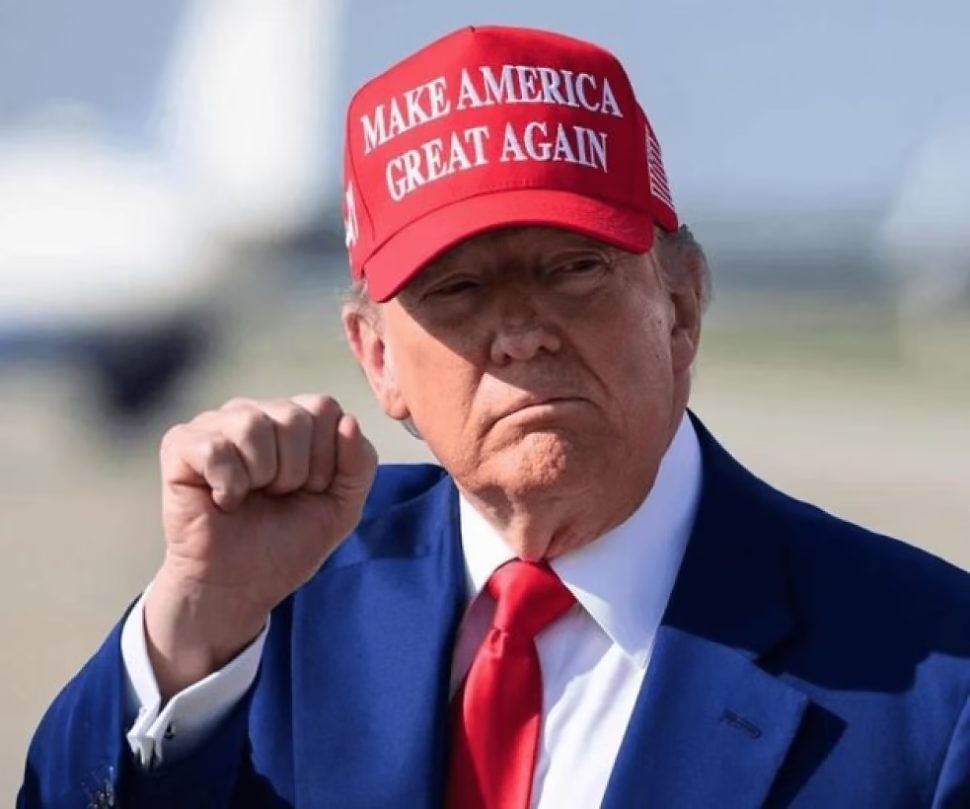
The conflict between Israel and Iran redefines the balance of power in the Middle East

Experts warn about the consequences of a military escalation in the Middle East and its global implications.

A Confrontation That Transcends Borders

The tension between Israel and Iran is not just a regional conflict, but a battle between two worldviews that seek to expand their influence in an increasingly multipolar global scenario. As a key ally of the United States, Israel acts as a strategic arm of Washington in the Middle East, while Iran, once a US ally before the 1979 Islamic Revolution, today represents China‘s interests in the region. What does this mean for the future of geopolitics? Let’s find out together!

The Persian Gulf: The Geopolitical Chessboard

According to Dr. Moisés Garduño, an expert from UNAM, the Persian Gulf has become the key area where these powers seek to impose their agendas. The Iranian nuclear program, classified by Israel as an “existential threat”, has been the trigger for this crisis. But here is a revealing fact: the Israeli attacks occurred just when Iran and the United States were in full negotiations to reactivate a nuclear agreement similar to the one in 2015. Coincidence? Hardly!

RelatedRussia and China promote resolution to stop conflict in the Middle East

Since the beginning of the Israeli incursion into Gaza, Washington has allocated almost 18 billion dollars in military aid to Tel Aviv, according to data from Brown University. This financial support has allowed Israel to maintain its operations in the region, from Gaza to Lebanon and Syria. But now, Iran represents its biggest challenge. The Iron Dome has shown vulnerabilities, and the Iranian arsenal has proven more lethal than expected.

A Strategic Mistake for the United States?

The recent US bombing of three Iranian nuclear power plants could be a dangerous turning point. Garduño warns that getting directly involved in this conflict would be a strategic mistake for Washington, whose true rival is China. Diverting resources from Asia to the Middle East could weaken its position vis-à-vis Beijing. Is the United States about to make a serious mistake?

Meanwhile, the cyberwar is already underway. The attack by hackers linked to Israel, who stole $90 million from an Iranian stock exchange, shows how the conflict is also being fought in the digital sphere. But a prolonged war could be devastating for both sides, especially Israel, where society is beginning to show signs of division and emotional exhaustion.

Final Thoughts: Where Are We Going?

This conflict could evolve into a scenario similar to that in Ukraine: a prolonged stalemate with intelligence battles and mutual attrition. The key is to reactivate diplomatic channels before it is too late. Will the parties be able to find a peaceful solution, or are we facing the beginning of a new era of global instability?

Share this analysis and join the conversation about the future of the Middle East! Do you think diplomacy can prevent further escalation? Explore more content on geopolitics and discover how these events impact the world. 🌍✨
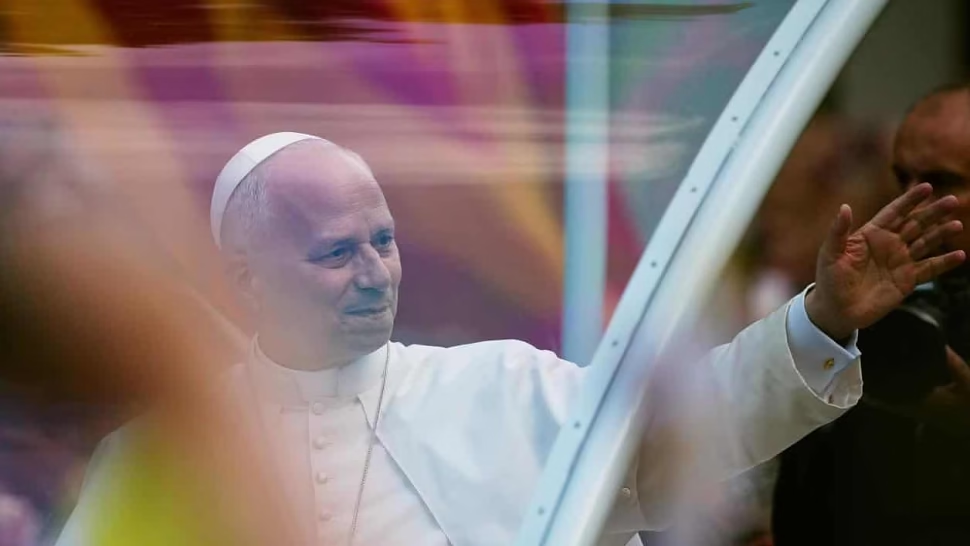
Pope Leo XIV asks for dignity for migrants in the Canary Islands

The pontiff threw flowers into the sea in memory of those who died on the Atlantic route.

A call from the port of Arguineguín

This Thursday, Pope Leo XIV visited the port of Arguineguín, in the Canary Islands, one of the points of greatest arrival of migrants to Europe. From there, he called for respect for his dignity and rights.

“Human dignity does not depend on a nationality nor is it lost when crossing a border,” the pontiff recalled. He asked governments to avoid indifference in the face of migratory tragedies.

The place was singled out in 2020 for the conditions suffered by hundreds of people, who spent weeks in makeshift camps without adequate services. Today, the Canary Islands continue to be a key route for migrants from West Africa.

Tribute at sea

Leo XIV also paid tribute to those who have lost their lives on the journey. Accompanied by migrants, he threw flowers into the ocean, a gesture similar to that of Pope Francis in Lampedusa in 2013.

The pontiff urged countries of origin, transit and destination to protect migrants and combat human trafficking networks. He warned that Europe cannot get used to its seas becoming places of suffering without recognizing the human stories behind it.

Continue reading

Ambassadors of the US and Canada congratulate Mexico for its World Cup victory

Ambassadors from the US and Canada celebrate Mexico's 2-0 victory against South Africa at the opening of the World Cup.

The ambassadors of the United States and Canada in Mexico, Ronald Johnson and Cameron Mackay, respectively, congratulated the country on the victory of the Mexican National Team against South Africa (2-0) in the opening match of the FIFA World Cup.

Reactions of diplomats

The American ambassador celebrated the start of the World Cup, which he called “the largest sporting event in history.” On social networks he wrote:

“As we celebrate the beautiful game that unites our three nations, we also celebrate the cooperation, friendship and shared purpose that help make this the safest and most memorable World Cup in history.”

Johnson highlighted that the Azteca Stadium is hosting an inaugural match for the third time, becoming the first stadium in the world to reach that milestone. He attended accompanied by his wife Alina Johnson.

For his part, the Canadian ambassador wrote: “What a game! I congratulate the Mexican National Team for their victory. Likewise, I recognize South Africa. After 16 years, seeing them compete again is inspiring.”

Call for civility

At the start of the fair, the president of the Senate board of directors, Laura Itzel Castillo, ratified her call for civility, coexistence, security, respect for the law and the protection of the rights of all people to prevail.

Castillo stressed that soccer remembers the strength of a united people. He reiterated the statement of the Permanent Commission so that civility and security prevail in the tournament. “Long live Mexico!” he emphasized.

Finally, he celebrated the victory of the Mexican squad and urged the National Team to be proudly celebrated for raising the name of the country.

Continue reading

The US bombs Iran and Tehran responds with attacks on neighboring countries

Washington's new bombings in Iran unleash retaliation against coalition bases in the region.

The United States launched new airstrikes against targets in Iran, in an escalation that reignites tensions in the Middle East. President Donald Trump warned that more military action could come and accused Tehran of dragging out negotiations for an agreement.

“He will pay the price,” said the US president.

Iranian response

The reaction was immediate. Tehran carried out attacks against targets in Bahrain, Kuwait and Jordan, countries that host US bases. According to official reports, several projectiles were intercepted with no casualties reported. Jordanian authorities confirmed the neutralization of missiles aimed at military installations.

Details of the offensive

The United States Central Command reported bombings against air defense systems, radars and control centers in Iranian territory. An oil tanker accused of violating sanctions was also disabled. Iran denounced damage to civilian infrastructure and described the actions as a violation of its sovereignty.

Diplomatic tension

Iranian Foreign Minister Abbas Araghchi stated that his country reserves the right to respond and will reconsider its position in the negotiations. Meanwhile, regional mediators like Qatar are pushing for talks to avoid further escalation. Both parties claim to seek a negotiated solution.

The conflict is complicated by Israeli military operations in the region. Prime Minister Benjamin Netanyahu maintains a firm stance against Iran and its allies, which, coupled with recent exchanges of attacks, raises the risk of an expansion of the conflict.

Continue reading