The Buen Fin raffle rewards winners without charging taxes

The government pays local taxes so that lucky winners receive their full prize, in a curious effort to boost spending.

The fiscal irony of the year: spend to win (without the Treasury touching you)

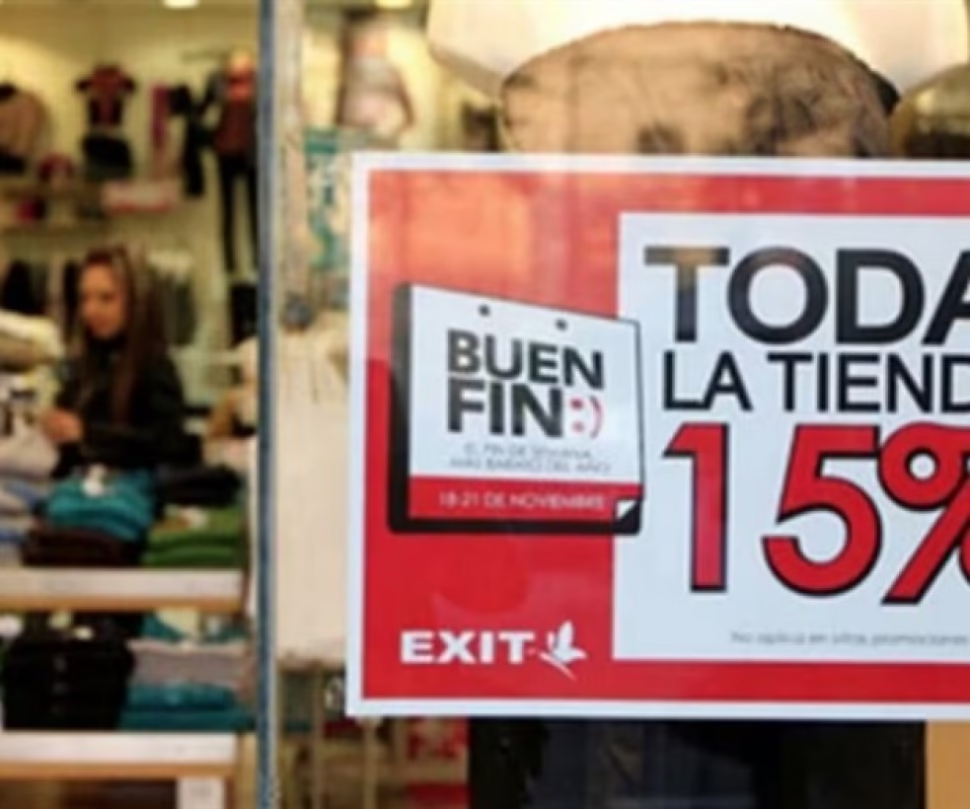
In a turn of events that reminds us that reality is always stranger than fiction, Buen Fin 2025 has decided that the lucky winners of its tax draw will not pay… yes, you guessed it, taxes. It seems that the universe, in a burst of unprecedented generosity, has aligned the stars so that the joy of winning a prize is not clouded by the harsh reality of the tax return. Isn’t it moving?

The miracle, because calling it anything else would be heresy, was officially sanctified in the Official Gazette of the Federation on Friday, October 31. A perfect date, since the presidential decree that establishes it is, without a doubt, the most elaborate trick-or-treater of the year for taxpayers. The stated objective is “to encourage the use of electronic payment methods.” Because, of course, nothing motivates the responsible citizen more than the promise of free money and the temporary suspension of tax gravity laws.

RelatedGood End 2025 Dates Offers and Millionaire Draw

The distribution of the government piñata

The Tax Administration Service (SAT), that entity normally associated with less festive news, will become a kind of fiscal Santa Claus, distributing the not inconsiderable amount of 500 million pesos. Of this loot, 400 million are destined for lucky cardholders, who will be able to receive from 500 to 20 thousand pesos, with a grand prize of 250 thousand pesos. And best of all: you will receive it in its entirety, without that unpleasant retention that usually appears as the unwanted guest in any happy transaction. Can you imagine? He wins 20,000 pesos and takes… 20,000 pesos. Crazy.

The million dollar question, or the 400 million in this case, is: where is the trap? Because in the world of taxes, if something seems too good to be true, there’s usually an accountant somewhere silently crying.

The Forced Altruism of the Federation

This is where the plot thickens in a delightfully bureaucratic way. So that state and municipal governments do not stare with their hands outstretched and frowning, the Federation has decided to act as a benefactor. In an unprecedented act of institutional charity, he will pay out of his own pocket the local taxes that would correspond to each winner. That is, the central government uses our money to pay the local government taxes on a prize it gave us to spend our own money. Does anyone else feel like they’re in a financial time loop?

It is argued that it is “pertinent” to grant this fiscal stimulus to the states that decide to participate. Such a nice word, “stimulus,” that sounds like a caress and not a complex accounting mechanism to move money from one place to another. This entire fiscal ballet is carried out under the protection of article 33-B of the Federal Tax Code, allowing banks to credit against the Income Tax (ISR) the amount of the prizes given away. In short: a perfect ecosystem where everyone wins, especially the feeling that we have entered a parallel dimension where tax logic has taken a vacation.

So now you know, dear citizen. Take out your plastics and prepare your budget for the Buen Fin. You will not only be hunting for offers, but also participating in a peculiar lottery where the biggest prize is, perhaps, the rare experience of having the treasury smile on you, even for a few moments. A masterstroke to reactivate the economy, or simply the most entertaining tax reality show of the year. You decide.

Does this seem like a brilliant strategy or a financial circus? Share this gem of tax engineering on your social networks and make your contacts also wonder what world we live in. Explore more content about economics and the curious ways money moves.
Imports of Mexican cattle to the US resume

Following a health agreement, the US will reopen the port of Douglas, Arizona, for Mexican cattle.

President Claudia Sheinbaum reported that the United States will resume importing Mexican cattle starting the last week of August. The decision came after an official communication from the US Secretary of Agriculture, Brooke Rollins.

Reopening schedule

The reopening will begin at the border port of Agua Prieta, Sonora, linked to the Douglas crossing, Arizona. August 24 will be the first date of operation. Later, two additional points will be enabled in Chihuahua, subject to compliance with the Joint Action Plan against screwworm.

Sheinbaum instructed federal agencies to accelerate coordination with US authorities. He highlighted the work of the Secretary of Agriculture, Julio Berdegué, and the director of Senasica, Columba López, to strengthen health measures.

  • The animals will enter with complete inspections to verify that they do not show signs of the plague.
  • Later, the opening of the ports of Santa Teresa and Columbus, in New Mexico, will be evaluated.

The president described the news as positive for Mexican ranchers, who for months contained the spread of the screwworm. He appreciated Rollins’ willingness to maintain an institutional relationship.

Rollins, for his part, stated that the protection of the US livestock industry remains a priority and that the temporary closure of crossings was necessary to reduce risks. The reopening is possible thanks to binational collaboration.

Continue reading

More than eight million apocryphal cigarettes seized in Manzanillo

Joint operation in Manzanillo detected shipment of counterfeit cigarettes.

Operational in the port of Manzanillo

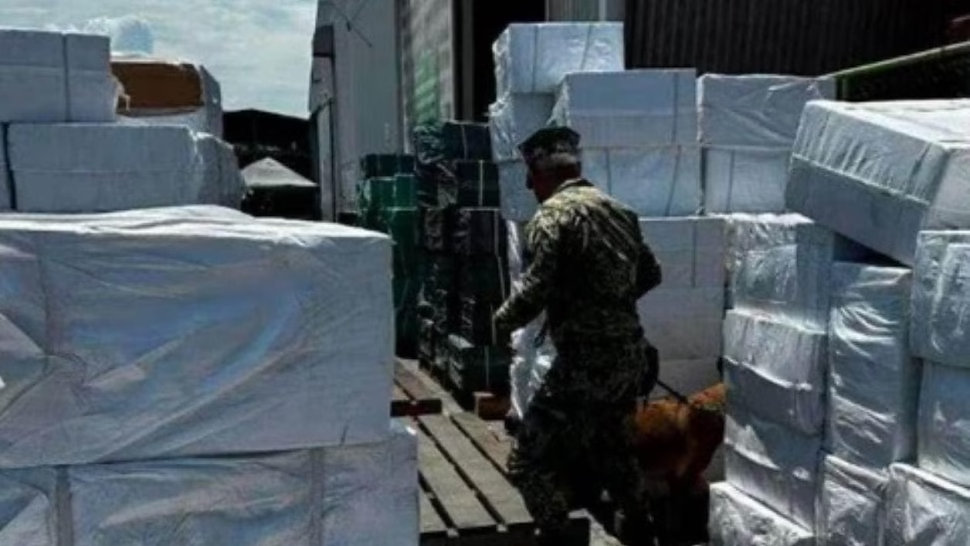
Federal authorities seized more than eight million allegedly apocryphal cigarettes in the port of Manzanillo, Colima. The operation was coordinated by agencies of the security cabinet and the National Customs Agency of Mexico (ANAM).

Personnel from the ANAM and the Administrative Unit of the Manzanillo Customs detected inconsistencies in an operation to import cigarettes from abroad. This led to a specialized review.

As a result of the inspections, the authorities located 8 million 436 presumably counterfeit cigarettes. The merchandise was insured with the support of the Secretary of the Navy (Semar).

The ANAM reported that this type of operations are part of the permanent mechanisms of operational intelligence, risk management and strategic analysis. The objective is to strengthen security in foreign trade operations and detect documentary irregularities or goods of illicit origin.

The comprehensive analysis of the operation made it possible to reinforce documentary traceability, operational review and validation of commercial profiles. The authorities maintain surveillance at entry points into the country to combat illegal trade.

Continue reading

Perception of insecurity drops to 59.8%: Sheinbaum

Perception of insecurity in Mexico drops to 59.8%, the lowest figure since 2018.

ENSU results

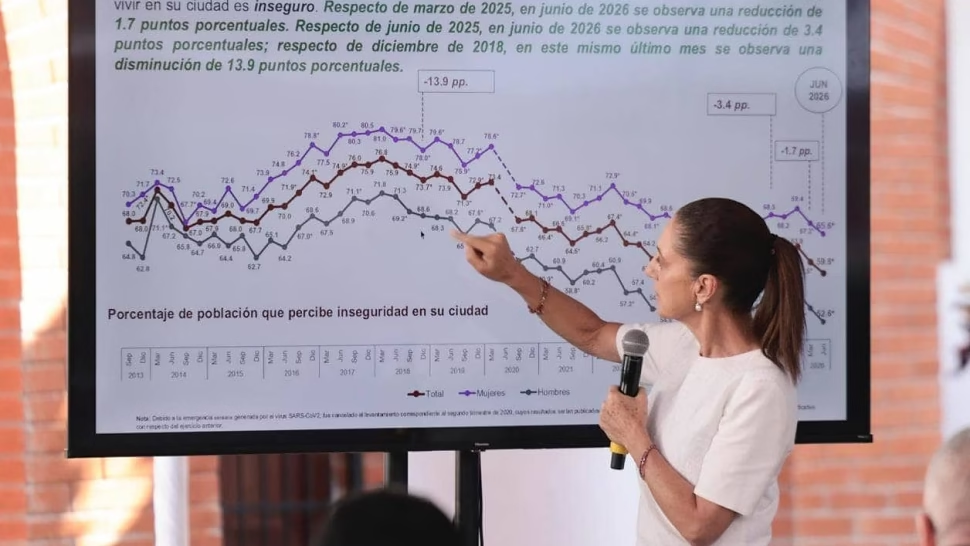
President Claudia Sheinbaum reported that the perception of insecurity in urban areas fell to 59.8% in June 2026, according to the National Urban Public Security Survey (ENSU) of the INEGI. In December 2025 it was 63.8%, which represents six consecutive months of decline.

“The important thing here is that we are giving results in the security indicators and people are beginning to notice this decrease,” he said during the morning conference in Cuernavaca, Morelos.

Historical comparison

Sheinbaum recalled that in December 2018, under the government of Andrés Manuel López Obrador, the perception of insecurity was 73.7%. The previous lowest point was reached in September 2024 at 58.6%. The president attributed the improvement to the National Security Strategy.

The ENSU measures citizens’ feeling of insecurity in their environment. Recent data reflects a positive trend, although the challenge remains to maintain the reduction in crime. The authorities continue to implement actions to consolidate these results.

Continue reading