The SAT celebrates collection record while taxpayers hold their breath

The Mexican treasury exceeds all expectations with historic figures, while taxpayers watch with a mixture of pride and pocket pain.

A new record to frame (and to pay for)

It seems that the Tax Administration Service (SAT) has found the magic formula that we are all looking for: how to make money appear. And boy has it appeared. In a display of efficiency that leaves us all speechless (and a little lighter in our wallets), tax collection from January to November 2025 reached the astronomical figure of 4 trillion 905 thousand 415 million pesos. A real increase of 4.6% compared to the same period of the previous year. The key? Simply charge more. Brilliant strategy.

This historical milestone, which will surely deserve a commemorative plaque in some government office, contributed to the total revenue of the treasury exceeding by a scandalous (or admirable, depending on which side of the form you are on) 102.3% that authorized by the Congress of the Union. Because, of course, why follow budgets when you can double them. The goal for the entire year was to raise 5.2 billion pesos. At this rate, they could end up funding a mission to Mars… or maybe just pay more subsidies.

RelatedMexico reaches a historic collection of 4.6 billion pesos

The tribute podium: Who contributes the most to the party?

In the exciting ranking of “Which tax bleeds us the most this year?”, the gold goes to, like an Olympic champion of financial extraction, the Income Tax (ISR). With a growth of 5.1%, it accumulated the handsome sum of 2 billion 652 thousand 597 million pesos. In Christian terms, that is 222,532 million pesos more than last year. A difference that companies and taxpayers surely noticed with a slight shudder when reviewing their account statements.

The silver medal goes to the always controversial Special Tax on Production and Services (IEPS), that sneaky tax that you pay on gasoline, cigarettes and soft drinks, almost without realizing it. This grew by 4.4%, contributing 617 thousand 787 million pesos to the public coffers. That is, 47,775 million more than in 2024. One can almost hear the sound of the government cash registers ringing non-stop.

And in third place, perhaps disappointing enthusiasts of aggressive taxation, came the Value Added Tax (VAT). With a modest (by its standards) growth of 1.4%, it “only” managed to raise 1 billion 369 thousand 885 million pesos. A shame, just 68 thousand 540 million pesos extra for that concept. We will have to try harder next year, dear IVA. With a little effort, you could push that percentage higher and make bread and milk an even more exciting adventure at the grocery checkout.

The final count of this epic fundraising feat, under the mandate of President Claudia Sheinbaum Pardo, was 5 billion 529 thousand 814 million pesos in total income for the Federal Government. A real increase of 5.9%. In other words, there were 500,591 million pesos more floating around in public treasuries than the previous year. Money that, without a doubt, will be used with the utmost neatness and without any type of controversy, as is tradition in public administration.

In short, while the SAT rubs its hands with a new record, the average taxpayer rubs his eyes, in disbelief, and then his pocket, confirming that it is indeed emptier. It is the cycle of fiscal life: they collect, we recalculate. A perfect symbiosis, if you think about it… although it’s better not to think too much, as this can generate intellectual surplus value and we don’t know if it is taxed.

Do you know someone who needs a dose of fiscal reality (and sarcasm)? Share this gem of national accounting on your social networks and help us spread tax “joy.” Want more analysis on how the government works magic with numbers? Explore our related content.
INEHRM becomes a research and teaching center

The INEHRM is transformed into a research and teaching center under the new secretariat.

Transformation of the INEHRM

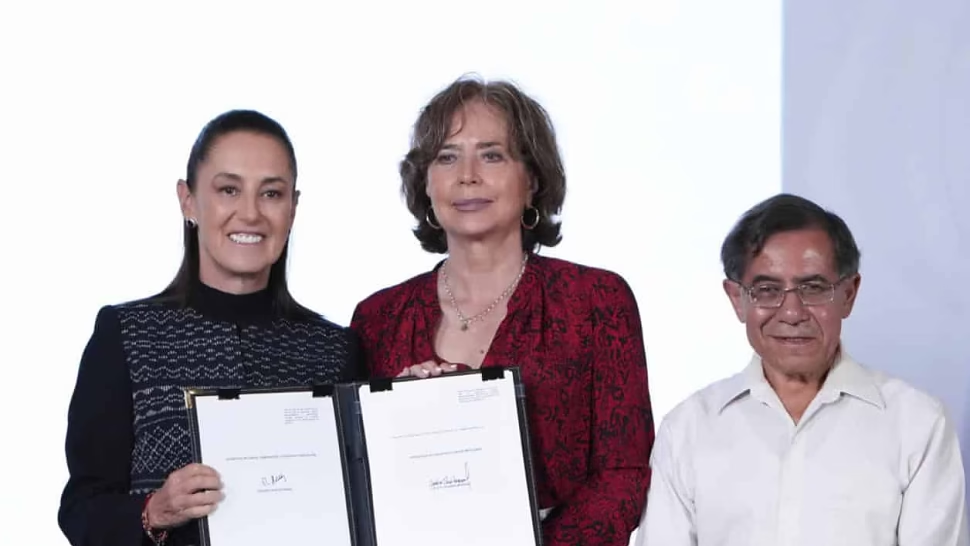
President Claudia Sheinbaum signed the decree that transfers the National Institute of Historical Studies of the Revolutions of Mexico (INEHRM) to the Secretariat of Science, Humanities, Technology and Innovation (SECIHTI). The institute becomes a decentralized public body with an academic focus.

Rosaura Ruiz Gutiérrez, head of SECIHTI, explained that the new scheme will train specialists in history to strengthen national capacities in social sciences and humanities.

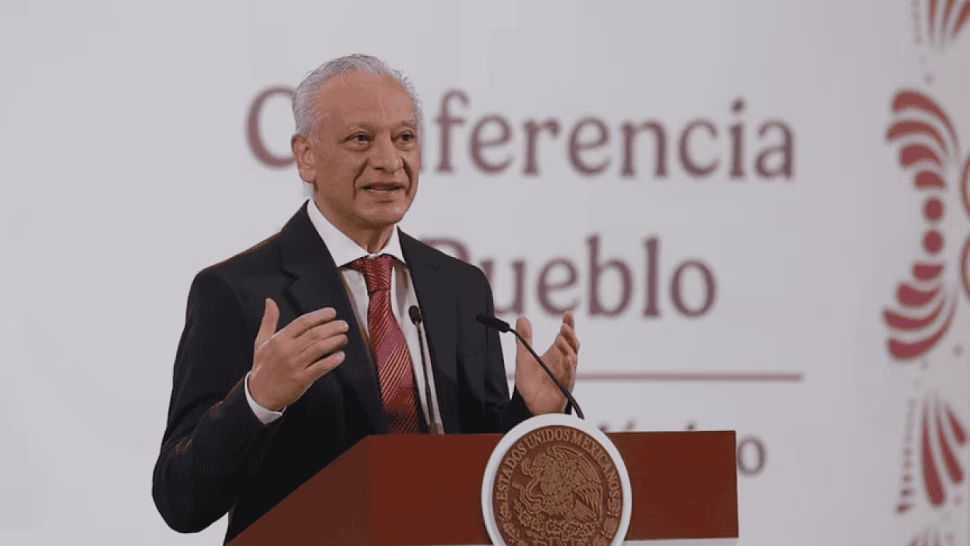
Felipe Arturo Ávila Espinosa, director of the INEHRM, explained that the study plans will link historical knowledge with social, economic, political and cultural problems of the country, and will address the needs of the Federal Public Administration.

Hybrid educational offer

The offer will include bachelor’s degrees in History, Social Sciences and Humanities, and Public Administration and Good Government. In postgraduate studies, master’s degrees will be added in Mexican Humanism, Gender and Feminism Studies, and Social Movements and Rescue of Historical Memory. There will also be specialties in Political Communication and History Teaching.

Graduates will cover topics such as agrarianism, health, migration, artificial intelligence, violence and human rights.

Headquarters and call

The new headquarters will be at 80 Guatemala Street, Historic Center of Mexico City. The first admission call will be launched in July, and classes will begin in September.

Continue reading

Prosecutor’s Office grants protection measures to victim of family violence

The Morelos Prosecutor's Office issued protection measures after a complaint of family violence against the former director of Pemex.

The Morelos Attorney General’s Office activated protection measures in favor of Felicia Jiménez Lavie, who filed a complaint for family violence against her husband, Víctor Rodríguez Padilla, former director of Pemex. This was reported by prosecutor Fernando Blumenkron Escobar.

The measures, the official explained, will be available when the victim requires them. The complaint was filed in Mexico City and the Women’s Secretariat of the Government of Mexico directly follows up on the case.

Investigation in progress

Until now, Jiménez Lavie has not gone to the local Public Ministry to contribute more elements to the investigation folder. This was initiated ex officio last Friday, June 26, after a video was broadcast with images of attacks against the woman.

Blumenkron assured that the portfolio continues its integration. “The proceedings have not stopped and we are going to continue to guarantee justice for the victim,” he said. In addition, he indicated that there is coordination with the Women’s Secretariat and the capital’s Prosecutor’s Office, under the care route for victims of family violence.

Among the actions carried out, the Morelos Prosecutor’s Office seeks to locate the address where the physical assault occurred, to carry out expert reports in accordance with the images of the video broadcast by the victim herself.

Continue reading

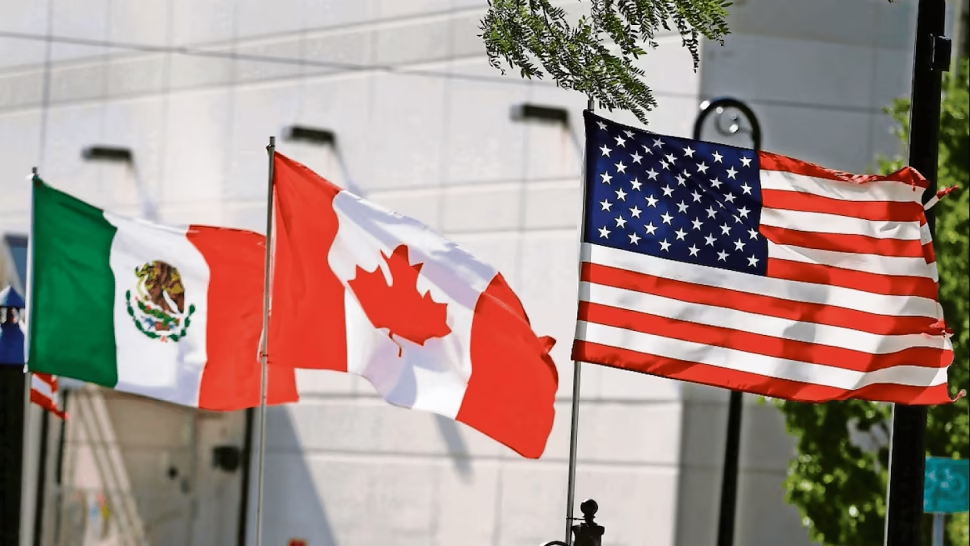
Trump does not extend T-MEC: Mexico faces annual review

US rejects automatic extension of the T-MEC; validity is reduced to 10 years with annual review.

Rejection of automatic extension

The United States decided not to automatically renew the Treaty between Mexico, the United States and Canada (T-MEC) for 16 years. This reduces its validity to a decade with an annual review. The measure generated concern among Mexican legislators.

Ricardo Monreal, coordinator of Morena in San Lázaro, explained that the treaty remains in force for another 10 years, but subject to evaluation each year. He noted that the United States presented 54 observations, including issues such as the vaquita porpoise and piracy. Mexico, for its part, raised 13 points, including clause 232 on tariffs.

“Only it will be reviewed year after year, but the Treaty is not finished, it continues for another 10 years because that is how it was signed six years ago,” declared Monreal.

The legislator warned that Donald Trump has been a constant critic of the USMCA and called for considering the benefits it has brought to the three nations.

Reactions of the opposition

Héctor Saúl Téllez, vice economic coordinator of the PAN, considered that the US position shows a lack of strategic anticipation on the part of the federal government.

“The US decision not to automatically extend the USMCA for 16 years in today’s review is not the end of the treaty, but it does reveal a lack of strategic anticipation by the federal government,” he stated.

Téllez recalled that Article 34.7 of the agreement had been known since 2018. Reaching July 1 without a clean extension represents a risk that, he said, should have been avoided.

The annual review will allow adjustments, but uncertainty about the future of regional trade persists. Mexico and Canada will seek to maintain the stability of the agreement for the next ten years.

Continue reading