The ban on vaping funds organized crime

The fight against vaping enriches cartels and creates a paradise for smuggling, according to international analysis.

The genie (with the smell of tutti-frutti) that came out of the bottle

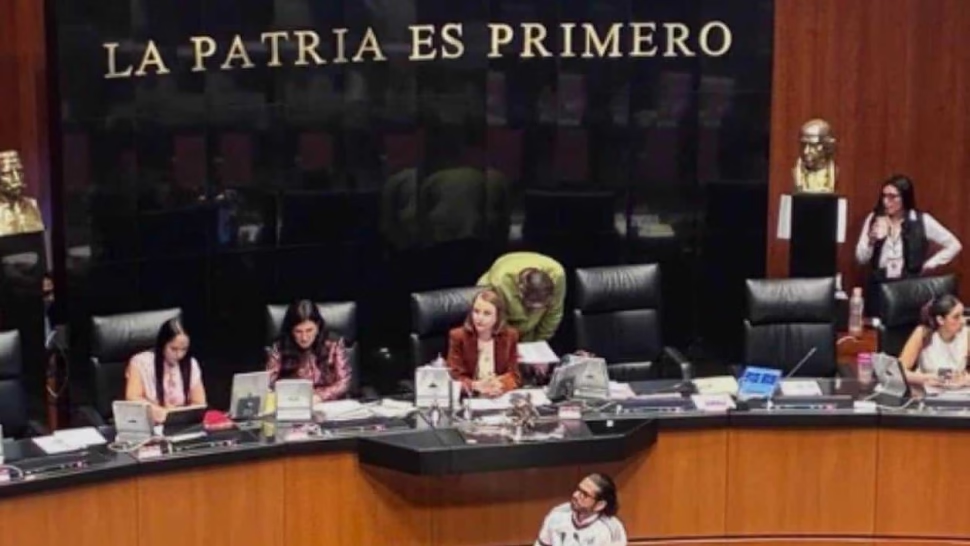
In a twist that absolutely no one could foresee (a lie, we all saw it coming), the PRI bench in the Senate has raised its voice to point out the obvious: the brilliant ban of vapers orchestrated by then-president López Obrador has achieved an unprecedented achievement. No, not saving youth from artificial aromas, but handing over the market for that product to the loving hands of organized crime. That’s right, while you’re wondering how your 15-year-old neighbor still gets his mango and chili vape, the answer is simple: it’s now a matter of national security, with drug trafficking logistics and zero health controls. Because nothing says “public health” like buying an electronic device from the same organization that diversifies its portfolio between fentanyl and avocados.

Hugs, not bullets… but with cotton candy steam

In a legislative analysis that was surely written between sighs of “we told you so”, the senators highlight the poetic coincidence between this reform and the policy of “hugs and not bullets”. Apparently, the strategy not only applies to people, but also to illicit goods. The Mexican constitutional prohibition has become, according to “USA Today”, a manual of best practices for smuggling. The result? The cartels, those eternal entrepreneurs, have found a lucrative opportunity more diversified than an influencer. The consequences, in case anyone is wondering, are economic, fiscal and social, but hey, at least the government can boast that it “did something” against vaping, even if that “something” smells suspiciously like untaxed money and unsecured devices.

Journalist Mark Esper—no relation to the frustrated desires of consumers—exposes the harsh reality: prohibition is basically an economic stimulus program for drug traffickers. Forcing citizens to purchase their electronic devices through the distribution networks of cartels is like opening an Amazon Prime branch managed by Chapo Guzmán. “Mexico cannot combat these criminal organizations with one hand and, at the same time, facilitate their financing with the other. It makes no sense,” maintains the author. A reflection so logical that it hurts, like hitting your little toe on the corner of a table.

The distorted economy, or how to create a smoke monster

To top off the move, it is added that cartels survive by exploiting legal loopholes and economic distortions, often created by the governments themselves. Wow, what a surprise. It’s almost as if well-intentioned but poorly designed policies have unintended consequences. “When the laws and policies of our southern neighbors create black markets, cartels fill that void,” they noted. In other words, if you build a stadium, they run the game. It is almost offensively simple.

To make the panorama more international and ridiculous, Chad Wolf, former acting Secretary of Homeland Security of the United States, declared that Mexico must eliminate these absurd prohibitions to standardize regulations with its T-MEC partners and close spaces for organized crime. In other words: “neighbor, please stop complicating life.” Wolf warned in the Houston Chronicle that, as long as these inconsistent policies exist, the cartels will continue to diversify their illicit activities. So now you know: that piña colada vape could be funding the next big innovation in… soda traffic? Criminal diversification knows no limits.

In summary, we have a prohibition that instead of protecting, harms; that instead of collecting, evades; and that instead of controlling, it gives control to those who should least have it. A masterpiece of political irony, served with a touch of smoke… of dubious origin.

Are you surprised how a policy can have such predictably disastrous consequences? Share this gem of legislative irony on your social networks and help more people see the smoke… behind the smoke. Explore more analysis on the policies that fuel the informal economy on our site.

High-impact crimes have fallen 53% since 2018, the Government reports

Official report attributes the reduction to the participation of the Armed Forces in public security.

Key figures

The Government of Mexico reported a 53% drop in the daily average of high-impact crimes since 2018. The figure went from 969.4 to 455.8 cases per day, according to the Seventh Semiannual Report of the Permanent Armed Forces in Tasks to Support Public Security.

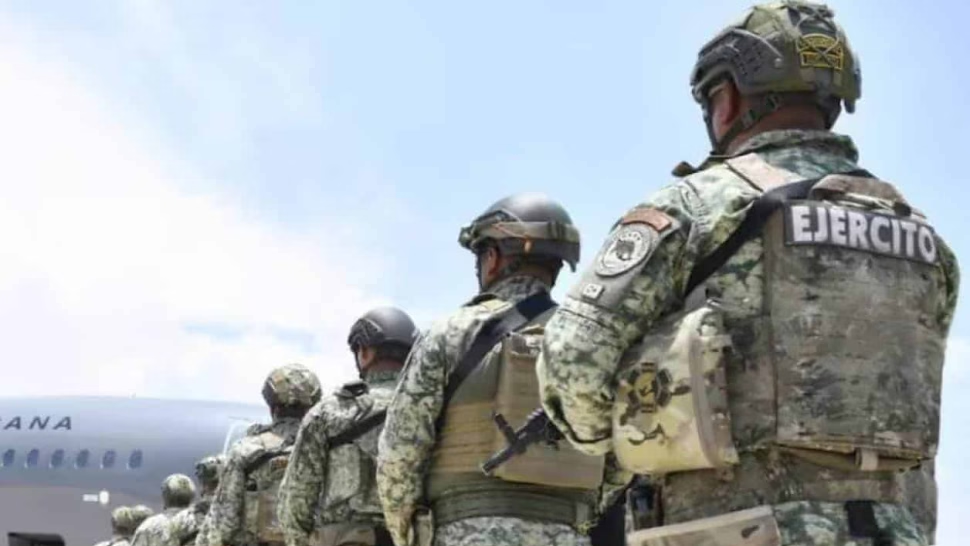
The document, delivered to the Permanent Commission, highlights the intervention of the Army, the Air Force and the Navy as a central factor. The data also shows a 40% reduction in victims of intentional homicide between September 2024 and April 2026: from almost 83 to 49 per day.

During the first four months of 2026, compared to the same period in 2025, feminicide, extortion, kidnapping for ransom, intentional injuries with a firearm, robberies with violence and robbery of a carrier decreased. Vehicle theft fell 56.5% compared to 2018.

Military deployment

The Secretariat of National Defense deployed 45,247 troops between November 2025 and May 2026 in entities with a high incidence of homicides and violence. More than two thousand soldiers were sent to Jalisco after the arrest and death of Nemesio Oseguera Cervantes, alias “El Mencho.” Operations were also reinforced on the northern border and in Michoacán.

The Mexican Navy expanded its presence with 3,742 elements in 18 states for surveillance and crime prevention. In addition, it allocated more than 2,000 troops to protect 218 strategic facilities in the energy and financial sectors.

In 2026, National Defense had a budget of 170,753 million pesos; 28,867 million were allocated to public security. The Secretary of the Navy received more than 3,477 million pesos for support tasks.

The federal government assured that military action is maintained under constitutional principles: extraordinary, regulated, supervised, subordinate and complementary to civil authorities, with respect for human rights. The report concludes that the participation of the Armed Forces will continue as the central axis of the national security strategy.

Continue reading

Laura Itzel Castillo confirms that the former director of Pemex was her advisor

The president of the Senate recognized a working relationship with the former director of Pemex accused of violence.

The employment relationship

The president of the Senate Board of Directors, Laura Itzel Castillo, confirmed that Víctor Rodríguez Padilla, former director of Petróleos Mexicanos (Pemex), worked as her advisor when she was part of the company’s board. Rodríguez Padilla is accused of an alleged case of domestic violence.

In an interview, the legislator assured that she was unaware of the conduct attributed to her. “We see faces, we do not know hearts,” he said. He also stressed that anyone who commits violence against a woman must face the corresponding legal consequences.

Castillo stressed that there is nothing to hide about his professional relationship within Pemex. In addition, she highlighted that the government maintains a feminist agenda to combat all forms of violence—physical, sexual, economic and patrimonial—and called to denounce these events.

Finally, he recognized the academic career of the former director: “He has a doctorate and specialization in oil issues. During his performance he fulfilled his responsibilities.”

Continue reading

Permanent Commission pays tribute to victims of celebrations

Congress remains silent for four deaths in celebrations for the victory of the Mexican National Team.

Tribute in Congress

The Permanent Commission of the Congress of the Union dedicated a minute of silence to the four people who lost their lives during the celebrations for the victory of the Mexican men’s soccer team in Mexico City.

Laura Itzel Castillo, president of the Board of Directors, informed the plenary session that the capital’s Health Secretariat confirmed the death of two women, ages 19 and 48, as well as two men, ages 30 and 44. The events occurred in the surroundings of Paseo de la Reforma.

During the session, it was recalled that the Government of Mexico City, headed by Clara Brugada Molina, offered institutional support to the families of the victims and accompaniment in the corresponding processes.

The legislator asked the members to stand up for the posthumous tribute. He expressed condolences to the bereaved and wished them quick resignation in the face of the loss.

At the end, Castillo also congratulated the Mexican team for its performance in the 2026 FIFA World Cup and wished them success in the upcoming matches of the tournament.

Continue reading