Textbook reform postponed until 2027

The changes in free textbooks will wait until the 2027-2028 cycle, confirmed the SEP.

The great educational change will have to wait

Here’s some news that will make many parents and teachers take a deep breath… and not exactly with relief. The promised renewal of free textbooks will not come soon. In fact, we will have to wait until the 2027-2028 school year to see it materialize.

Angélica Noemí Juárez Pérez, the Undersecretary of Basic Education, confirmed it with a logic as cold as it was forceful: the books for the next cycle are already in the printing press. Modifying them now would be logistical chaos.

“Delaying production would mean not guaranteeing that the books will be available at the beginning of the next school year,” warned Juárez Pérez during the morning conference. He directly described it as “unacceptable” for the system.

And what will change when it finally arrives?

The SEP has not been with its hands crossed. Throughout 2025 they collected opinions from teachers, specialists and, crucially, the students themselves from preschool to secondary school. The idea was to listen to those who use these books every day.

RelatedTextbooks will change to include women and indigenous languages

The result is a list of adjustments ranging from language and images to the pedagogical content itself. It will start with primary and preschool, adapting everything to the real age of the children.

It is as if a great theater announced a new work, but they tell us that the premiere is in two years. The set design, the script, everything is under review… but the curtain won’t rise anytime soon. In the meantime, classrooms will continue to operate with current material.

The question that remains is simple: will it be worth the wait? The Mexican educational system is betting that yes.
Perception of insecurity drops to 59.8%: Sheinbaum

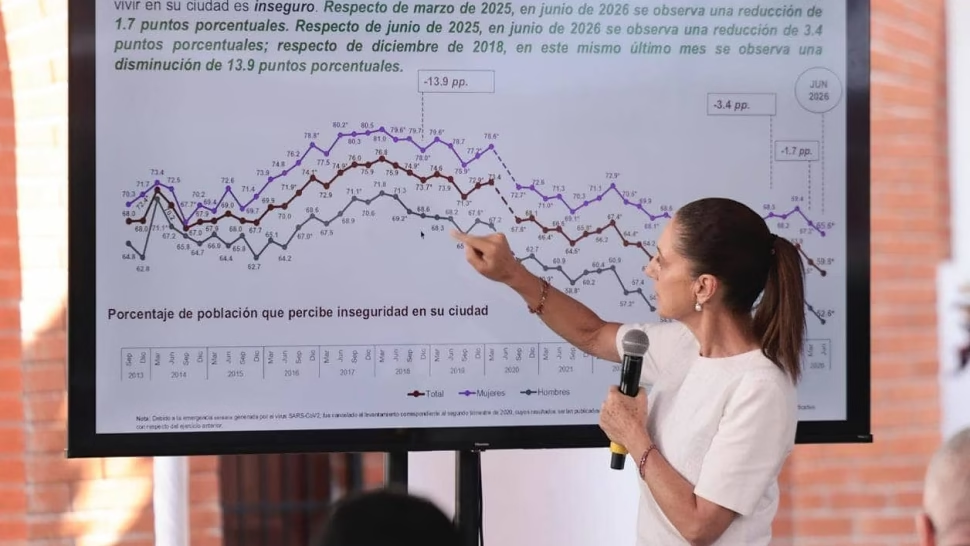
Perception of insecurity in Mexico drops to 59.8%, the lowest figure since 2018.

ENSU results

President Claudia Sheinbaum reported that the perception of insecurity in urban areas fell to 59.8% in June 2026, according to the National Urban Public Security Survey (ENSU) of the INEGI. In December 2025 it was 63.8%, which represents six consecutive months of decline.

“The important thing here is that we are giving results in the security indicators and people are beginning to notice this decrease,” he said during the morning conference in Cuernavaca, Morelos.

Historical comparison

Sheinbaum recalled that in December 2018, under the government of Andrés Manuel López Obrador, the perception of insecurity was 73.7%. The previous lowest point was reached in September 2024 at 58.6%. The president attributed the improvement to the National Security Strategy.

The ENSU measures citizens’ feeling of insecurity in their environment. Recent data reflects a positive trend, although the challenge remains to maintain the reduction in crime. The authorities continue to implement actions to consolidate these results.

Continue reading

Sheinbaum delivers 43 homes in Morelos through the Housing Plan

President delivers homes, settlements and deeds in Xoxocotla, Morelos.

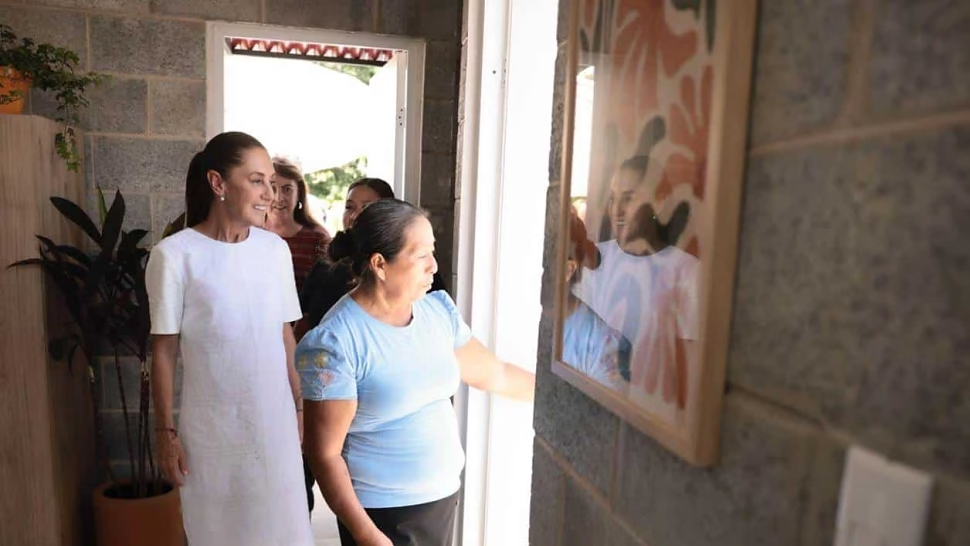
President Claudia Sheinbaum led in Xoxocotla, Morelos, the delivery of 43 new homes from Conavi, 348 settlement certificates from Fovissste and 79 deeds from INSUS. It’s all part of the Housing for Wellbeing Program.

“Previous governments took from the people, we increased the minimum wage, we are providing homes with accessible loans and we are removing debt from families,” said the president.

“Those from before governed for a few, the governments of the Transformation govern by the people and for the people of Mexico,” he added.

Plan details

Sheinbaum recalled that the program contemplates the construction of 1.8 million new homes in the country; the forgiveness and restructuring of unpayable loans for 5 million families; and the delivery of one million deeds to guarantee legal certainty.

The homes are aimed at people with incomes of one to two minimum wages. The land for new houses is already available throughout the national territory.

The Secretary of Agrarian Development, Edna Elena Vega Rangel, explained that in Morelos the goal was expanded from 10 thousand to 24 thousand new homes. Of these, 3,893 are already hired. In addition, 8 thousand families will receive deeds and more than 35 thousand will improve unpayable loans. Nationally, the program will benefit more than 10 million families.

The director of Conavi, Rodrigo Chávez Contreras, reported that of the 500 thousand homes under his charge there are already 320 projects to build 150 thousand houses. Of them, 75 thousand have already been assigned in 119 municipalities. In Morelos, 2,000 homes are being built in seven municipalities; 90 of them for Xoxocotla, of which 43 were delivered today.

Governor Margarita González Saravia thanked the president and confirmed that the state already has land for the 24 thousand houses in eleven municipalities.

One beneficiary, Araceli Pacheco López, thanked the delivery of her home, which she described as “very nice.”

Continue reading

US Commander meets with Sedena and Semar in Veracruz

Senior military commanders of Mexico and the United States review joint strategies against organized crime.

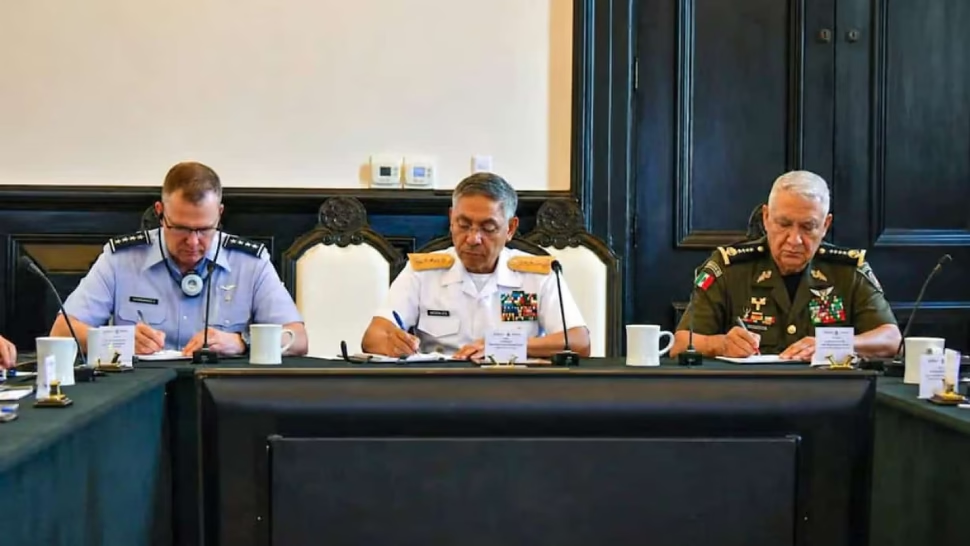
The commander of the United States Northern Command, General Greg Guillot, visited Mexico to meet with senior officials from the Secretariat of National Defense (Sedena) and the Secretariat of the Navy (Semar). The meetings occurred on July 22 in Veracruz.

Bilateral security cooperation

Guillot met with the head of the Sedena, General Ricardo Trevilla, and with the Secretary of the Navy, Admiral Raymundo Pedro Morales. The US embassy described the meetings as progress in the defense relationship between both countries.

Among the topics addressed are specialized training in special operations and against organized crime, the exchange of information, and cooperation to counter unmanned aerial systems. The North American Maritime Security Initiative was also reviewed.

“The security of North America depends on the strength of its alliances and the ability of its members to act with common objectives,” said General Guillot.

Both nations reiterated their commitment to expanding cooperation, respecting sovereignty, territorial integrity and shared responsibility for security.

Continue reading