Sterile flies are released to eradicate livestock pests in Chihuahua

They release 2.5 million sterile flies against the screwworm in Chihuahua.

The Ministry of Agriculture and Rural Development (Sader) announced the release of the first batch of 2.5 million sterile cattle screwworm flies in southern Chihuahua. The insects were produced at the Metapa de Domínguez plant, Chiapas, as part of the federal strategy to eradicate this pest that mainly affects cattle.

Production and dispersion

The National Agri-Food Health, Safety and Quality Service (Senasica) completed the first cycle of production and sterilization of pupae on July 24. These were shipped to Tampico and then transferred to Chihuahua. The flies were placed in terrestrial dispersion chambers in the municipality of Coronado.

RelatedMexico imports 24 tons of flies to combat livestock plague

To differentiate sterile insects from wild ones, the pupae are stained with green dye. When opened, the dye impregnates the adult fly, facilitating its identification in the field.

“This action represents a milestone because it is the first cycle of flies produced and sterilized in Mexico since 2012,” said Javier Calderón Elizalde, chief director of Senasica.

Calderón supervised the final works of the batch at the Chiapas plant, which began operations in the last week of June. He noted that production will be gradual and uninterrupted, with the goal of reaching 100 million insects by the end of the year.

Benefits for livestock

The official recognized the efforts of producers and society to agree on solutions that benefit Mexican livestock. The eradication of the screwworm reduces economic losses and improves animal health in the country’s livestock regions.


Sheinbaum announces automation and more surveillance in customs

The president announced 1,200 hires and more hours of operation in customs.

Customs automation and contracting

President Claudia Sheinbaum reported that automation and non-intrusive review are being promoted in all customs in the country. During his morning conference at the National Palace, he detailed that more than 1,200 young people were hired to extend the operating hours of some points.

“We strengthened the surveillance center in Querétaro with cameras; the Digital Agency helped us in data processing and streamlining procedures,” he explained.

Data on crossings and technology

Sheinbaum pointed out that previously, due to lack of personnel, several customs offices were open only eight hours a day, which generated long lines. Now the main ones operate longer. José Antonio Peña Merino, head of the Digital Transformation Agency, indicated that at the intersections of Sonora and Baja California an increase in red traffic lights is not reported, but rather greater precision in the detection models.

“X-ray equipment is installed for non-intrusive inspection, especially in cargo. This allows the Customs Monitoring Center to detect anomalies with greater accuracy,” he added.

In Baja California, there are 135,000 daily crossings of private vehicles and between 2,200 and 5,100 of cargo, depending on the season. In Sonora, daily crossings are 25,000 for individuals and 1,200 to 2,600 for cargo.

Continue reading

Public consultation on radio and TV audience rights

Federal government opens consultation on radio and TV audience rights.

The Government of Mexico launched a public consultation to define the guidelines that will guarantee the rights of audiences on radio and television. The period for receiving observations will go from July 27 to August 21. Citizens, concessionaires, academics and civil organizations may participate.

The legal advisor to the Presidency, Luisa María Alcalde Luján, explained that the guidelines recover constitutional provisions from 2013 and are aligned with the new Telecommunications Law. He recalled that in 2017 several rights were eliminated, but the SCJN invalidated that setback.

“With the new law, the rights of audiences are recovered and strengthened,” said the Mayor.

What rights are protected?

The document establishes that the public has the right to receive truthful information, distinguish between news and opinion, separate advertising from editorial content, exercise the right of reply and access content accessible to people with disabilities.

Broadcasters must develop a code of ethics with editorial criteria and complaint mechanisms. They will also appoint a defender of the hearings, with impartiality and transparency. Complaints will be resolved within 20 days. If irregularities are detected, the matter may reach the IFT and lead to sanctions.

President Claudia Sheinbaum stressed that public consultation will enrich the regulation. He clarified that for now it only applies to radio and TV concessionaires, not to written press or digital platforms, although he did not rule out analyzing its future inclusion.

“The written press is not incorporated… it would have to be reviewed if necessary, or the platforms, which are topics under discussion,” Sheinbaum said.

Continue reading

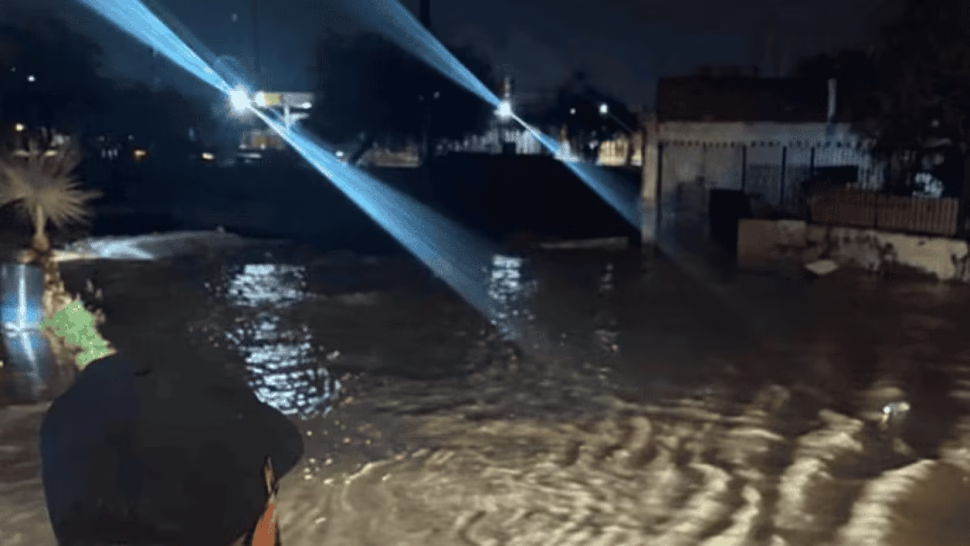
Storm in Hermosillo: damage and rescue of a minor

Strong storm in Hermosillo causes flooding, falling trees and the rescue of a minor dragged by a stream.

Storm hits Hermosillo with winds of 81 km/h

The intense storm recorded on the night of Monday, July 27, left multiple effects in Hermosillo. The wind gusts, up to 81.3 kilometers per hour, broke windows at the San Ángel hotel and knocked down advertisements from a gas station. Trees, cables and poles also fell on different roads.

Dozens of cars were stranded due to severe flooding. Lightning struck a palm tree and caused a fire, controlled by emergency teams.

Rescue of a minor in the south of the city

The moment of greatest tension occurred in the Peredas Invasion, south of Hermosillo. A child was swept away by the current of a stream while emergency services responded to another report. Francisco Matty Ortega, head of the Hermosillo Fire Department, explained:

“The incident occurred while we were responding to a report of a vehicle dragged through a nearby canal. The minor was rescued by local youth and later transferred by the Municipal Police for medical evaluation for blows suffered.”

The City Council reported 27 incidents until 8:30 p.m.: eight downed cables, six risky traffic conditions or stranded vehicles, five trees downed or at risk, four short circuits, two downed poles, a fire and a spectacular collapse.

Intense rains in Sonora

The State Coordination of Civil Protection reported that Hermosillo concentrated the largest number of reports in the state. The heaviest rainfall occurred in Ures (75 mm), Bacanora (65 mm), Huépac (52 mm) and San Javier (50 mm). Until 9:00 p.m., no deaths or injuries were reported, nor were there any flooding in homes, landslides or road closures. The authorities reiterated the call not to cross streams and to report emergencies to 9-1-1.

Continue reading