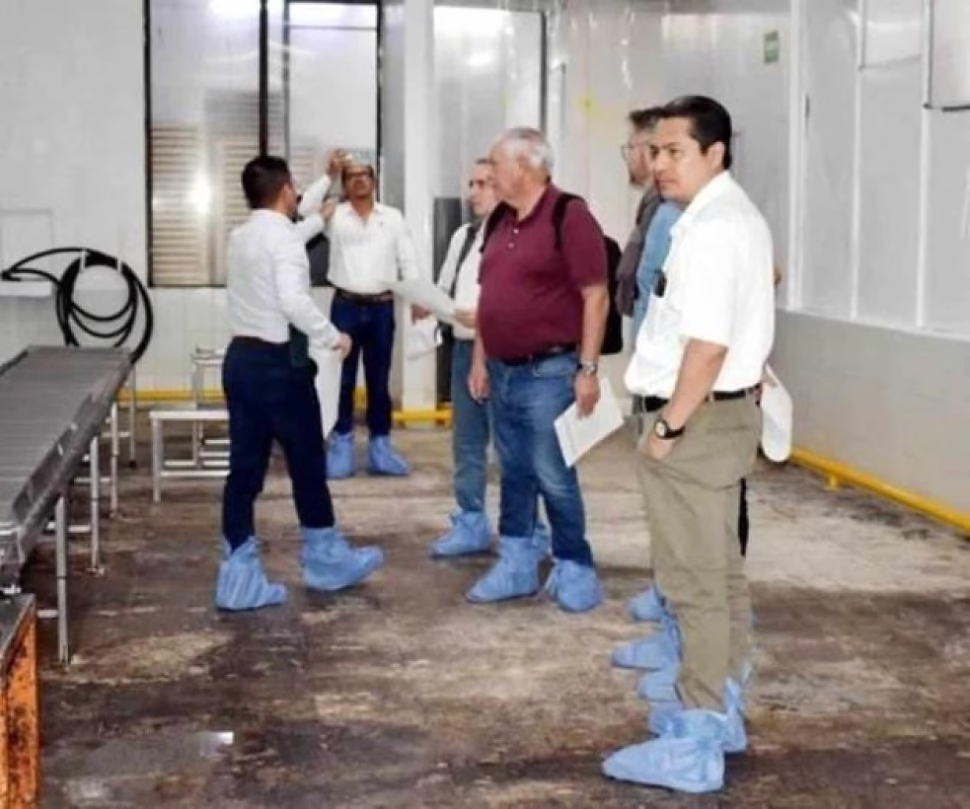
Mexico validates sterile fly plant to combat livestock plague

International experts evaluate strategies to stop the expansion of a livestock pest with pioneering technology.

International validation for an innovative strategy

The historic Moscamed plant, located in Metapa de Domínguez, Chiapas, has been validated by the Food and Agriculture Organization of the United Nations (FAO) as a strategic center for the production of sterile flies intended to combat the livestock screwworm (GBG). This decision marks a milestone in the fight against one of the most devastating pests for the livestock industry in America. The Government of Mexico highlighted that the infrastructure, operational since 1979, has specialized equipment, including a rechargeable irradiator, which will facilitate its adaptation to the new function.

Investment and transnational collaboration

The United States Department of Agriculture (USDA) announced an investment of 21 million dollars to modernize the plant, with the goal of producing 100 million sterile insects weekly. The visit of international experts, including Frédéric Poudevigne from the FAO and representatives from the International Atomic Energy Organization (IAEA), underlines the urgency of analyzing the rapid advance of GBG from Central America to Mexico in less than two years. It was proposed to evaluate more effective wild strains if the current one shows signs of unadaptability.

RelatedMexico and the US build a sterile fly plant to control livestock pests

The technique of releasing sterile males, tested against the Mediterranean fly in this same plant, reduces the reproduction of the pest by crossing infertile specimens with wild females. However, the temporary closure of US borders to Mexican livestock – in effect since May 11 – reflects the seriousness of the problem and the need for immediate solutions.

Historical context and future challenges

Founded in 1979, Moscamed operated for four decades in the sterilization of fruit flies, demonstrating the viability of this method. Its reconversion for the GBG faces challenges such as the selection of optimal strains and coordination with affected countries. Brazil, represented by Jorge Caetano Junior, actively participates in the project, evidencing the regional scope of the initiative.

According to the Secretary of Agriculture and Rural Development (Sader), this approach not only protects livestock production—which contributes 1.7% of the national GDP—but also avoids million-dollar losses due to quarantines. The USDA will reevaluate the import restriction every 30 days, putting pressure on Mexico to demonstrate tangible results.

Economic and scientific impact

The GBG plague, native to the Caribbean, affects cattle, pigs and even humans, with larvae that devour living tissues. Its control through sterilization reduces the use of pesticides, aligning with sustainability goals. The 21 million dollars invested by the US reflect confidence in this technology, although experts insist on monitoring its long-term effectiveness.

Are you interested in learning more about agricultural innovations? Share this article and discover how science transforms the fight against pests. #SustainableAgriculture#Innovation


AICM taxi drivers refuse to apply discounts agreed for the World Cup

Three AICM taxi drivers groups refuse to apply discounts of up to 18% during the World Cup.

Three groups of taxi drivers that operate at the Mexico City International Airport (AICM) refused to apply discounts of up to 18% on their rates during the World Cup. The measure contradicts previous agreements announced by airport authorities and part of the union.

The companies Nueva Imagen, Porto Taxi and Sitio 300 issued a statement to clarify their position. They argued that they have no contractual relationship with the Grupo Aeroportuario Marina (GAM), the entity that promoted the benefits for airport users.

According to permit holders, the announced discounts do not represent a direct reduction in rates. They are, they say, adjustments derived from compensation for improper charges and administrative processes for maintenance work at the AICM.

They demand transparency

The taxi drivers asked the AICM authorities to make public the documents that support these measures. They also called on the GAM to make transparent the minutes and contracts where the application of discounts had been agreed upon. They questioned the legal validity of the obligations attributed to them.

The refusal could affect users who expected more affordable rates during the sporting event. Until now, there is no certainty about the real cost of service at the AICM during the World Cup.

Continue reading

Morena opens the door to a coalition with the PVEM in San Luis Potosí

Morena conditions alliance on PVEM ruling out Ruth González for the governorship.

Morena-PVEM Coalition for 2027?

The state leadership of Morena in San Luis Potosí left open the possibility of an alliance with the Green Ecologist Party (PVEM) for the local elections of 2027. The condition: that the PVEM present a different profile from that of Senator Ruth González.

Rita Ozalia Rodríguez Velázquez, state president of Morena, explained that if the PVEM discards Ruth González—wife of Governor Ricardo Gallardo—the green party could lead the coalition, which would also integrate the Labor Party (PT).

The leader clarified that the relationship with the PVEM at the local level does not face a conflict, although she admitted that there is no direct communication between both state leaders. Decisions about alliances, he said, are made by national leaders.

The possible agreement arises in the midst of the debate about nepotism, after Ruth González’s intention to succeed her husband in the state government was questioned. Morena looks for profiles that avoid that controversy.

Rodríguez Velázquez stressed that there is coordination between the party leadership to define the electoral strategy. For now, the panorama in San Luis Potosí remains open.

Continue reading

Morena accuses INE advisors of being ‘ill-wishers’

The Morena leader accuses INE advisors of being 'ill-wishers' and defends her affiliation system.

Morena questions the impartiality of the INE

The national leader of Morena, Ariadna Montiel Reyes, pointed out that within the INE there are advisors with critical positions towards her party. He described them as “Morena haters” during a press conference where he addressed recent resolutions on duplicate affiliations.

Montiel affirmed that his party abides by the determinations of the Electoral Court. The authority ordered the elimination of more than 93 thousand affiliate records and leave under review about 19 thousand cases that the INE must verify.

The leader demanded that the institute adhere to the resolutions of the General Council and not to individual opinions. He accused that there are figures close to past electoral administrations who maintain a critical stance towards the movement.

Regarding the affiliation system, Montiel defended that Morena’s application is efficient. He assured that it surpasses that of the INE in functionality, since it allows duplications in the records to be detected.

He also proposed that the INE should have real-time verification mechanisms to cross-check affiliation data. However, he acknowledged that there are different processes between parties and the electoral authority.

Continue reading