STE tenders 18 new trolleybuses for strategic route in CDMX

CDMX is advancing a key sustainable transportation project with a million-dollar investment to connect strategic points in the capital.

Acquisition of units and details of the new route

The Electric Transport Service (STE) of Mexico City has formally begun the acquisition process of 18 new trolleybus units. This public procurement procedure, published in the Official Gazette of the capital, aims to renew and expand the electric public transport fleet. The tendered units are simple type, with a standard length of 12 meters, and are specifically intended to operate on the so-called route 14. This line will constitute a vital connection corridor between University City, an academic and busy hub, and the Huipulco Modal Transfer Center (Cetram), a key multimodal node in the south of the city. The resolution of the bidding process is scheduled for December 23, setting the schedule for the next phase of implementation.

Investment, infrastructure and impact on metropolitan mobility

This mobility project is part of a comprehensive strategy to modernize the transportation system in the face of large-scale events, such as the 2026 World Cup. The Mobility Secretariat (Semovi) has detailed that the global investment for the launch of this route amounts to 635 million pesos. This amount is broken down into two main components: the acquisition of the electric vehicles and the construction of the necessary support infrastructure. The civil works, which include the installation of the catenary (aerial wiring) and road improvements, have been awarded to the national firm Elite Engineering, with a contract for 157 million pesos.

RelatedSamuel García announces 4,000 new transport units for November

The new line will have an extension of 13.2 kilometers and an estimated travel time of 33 minutes, which promises an efficient and predictable travel alternative for users. From a technical and urban planning perspective, the route will not only improve connectivity between two points of high demand, but will also serve as a sustainable transportation axis, reducing polluting emissions and vehicle congestion. Its operation will be crucial to absorb and effectively distribute the massive influx of visitors anticipated during the World Cup 2026, contributing to the resilience of the metropolis’s mobility system.

The decision to invest in trolleybus technology reinforces the commitment to a low-emission collective transportation model. Unlike other alternatives, trolleybuses offer the advantage of pure electric traction—zero local emissions—combined with the ability to operate on shared or dedicated lanes. The execution of this project demonstrates an analytical approach that prioritizes medium-capacity mobility solutions, complementary to the metro and metrobus, to optimize the public transportation network. The correct implementation of the infrastructure by the contracting company is a determining factor to guarantee the reliability, punctuality and safety of the service from its inauguration.

Do you think this commitment to electric transportation in the city is valuable?Share this news on your social networks to spread the word about sustainable mobility projects and explore more content related to urban transformation on our site.

Housing for Wellbeing boosts GDP by 1%, says Sheinbaum

Sheinbaum announces that the housing program contributes 1% to the GDP and will benefit 30 million.

Housing for Wellbeing and its economic impact

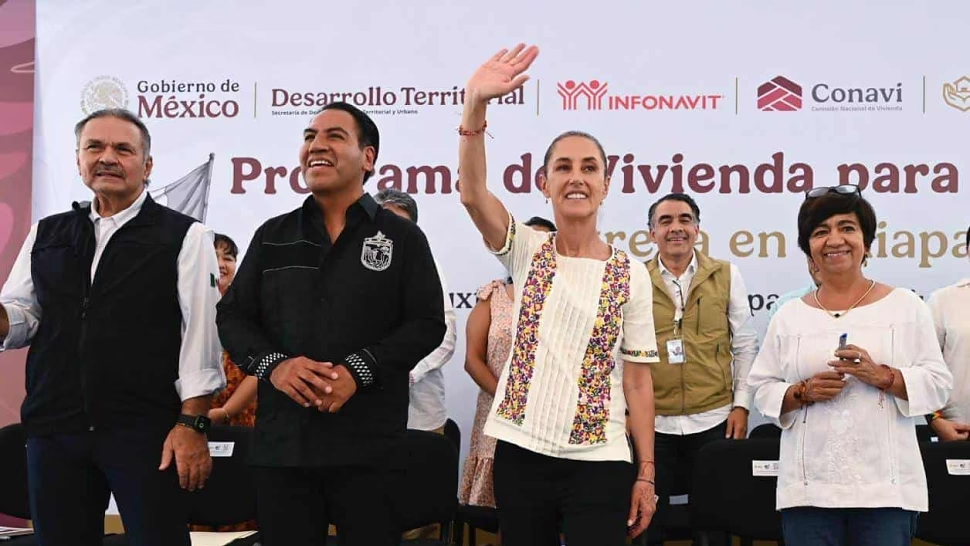
From Tuxtla Gutiérrez, Chiapas, President Claudia Sheinbaum highlighted that the Housing for Wellbeing program contributes about 1 percent to the national Gross Domestic Product (GDP). This, thanks to the jobs it generates in construction and related sectors.

“There is nothing happier that can make the President and her entire team than to see the joy on their faces for receiving a home today,” said Sheinbaum during the delivery of 48 homes in the Infonavit Lacantún development.

In addition, 401 settlement certificates from Fovissste and 503 deeds from Insus were delivered. The president stated that the program will benefit nearly 30 million people during her six-year term.

“Thanks to the Housing for Wellbeing program, it is contributing close to 1 percent of GDP to the country’s economic growth. And if we consider that each home employs at least 4 people, a very important number of jobs are being generated,” he pointed out.

Investment in Chiapas

The Secretary of Agrarian, Territorial and Urban Development, Edna Elena Vega Rangel, explained that in Chiapas 42 billion pesos are allocated to build 70 thousand new homes in the six-year period. Of these, 50 percent are already hired.

The general director of Infonavit, Octavio Romero Oropeza, reported that at the national level there are 420 housing complexes in 31 states, with 475 thousand homes. Of them, 190 thousand are already under construction, and 3,600 have been delivered. In Chiapas, Infonavit contemplates 34 thousand homes with an investment of more than 20 billion pesos.

Governor Eduardo Ramírez Aguilar thanked the President for the homes delivered, while the beneficiary Miguel Ángel Ramírez Trujillo expressed his gratitude for the future it represents for his family.

Continue reading

CRT foresees 85% of registered lines before staggered cuts

The CRT estimates that between 120 and 130 million cell phones will be registered before the progressive cut.

Mobile line registration: 85% will be linked before cuts

The Telecommunications Regulatory Commission (CRT) expects that between 120 and 130 million cell phones will be registered, which represents about 85% of the total active lines in the country.

Currently there are 144.6 million lines. Ricardo Castañeda Álvarez, general director of Regulatory Policy of the CRT, estimated that between 14 and 24 million will not be registered and will be deregistered as the process progresses.

The suspension process will begin on August 15. Lines ending in 0 will be deactivated first and then in stages until the end of the year, with the aim of avoiding technical saturations.

Castañeda explained that the extension was due to the risk that millions of users would not meet the original deadline, which would have generated operational complications similar to massive saturations in emergencies. He ruled out a new extension of the deadline.

He assured that the registry does not violate privacy because the information is managed by the operators. The main objective is to combat crimes such as extortion, fraud and virtual kidnappings.

Continue reading

They accuse the PAN of an irregular scheme in social support

Morena accuses the PAN of an alleged scheme to collect commissions on social programs.

Accusations for alleged diversion in social programs

Morena deputies in Mexico City accused PAN legislators of operating an irregular scheme through the sale and purchase of household products, supposedly disguised as a social support program in Tlalpan and Xochimilco.

According to the complaint, those involved acquired items such as water tanks, cisterns, solar heaters, washing machines, mattresses, laptops and screens through a civil association. They would then have resold them at higher prices to the inhabitants of those districts.

Morena spokesperson Paulo García stated that the mechanism included a triangulation of resources where the civil association paid commissions for each product delivered. In addition, legislators would have made profits between the purchase price and the resale price.

The Morenistas pointed out that the products carried names, photographs and partisan colors, which could constitute personalized promotion of public servants, prohibited by Article 134 of the Constitution outside of electoral campaigns.

The complainants announced that they will file complaints with the Electoral Institute of Mexico City so that the facts can be investigated.

For their part, PAN legislators denied the irregularities. They assured that these are operations between individuals through a foundation that sells products at low cost, without public resources.

The case has opened a debate about transparency and oversight of social programs in the capital’s mayors.

Continue reading