States with educational lag lead controversial teacher evaluation

The new educational results, where teachers rate their students, show a miraculous improvement that baffles specialists.

The educational miracle that no one believed in

In a turn of events as unexpected as finding a diamond in a mud, the states that traditionally occupied the last places in education – our beloved Oaxaca, Guerrero, Chiapas and Michoacán – have experienced a miraculous academic transformation. Overnight, and thanks to the brand new Integrative Learning Exercises (EIA), they have become the most diligent students in the class. The secret of this success? A revolutionary formula: that the teachers themselves evaluate their students. What could go wrong, right?

The Ministry of Public Education, in a burst of creativity worthy of an award, decided to replace the boring and objective diagnostic tests with this new system where the one who judges is also the one who teaches. Imagine a soccer match where each team scores its own goals and proclaims itself champion. Well, basically, that’s what EIAs are. The data, to which EL UNIVERSAL had access, reveal that Oaxaca and Chiapas are now powers in Languages, while Michoacán leads in Scientific Knowledge and Guerrero stands out in that ethereal thing called “Of the human and the community.” Because, of course, who better to evaluate ethics and community than a state with serious social conflicts?

RelatedAnalysis of the 2026 education budget reveals historic cuts

The experts, with their eyebrows raised

Faced with this panorama of self-inflicted excellence, education specialists, those professional killjoys, have not been able to contain their laughter (or tears). Erik Avilés, from the Michoacan Institute of Educational Sciences, pointed out with enviable delicacy that EIAs reflect a “subjective perception of learning.” Come on, it’s like asking a street artist if his work is the best in the world: the answer, dear reader, we know in advance.

But the award for the most caustic comment goes to Eduardo Backhoff, former president of the INEE, who suggested that this methodology is “prone to teaching laxity.” “Laxity” is a very fancy way of saying that teachers may be painting a much rosier picture of reality. Backhoff, with the patience of someone who has seen too much, recalled that historically these states have had the worst results in serious external evaluations such as PISA. And now they are the first? Come on, even the most optimistic student in the class would blush at such… improvement.

The conclusion among experts is unanimous: these results lack the slightest reliability and objectivity. The EIAs would be nothing more than an administrative screen, a brilliant exercise in statistical makeup designed to hide the harsh reality. It’s the educational equivalent of putting a new curtain on a house that’s falling apart: it looks pretty, but the structural problem is still there.

So now you know: if you want your children to be listed as geniuses in official records, make sure their teacher is also their evaluator. It’s the new magic formula for instant educational success. Because in the Mexico of the fourth transformation, meritocracy has been replaced by “self-qualificationocracy.”

Are you surprised by this creative interpretation of educational results? Share this note and help uncover the true level of learning in Mexico. Explore more related content on the quality of education in our national topics section.

Applicants demand in-person exam after complaints of irregularities

Not admitted applicants demand a new in-person exam after denouncing the use of AI in a virtual test.

Demonstration in CU due to alleged irregularities in virtual exam

Applicants not admitted to the first virtual UNAM bachelor’s entrance exam gathered at 11:00 a.m. in the vicinity of the Ciudad Universitaria Metro and Insurgentes Sur. They marched towards the Rectory Tower demanding the cancellation of the process and the completion of a new in-person test.

The protesters reported alleged irregularities in the online evaluation, such as the use of artificial intelligence to gain advantage. With slogans like “No to AI, yes to the solution!” and “Clean and transparent exam!”, asked the authorities to guarantee equal conditions.

Melanie Maya, 18, a Psychology applicant who failed by one hit, noted that many students prepared for months. He considered it unfair that those who used improper tools had an advantage. The young woman asked to regulate the use of AI in the exam and for UNAM to investigate and sanction those who engaged in dishonest practices.

The protesters reiterated their request that the exam be held in person again to ensure transparency and equity for all young people seeking to enter the highest educational institution.

Continue reading

New audio reveals Marina del Pilar’s visa procedures

Leaked audio shows the governor's efforts to recover her US visa.

A new audio of intercepted calls from the governor of Baja California, Marina del Pilar Ávila, was released by journalist Héctor de Mauleón. The recording reveals alleged approaches by the president to United States authorities to recover her visa, withdrawn last year without public cause.

Deals with former FBI agent

In the audio, Ávila points out that she hired Juan Sandoval, an alleged former FBI agent, and lawyer Michael Nadler to support her in the process. He sought to establish communication channels with Washington. According to De Mauleón, there are also WhatsApp messages between the governor and an intermediary who acted through American contacts. Ávila requested that the following meetings be only between his lawyers and representatives of the United States to avoid appearing to seek other negotiation mechanisms.

Opposition criticism

The revelations raised questions from the opposition about the scope of the approaches and the possible delivery of security information. Ávila maintains that their conversations were only intended to clarify his visa situation.

Accusations against Jaime Bonilla

The governor accused her predecessor, Jaime Bonilla, of being behind the intervention and dissemination of the calls. Bonilla rejected the accusations. The government of Claudia Sheinbaum has expressed support for Ávila in the face of the leaks, although new audios are expected that the president herself acknowledged could be disseminated.

Continue reading

Hurricane Genevieve reaches category 5 in the Pacific

The cyclone strengthens far from the coast but generates dangerous waves in southwest Mexico.

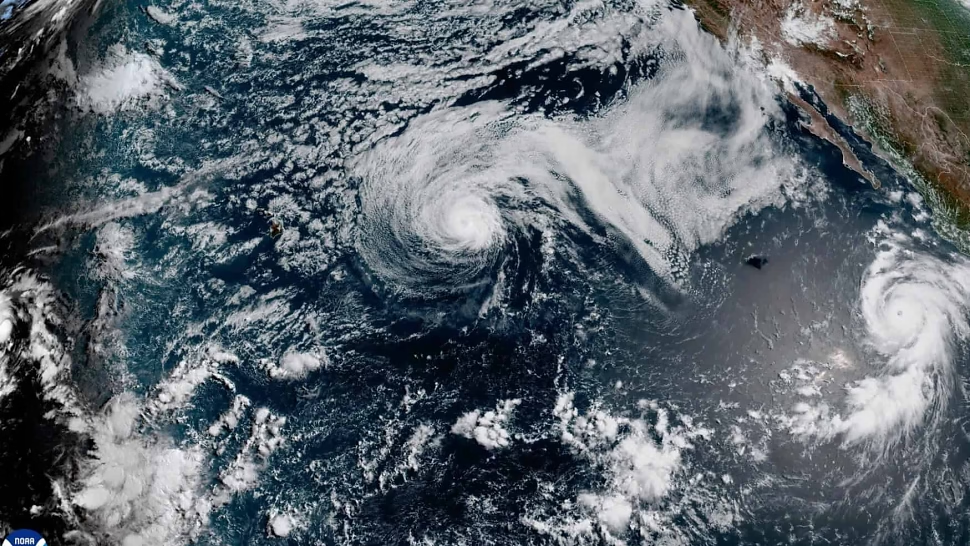
Genevieve and Fausto: two hurricanes in the Pacific

Hurricane Genevieve intensified into a Category 5 cyclone, the first of that magnitude to hit the eastern Pacific in two years. It is located 835 kilometers south-southwest of Baja California with sustained winds of 250 km/h. It advances towards the northwest, parallel to the Mexican coast, without touching land.

Despite the distance, authorities warn of high waves in southwest Mexico and the Baja California peninsula. There are no active coastal warnings, but the system is expected to fluctuate in intensity before weakening this week.

On the other hand, Hurricane Fausto is moving through the Pacific as a category 1, with winds of 130 km/h. Its trajectory points towards the Hawaiian archipelago, although forecasts indicate that it will pass north of the islands without touching land. However, waves and ocean currents are already intensifying along the eastern shores of Hawaii.

Specialists recommend that the population remain attentive to the evolution of both systems and follow civil protection instructions. Although they do not represent a direct threat to populated areas, their maritime effects can generate dangerous conditions for navigation and coastal activities.

Meteorological authorities maintain constant monitoring of Genevieve and Fausto.

Continue reading