Generation Z faces job insecurity and massive educational lag

A detailed analysis exposes how the lack of formal and educational opportunities is defining the economic future of millions of young people in the country.

A structural analysis of precariousness in generation Z

The demographic cohort known as generation Z, between 15 and 29 years of age, faces a socioeconomic reality characterized by a critical intersection between job instability and an insufficient educational level. The data, far from being anecdotal, reveal a systemic pattern. According to research conducted by the Youth Alliance with Decent Work, approximately 32% of individuals in this age range, which translates into 11 million young people, experience monetary poverty. At the same time, more than 10 million work in jobs considered precarious, establishing a direct correlation between informality and the inability to generate sufficient income.

Quantitative findings on employment and living conditions

The study titled “Young Opportunity in Generation Z” diagnoses a situation where new generations are unable to enter the formal labor market, access teleworking or build a professional career. The educational obstacle is fundamental: there is a generalized academic lag, with a significant proportion that does not complete upper secondary education. Of the 15.4 million young people of this generation who are already working, 60% (9.3 million) receive a salary below the poverty line, unable to afford two basic baskets. In addition, 9.4 million completely lack access to public health and social protection services, a direct consequence of labor informality. The contrast is evident when observing that only 3.4 million are employed in large or medium-sized corporations or in public administration.

RelatedJob insecurity affects 86% of agricultural workers in Mexico

The vicious circle between poverty and school dropouts

The analysis shows an early school dropout that becomes more pronounced after the age of 15. Almost half (49%) of young people of high school age (16 to 21 years) no longer attend any educational center. In a broader spectrum (15 to 29 years old), 27% present educational lag. Segmentation by age deepens the diagnosis: at age 28, only 27 out of every 100 young people completed a university degree. Three-quarters do not have higher education and nearly half did not finish high school. This condition is closely linked to socioeconomic level: while 91% of adolescents aged 15 to 17 in high-income homes remain in the educational system, only 56% of those in low-income homes do so, thus perpetuating a cycle of inequality of opportunities.

Strategic proposals for a comprehensive intervention

Faced with this scenario, the Youth Alliance with Decent Work proposes a set of public policy measures aimed at productive inclusion. The first line of action consists of revaluing and modernizing the technical baccalaureates under a dual training model, which combines academic instruction with practical experience, developing competencies aligned with the demands of the contemporary economic sector. For young people already in a situation of backwardness, flexible educational alternatives are proposed that integrate technical training, development of socio-emotional skills, empowerment and leadership.

Complementarily, it is suggested to implement a national first job strategy that guarantees safe training spaces and supervised work experience. Another key proposal is the expansion of public care services (child care centers, full-time schools, rehabilitation programs), which would free many young people, especially women, from domestic responsibilities and allow them to continue their training or seek employment. The culminating proposal is the guarantee of full compliance with fundamental labor rights, combating informality, poverty wages and the lack of stable contracts, to build a fairer and more protected youth labor market.

Are you interested in understanding how these challenges affect the country’s economic future? Share this analysis on your social networks to expand the conversation and explore more content on career and education trends on our platform.
They eliminate 1,711 procedures in the digitalization plan

Simplification program advances 60%; They seek to reduce corruption with technology.

Advance in simplification of procedures

Claudia Sheinbaum reported that the Procedures Simplification Program, run by the Digital Transformation and Telecommunications Agency (ATDT), has registered a progress of 60 percent. So far, 1,711 procedures have been eliminated and 3,497 have been simplified, with the goal of intervening 4,500 by 2026.

“Technology is there to make people’s lives easier and to avoid corruption,” said the president during the morning conference.

José Antonio Peña Merino, head of the ATDT, described this as the largest simplification in the country. Requirements were reduced from six to two on average. The gob.mx portal has been used by 56 million people, with two million weekly visits. The 24/7 window, a virtual assistant with AI, records almost two million interactions.

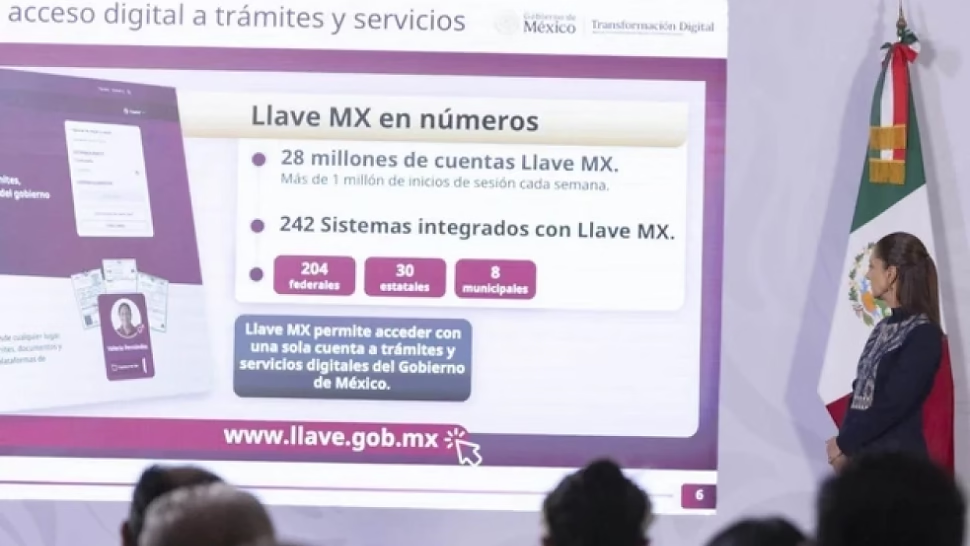
Llave Mx has 28 million accounts and one million uses per week, integrating 242 systems. The National Civil Registry Platform digitized 80 percent of its services; 18.2 million users already carry out transactions online. Resolution times went from 20 to five days.

In the passport, applications were reduced from 21 to five procedures and the requirements from six to three, with a 50 percent drop in resolution time. Almost five million users have used the platform. The consulates also simplified their processes: from 72 to 37 procedures, and from six to two requirements, with five million users.

In investments, the Digital Window for Medium-sized Companies was created, integrated into 18 entities. Federal procedures must be resolved in a maximum of 90 business days; otherwise, they will be considered authorized. For investments in Wellness Centers, amounts greater than 2 billion pesos or strategic sectors, authorization is immediate.

In addition, the Single Window for Foreign Trade and the National Platform for Commercial Establishments were activated, available in 105 municipalities. The latter allows businesses to be opened immediately and online, reducing from seven licenses to six notices and one license.

Continue reading

IPN is positioned among the three best public universities in Mexico

The Polytechnic climbs positions in the QS 2027 global ranking and consolidates itself as a reference in research.

IPN progress in the QS 2027 ranking

The National Polytechnic Institute was ranked among the three best-positioned public universities in Mexico, according to the 2027 edition of the QS World University Rankings, prepared by Quacquarelli Symonds.

The study places the IPN in the range 901–950 worldwide, within a universe of 1,507 classified institutions and more than 8,000 evaluated on a global scale. This reflects its presence on the international academic scene.

The institution highlighted that the result confirms its strategic role in higher education, science and technology, as well as sustained progress in academic quality and internationalization.

Key indicators

Among the main advances, the IPN reported improvements in the International Research Network and in the proportion of international students, with an increase of 33.33%. The ratio of students to faculty also increased by 20.58%.

The institute highlighted that the international scientific collaboration indicator showed a cumulative growth of 698% in three years. It attributed this achievement to the strengthening of its global academic ties and the institutional strategy led by its general director, Arturo Reyes Sandoval.

Continue reading

FGR appoints new prosecutors in Colima and Zacatecas

The Attorney General's Office appointed Susana Macías and Daniel Valdés to reinforce the administration of justice.

New appointments in the FGR

The Attorney General’s Office (FGR) appointed federal prosecutors for Colima and Zacatecas. The objective is to strengthen the administration of justice and improve coordination with local authorities.

Susana Aletxa Macías Medina took over as prosecutor in Colima. She has a degree in Law with a postgraduate degree in Criminology. He began his career in 2006 within law enforcement agencies and later held positions in the defunct Attorney General’s Office.

In Zacatecas, Daniel Valdés Vera was appointed representative. He has training in Law and two decades of experience in the Federal Prosecutor’s Office in Sonora, where he held various positions.

With these appointments, the FGR seeks to strengthen its state representation, improve results against irregularities and impunity, as well as strengthen collaboration with state and municipal security and justice authorities.

Continue reading