The Beverage Industry Announces a Strategic Change in the Face of Fiscal and Health Pressure
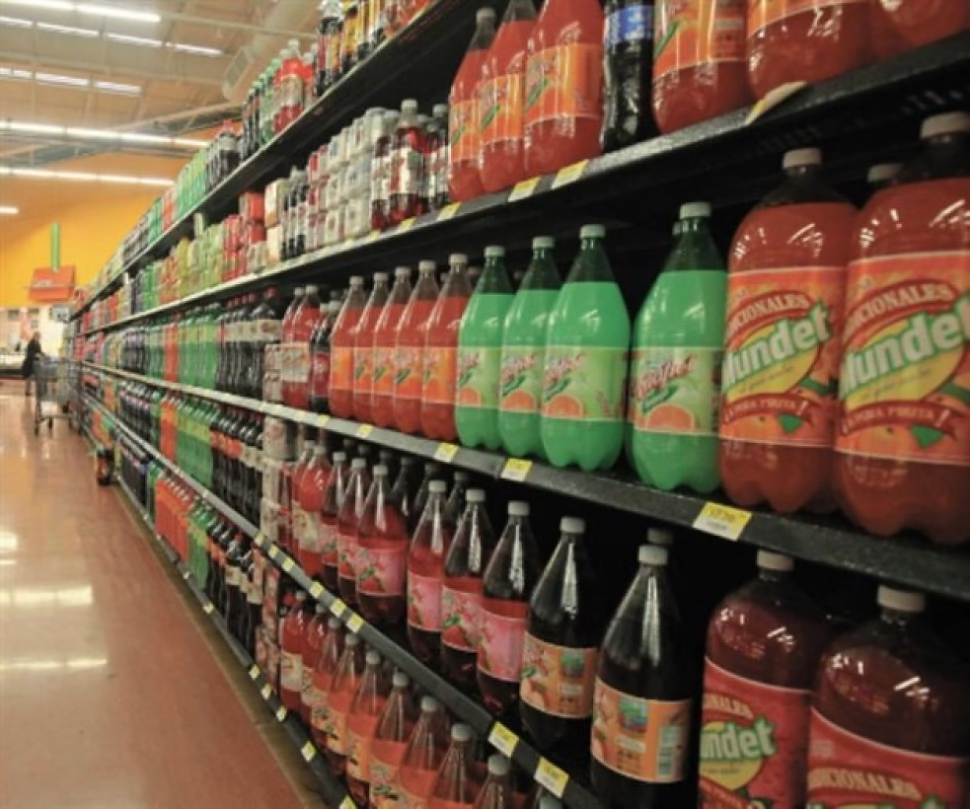
In a strategic move in advance of the legislative discussion to increase the rate of the Special Tax on Production and Services (IEPS) on flavored beverages, the soft drink sector in Mexico has communicated a set of measures aimed at the progressive reduction of sugar content in its product portfolio. This announcement, made in the context of a press conference in the Chamber of Deputies organized by the coordinator of the Morena caucus, Ricardo Monreal, signals a turning point in the industry’s stance in the face of growing public health concerns.
Andrés Massieu Fernández, executive president of the Mexican Beverage Association (MexBed), stated that the union is aware of the complex problems associated with excessive sugar consumption. In his statement, he recognized that the overweight and obesity rates in the country constitute a multifactorial challenge and affirmed the sector’s commitment to be an active part of the solution through concrete and general actions. This positioning reflects an adaptation to a regulatory and social environment that demands greater corporate responsibility in nutritional matters.
Specific Commitments and Reformulation Strategy
The strategy outlined by the industry focuses on several fundamental pillars. Firstly, innovation and reformulation efforts for existing products will be intensified. This involves modifying recipes to reduce caloric content without necessarily compromising flavor, a complex technical process that requires significant investment in research and development. At the same time, the launch of new presentations and portions will be promoted to provide the consumer with options with a lower amount of sugar.
A second pillar consists of the expansion of the portfolio of low-calorie or sugar-free beverages. The objective is to diversify the offer to attract a segment of the population that is increasingly concerned about their well-being. In addition, self-regulation measures in advertising matters will be strengthened, with special emphasis on the protection of minors. This includes eliminating the presence of children and adolescents under 16 years of age in marketing campaigns and prioritizing the promotion of healthier versions of products.
Massieu Fernández specified that the implementation of these measures will be decentralized, allowing each associated company to determine the optimal way to execute them according to their operational capabilities and specific market characteristics.
Corporate Agreements and Quantifiable Goals
In an announcement of great relevance within the sector, Patricio Caso Prado, senior director of Government Affairs of the Coca Cola bottling group, detailed a specific agreement reached by key players such as Coca Cola Femsa, Arca Continental and Jugos del Valle Santa Clara. This agreement, described as a decision of conviction and not just a regulatory one, establishes the goal of guaranteeing a 30% reduction in the caloric content of its drinks.
The implementation of this reduction will be carried out in a staggered manner, starting with the highest volume presentations. This means that the iconic drink, Coca Cola, will see its formula modified to contain a lower amount of calories per milliliter. The operational goal is ambitious: within a maximum period of one year, 70% of the total volume marketed in the country by these companies must comply with this new standard of reduced calorie content.
Commercial and Price Strategies to Encourage Migration
The industry recognizes that product reformulation must be accompanied by a commercial strategy that encourages the consumer’s transition towards healthier options. To this end, specific commercial actions designed to support the migration in consumption towards low-calorie products will be carried out. Patricio Caso Prado emphasized the crucial role of distributors and the different sales channels, as well as the necessary collaboration with the authorities.
A pivotal measure will be price differentiation. The stated objective is that drinks with lower or no caloric content have a lower final consumer price compared to their sugary counterparts. This is intended to be achieved by taking advantage of the extensive distribution network of the Coca Cola system, which includes millions of points of sale, and ensuring through labeling and control mechanisms that this differentiation of quotas is faithfully reflected in the market.
In addition, responsible marketing policies will be reinforced. This not only includes restricting advertising aimed at minors, but also a change in the approach to communication. Advertising of sugar-free versions will be prioritized, and promotion will be directed towards larger volume presentations intended for family or group consumption, to the detriment of individual portions, in order to discourage excessive and impulsive consumption.
Collaboration with Health Authorities
As part of this comprehensive commitment, the industry announced its willingness to collaborate directly with the Ministry of Health. It was agreed to set up a technical work table whose first tangible result will be the design and implementation of a pilot project to promote the consumption of low-calorie beverages in specific environments. This public-private collaboration represents a channel to align the industry’s objectives with national health policies and evaluate the real impact of these measures on the population’s consumption habits.
This set of announcements marks a significant chapter in the relationship between the sugary beverage industry and health regulators in Mexico. Although the proposed measures are substantial, their success will depend on transparency in their implementation, rigor in monitoring goals and the ability to generate a lasting and verifiable change in the nutritional profile of the products that dominate the Mexican market. The fiscal pressure of the IEPS clearly acts as a catalyst, but the underlying challenge remains improving public health outcomes associated with non-communicable diseases.
Does this seem like a step in the right direction to improve public health? Share this news on your social networks and help spread crucial information about changes in the food industry. Explore more content related to health and nutrition policy on our site.