Social radio and television stations demand equality in the telecommunications sector

Marginalized voices of the radio spectrum raise their cry before the Senate: will the system listen to their call?

A heartbreaking scream that shakes the foundations of the ether

In a scenario where the airwaves have become a battlefield, the radio and community television concessionaires launched a challenge that resonated like thunder in the heart of the Senate. It was not a simple request, it was a historic ultimatum! The voices of the eternally forgotten people of the electromagnetic spectrum – indigenous people, university students, social actors – rose with the force of a hurricane to demand the unthinkable: equal conditions in a system that has kept them in the shadows for decades.

The cry of the invisible

Mirelle Campos Arzeta, tireless warrior of the World Association of Community Radio Stations, planted her flag with words that cut like a knife: “Let the law recognize that our radio stations are not pirates, we are legitimate soldiers of communication!”. Every syllable of his speech distilled the bitterness of years fighting against infamous labels, while the big networks monopolized frequencies like medieval emperors.

RelatedSenate promotes public dialogue on reform of the telecommunications law

But the drama reached its climax when Sergio Valles Rivas, voice trembling with indignation, revealed the harsh truth: “We are ghosts in our own country, condemned to backwardness by laws written to silence us.” His denunciation of the systematic abandonment of social television stations left the audience paralyzed, as if they had just discovered a centuries-old conspiracy.

A proposal that could change the game

Among the rubble of this unequal system, a revolutionary idea emerged: demanding 10% of the government budget as a lifeline. It wasn’t charity, it was justice! Sandra Marcela Fernández from the UAM completed the picture with a devastating argument: “Current sponsorship is crumbs for those who feed the people with culture and education”. His call for ethical frameworks for university advertising sounded the final bell in this trial against inequality.

The stage is set. While the Digital Transformation Agency emerges as a possible savior, these rebellious voices have thrown down the gauntlet: Will this be the revolution that democratizes the airwaves, or another tragic chapter in the fight for the right to communicate? The Senate now has in its hands not only a legal reform, but the possibility of rewriting the history of the media in Mexico.

Share this call for equity on your social networks! May each click be an echo of these demands. Do you want to delve deeper into how community media transforms lives? Explore more content about alternative communication on our portal.
Controversy over an interview with Monsiváis reaches the Senate and the Palace

The republication of a 1999 interview unleashes accusations between the Executive and legislators.

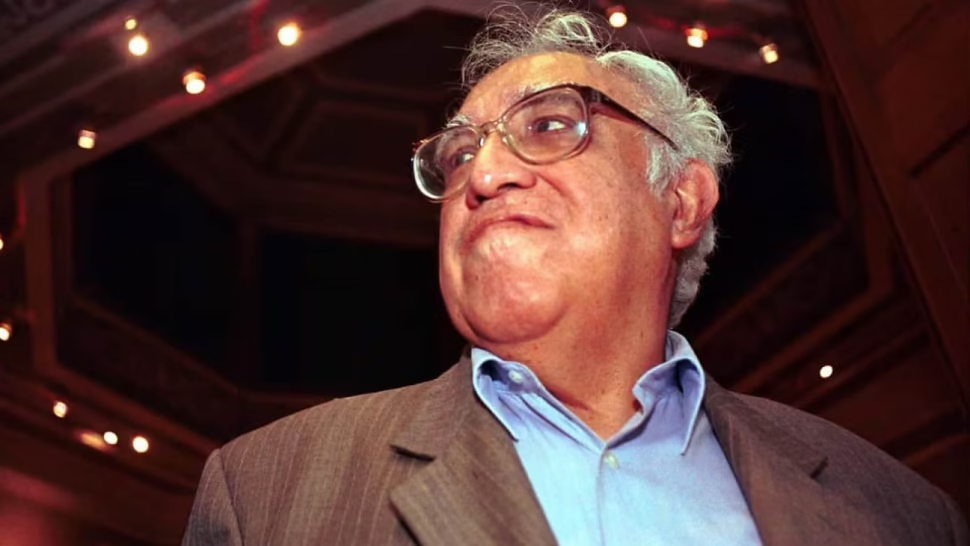
The republication of an old interview attributed to Carlos Monsiváis climbed to the center of the Mexican political debate this Wednesday. The issue was discussed both in the Senate and in President Claudia Sheinbaum’s morning conference.

The original text was written by journalist Edmundo Cázares in 1999 and recently republished by El Universal. It contains statements about the then head of Government Andrés Manuel López Obrador. Its veracity and context have been questioned, generating conflicting positions.

Sheinbaum describes the content as “grotesque”

During her conference, the president harshly criticized the publication. He described the content as “grotesque” and accused the medium of generating a controversy that distorts the tribute to the Mexican intellectual.

Reactions in the Senate

The issue also reached Congress. Senator Lilly Téllez read fragments of the text on the platform. In response, Gerardo Fernández Noroña rejected its use and maintained that it was a false publication with the intention of political attack.

The exchange reflects the polarization around the figure of López Obrador and the use of historical documents as partisan weapons.

Continue reading

PRI demands urgent action against violence in Guerrero

They denounce an incursion of armed civilians in Coyuca de Catalán; party calls for state intervention.

The national leadership of the PRI demanded that the Mexican State intervene urgently in response to the complaint by inhabitants of the Guajes de Ayala ejido, in Coyuca de Catalán, Guerrero. The residents reported the incursion of armed civilians into their community in the Sierra.

Call for safety

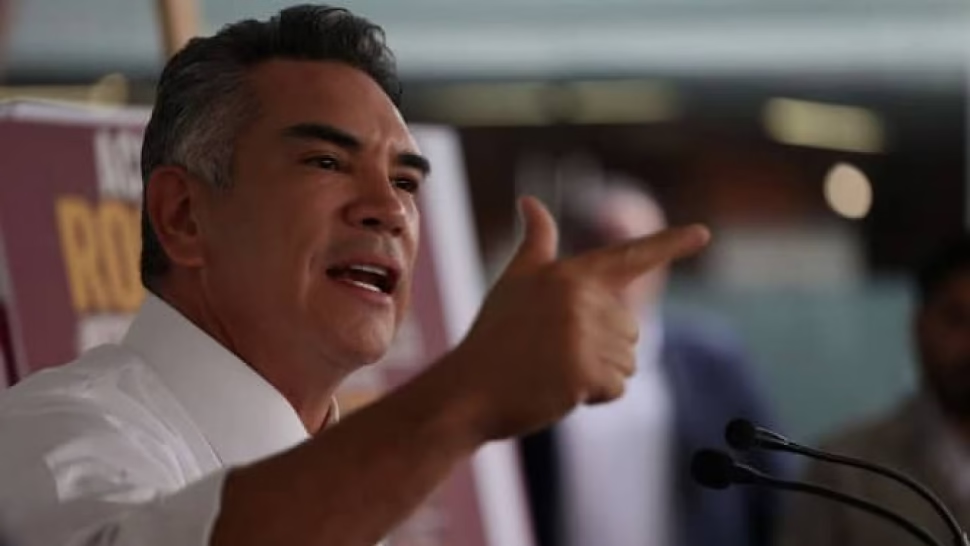
Alejandro Moreno Cárdenas, president of the party, asked the authorities to guarantee the safety of the families. He warned that these events should not be normalized due to the risk they represent for the civilian population.

The leader pointed out that in various communities in Guerrero they live under siege by armed groups. This has caused displacement, confinement of inhabitants and a constant climate of fear and uncertainty. He considered an immediate response from the State necessary.

Moreno Cárdenas also criticized the federal government for minimizing the situation of violence in the country. He affirmed that the population faces conditions of insecurity that require priority attention to restore the rule of law in the region.

Continue reading

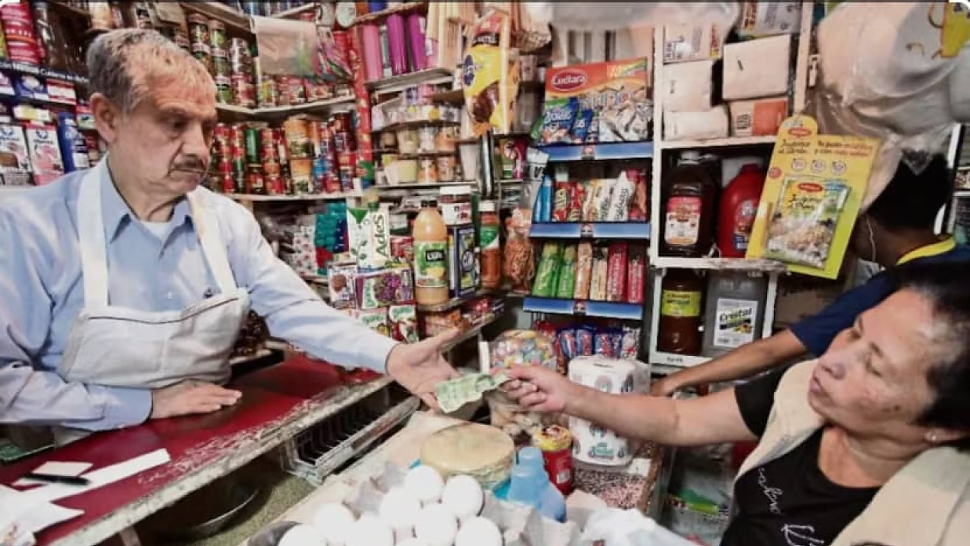
Inflation in Mexico slows down and remains at Banxico’s goal

Inflation drops to 3.55% in the first half of June, within Banxico's target range.

Inflation in Mexico continues to decline. According to Inegi, it stood at 3.55% annually during the first half of June. This represents a drop of 0.11 percentage points compared to the second half of May.

With three consecutive months of deceleration, the indicator remains within Banxico’s target range (3% plus/minus one point). This level is key for purchasing power.

Pressures on core inflation

However, pressures remain. Core inflation—which reflects medium and long-term trends—was at 4.12%, with a biweekly increase of 0.19 points. Within this category, merchandise rose 3.65% annually and services, 4.57%.

Non-core inflation and seasonality

In contrast, non-core inflation slowed to 1.61% annually, driven by the drop in agricultural prices. Products such as tomatoes, eggs and poblano peppers recorded significant decreases.

The report also reflected seasonal movements in tourist services, related to the summer and the Soccer World Cup. Air transportation, hotels and tour packages increased. Despite this, analysts foresee a favorable trend towards the end of the year.

Continue reading