A Statement that Shakes the Political Board
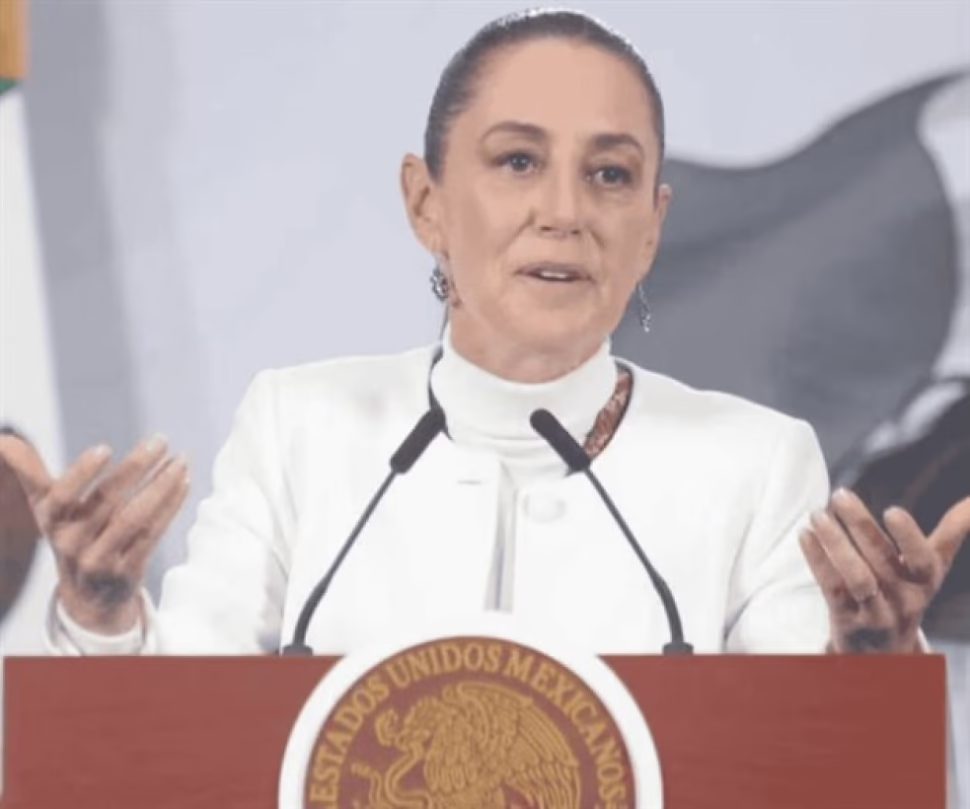
In the heart of the vibrant and always turbulent Mexico City, an advertisement has cut the air like a bolt of lightning, promising to unleash a storm of debates and conflicting passions. President Claudia Sheinbaum Pardo, with the firmness of someone who knows the weight of history, has raised her voice in an act of political audacity to demonstrate against the so-called and controversial “Wife Law“. This initiative, which is making its way like an unstoppable torrent in various states of the Republic, seeks to impose by mandate that the candidacy for governor be headed, in a mandatory and irrevocable manner, by a woman in the next electoral process. A plot twist that promised to rewrite the rules of the game, but that has found an iron opponent in the country’s top leader.
When questioned about this type of constitutional reforms, the president, with the serenity of a supreme judge, considered that it is not necessary to legislate in that sense. With measured words but full of conviction, he pointed out that there are already enough institutional mechanisms and tools to guarantee sacred gender parity in elected positions. “I believe that these laws are not necessary, the truth is,” he stated, releasing a phrase that will echo in the corridors of power for weeks. In a strategic move, he revealed that this week Minister Arturo Zaldívar will reveal crucial information about why this reform, already approved in the emblematic state of San Luis Potosí, is teetering on the brink of legal infeasibility.
The Wall of Reason Against the Wave of Obligation
President Sheinbaum, weaving her argument with the precision of a teacher, explained that, beyond the heated debate over its constitutionality, there is an ironclad agreement approved by the National Electoral Institute (INE). This pact, which must be incorporated into a future and transcendental electoral reform, strictly obliges political parties to nominate half of their candidates for women and the other half for men. In his opinion, this is the shield and the sword that fulfill the noble objective of guaranteeing equitable and fair participation. “With the agreement made by the INE, that the parties have to propose half of their candidates women and the other half men, the gender issue is fulfilled,” she maintained, establishing this principle as the cornerstone of modern democracy.
With the passion of someone who has seen the fruits of the struggle, the president stressed that these affirmative actions have been the key that has opened the doors for an unprecedented number of women to access the coveted governorships. A historic achievement that, he confessed with contained emotion, would hardly have occurred without these measures of restorative justice. And then, with palpable pride, he highlighted the brilliant performance of the current state leaders, launching a praise that sounded like an anthem: “The truth is that the governors do it very well.”
However, a grim warning emerged in his speech, a harbinger of conflicts to come. Sheinbaum warned that imposing mandatory male-female alternation by law could generate abysses of legal controversies or dangerous interpretations of exclusion towards possible applicants. With the vision of a stateswoman, she insisted that she does not see it necessary to advance these types of rigid provisions. “To avoid anything that is being oriented or preventing a person from participating, I don’t think it is necessary to choose the alternation of man-woman, man-woman,” he explained, drawing a scenario where the solution could become a new problem.
However, in an open ending that maintains intrigue, he indicated that the issue will still be analyzed at the highest deliberation tables. It will be reviewed, with a constitutional magnifying glass, whether or not these types of initiatives adjust to the supreme framework of the nation. The so-called “Wife Law” has generated a fiery debate in different local congresses, where it is proposed as an extreme measure to guarantee the continuity of parity in state executives. Its defenders see it as a necessary evil; Its critics, however, warn with a voice of thunder that it could enter into a catastrophic conflict with the sacred principles of free political competition and the self-determination of the parties. The board is set, the pieces are moving, and the fate of political equality in Mexico awaits its next epic chapter.
Do you think parity should be mandatory or is the current mechanisms sufficient? Share this crucial story on your social networks and explore more content about the debates that are defining the future of our democracy.