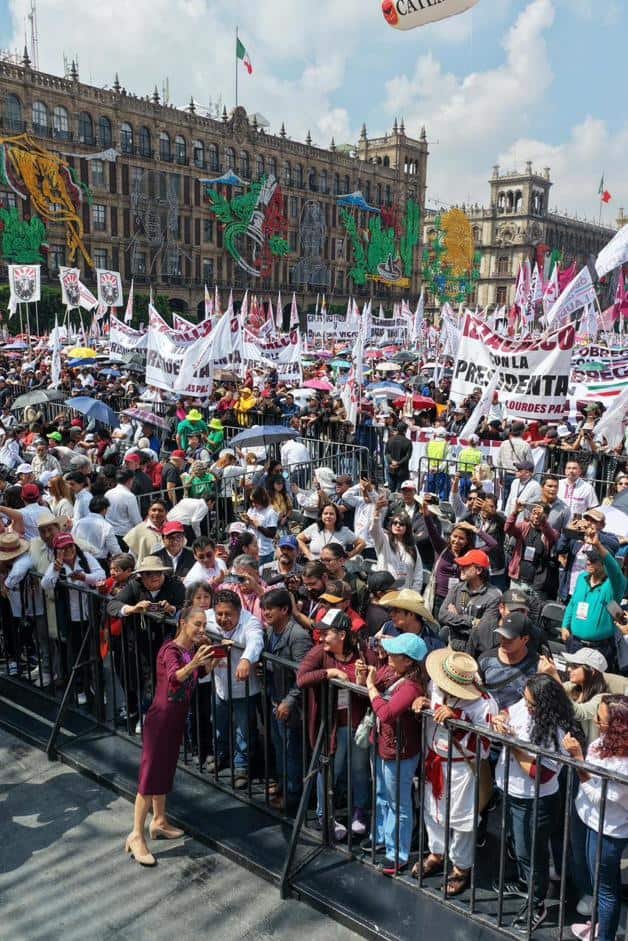
A Historical Commitment to the People of Mexico
In a speech of great political relevance, President Claudia Sheinbaum Pardo, the first woman to occupy the Head of the Federal Executive, ratified her unwavering commitment to citizens. The president emphasized that her work at the head of the government is governed by the principle of giving her soul and her life to achieve collective well-being and defend the country. Her declaration of being a President worthy of the historical greatness of Mexico seals a pact of responsibility with present and future generations, uniting her destiny with that of the people she serves.
This moment represents a milestone in national life, not only for the rise of women to the Government, but for the consolidation of a path towards social justice, dignity and the full guarantee of social rights. Sheinbaum Pardo stressed that these advances are not ephemeral phenomena, but the tangible result of decades of peaceful struggle, citizen organization and cultural resistance. It is about the materialization of a nation project that prioritizes its inhabitants.
Values and Project: The Pillars of the Fourth Transformation
In the face of attempts to divide, the President was emphatic in pointing out the strength of the Transformation movement. Cohesion, he stated, is based on shared and unbreakable values: honesty, the search for justice and a deep love for the people of Mexico. This electoral and government victory does not respond to a simple alternation in power, but to the implementation of a State philosophy: Mexican Humanism. The objective is not limited to an efficient administration, but to a deep transformation of the Nation, inspired by the example of honesty, austerity and conviction of Andrés Manuel López Obrador.
The economic model of the Fourth Transformation has demonstrated its effectiveness with concrete results. In the period between 2018 and 2024, 13.5 million Mexicans escaped poverty, an unprecedented achievement in the country’s recent history. Mexico is now positioned as the second least unequal nation on the continent, reducing the income gap between the richest and poorest sectors from 27 to 14 times. Macroeconomic indicators reflect this stability: an expected annual growth of 1.2 percent, a record in Foreign Direct Investment (FDI) in the first half of the year, an increase of 13.8 percent in the tourism sector, and a national currency that remains stable below 19 pesos per dollar. Added to this is an unemployment rate of 2.7 percent, one of the lowest globally, and annual inflation controlled at 3.7 percent for the month of September.
Structural Reforms and Consolidation of Welfare Programs
The legislative agenda has been equally robust. In the last twelve months, 19 constitutional reforms and 40 new laws have been approved that reconfigure the national legal framework. Among the most significant are the Reform of the Judicial Branch, the integration of the National Guard to the Secretariat of National Defense, and the constitutional recognition of indigenous and Afro-Mexican peoples as subjects of law. Also noteworthy are the amendments to articles 25, 27 and 28 of the Constitution, which allowed the recovery of Petróleos Mexicanos (Pemex) and the Federal Electricity Commission (CFE) as companies at the service of the people.
Other key reforms include the guarantee of public internet services, the incorporation of substantive equality of women in the Magna Carta, and the development of railway infrastructure with passenger trains. Likewise, the Programs for Wellbeing were protected as social rights in articles 4 and 27, the right to housing for workers was recognized, biodiversity was protected with the defense of native corn and the prohibition of transgenic corn, and non-reelection for popularly elected positions starting in 2030 was established, along with the prohibition of nepotism. The Constitution now explicitly states the rejection of any form of foreign interference or interventionism, reaffirming national sovereignty.
In terms of justice, the recent proposal to reform the Amparo Law seeks to expedite the administration of justice, guarantee prompt action against money laundering and prevent this legal resource from being used as a perpetual shield by elites who seek to evade their tax obligations.
The commitment to the well-being of the people is reflected in purchasing power. Between 2018 and 2025, the minimum wage experienced an increase of 135 percent in real terms. For the current fiscal year, 850 billion pesos were allocated to Wellness Programs, benefiting 32 million families, which means that 82.4 percent of Mexican households receive direct economic support. Three new initiatives are added to the existing programs: the Women’s Wellbeing Pension, the “Rita Cetina” scholarship and the Casa por Casa Salud program. In parallel, 20,358 indigenous and Afro-Mexican communities receive, for the first time in history, a direct budget, complemented by the continuity of 16 Justice Plans and the beginning of two new ones for the Amuzgo and P’urhépecha peoples.
Tangible Results in Public Safety
The implementation of the National Security Strategy has yielded encouraging results. Based on four fundamental axes—Attention to the Causes, Consolidation of the National Guard, Strengthening Intelligence and Investigation Capacities, and Coordination between Orders of Government—, this policy has achieved a 32 percent reduction in intentional homicides in a period of twelve months. In concrete terms, between September 2024 and September 2025, 27 fewer homicides were recorded per day, a figure that marks a positive trend in the pacification of the country.
The administration of President Sheinbaum thus consolidates a nation project that combines economic growth with social justice, national sovereignty with the integration of the most disadvantaged, and citizen security with unrestricted respect for human rights. It is a government model that, based on conviction and principles, seeks to honor the trust placed by the people of Mexico.
Do you find this information about the direction of the country valuable? Share it on your social networks and explore more content on public policies and national development.