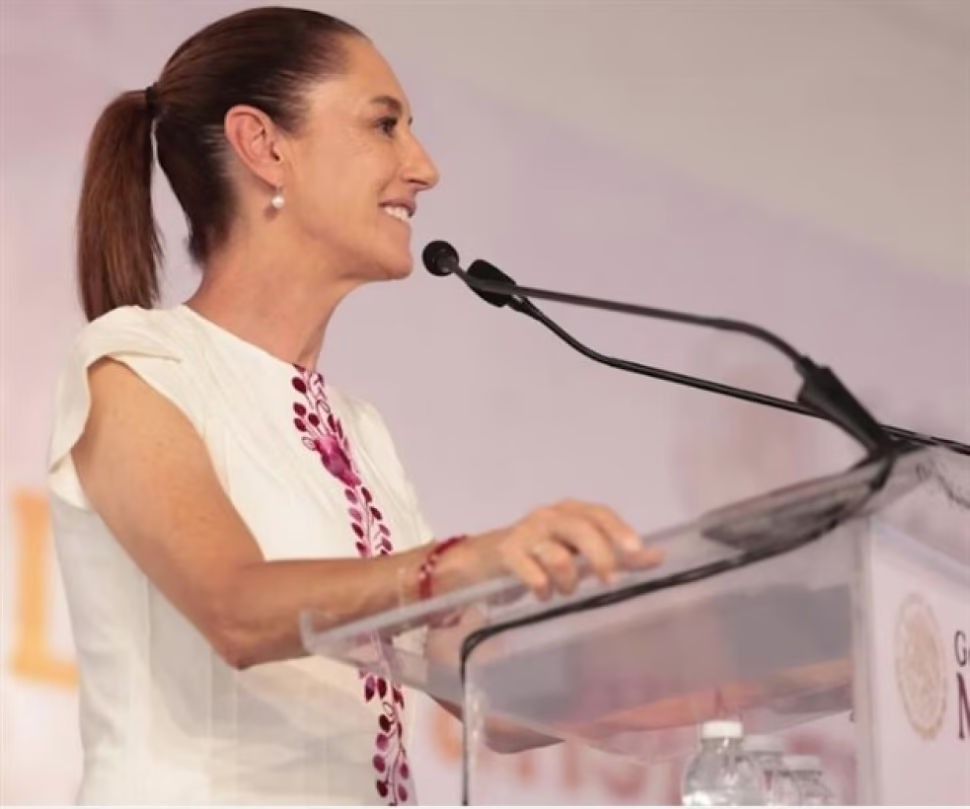
Sheinbaum presents his report to supporters in Ciudad Juárez

The Juárez Vive stadium fills from dawn to receive the president, in an event that mixes militancy and officials.

The Caravan of “Transformation” Lands at the Border

It seems that the transformation, that ethereal and traveling lady, needed to stretch her legs and has decided to do so on the hot soil of Ciudad Juárez. Hundreds of Morena militants, in a display of fervor that would make any fan of a K-pop group pale, await with stoic patience the arrival of President Claudia Sheinbaum. Their mission: to be the flesh-and-blood audience for the staging of the report within the famous “The Transformation Advances” tour. Will it move towards a free buffet? The unknown is in the air.

The setting chosen for this ritual of accountability could not be more symbolic: the Juárez Vive stadium. Because what better place to talk about achievements than a venue designed to celebrate goals and victories? From 6 in the morning – an hour more typical of a low-cost flight than a political event – ​​the parade of buses and faithful souls began, not only from the town, but from other municipalities of Chihuahua. One wonders if the call promised something more than speeches, perhaps a raffle for a washing machine or, at least, a portable fan.

RelatedSheinbaum reaffirms the direction of the transformation in the Zócalo

The Cast of a Gala Day (Required)

On location, as in any good production, there is a diverse cast. On the one hand, the base militants, those soldiers of the cause who probably know every crack in the sidewalk. On the other hand, a more… let’s say, motivated group: the employees of state, municipal and federal governments. Voluntary assistance or practical resume exercise? It is one of those mysteries that political science has not yet been able to decipher, but that we all understand perfectly. Completing the picture are the sympathizers, those good-hearted citizens who still believe that a rally is a fun plan for a Friday afternoon.

The choreography of the event is meticulously planned. The president’s long-awaited message is expected to cross the president’s lips at 1:15 p.m. this Friday. Not an hour before, not a minute after. Swiss precision is key in these acts, where each pause and each applause are as studied as the steps of a ballet. At that exact time, just when the stomach of the average Mexican begins to roar for food, the head of the federal Executive will take the microphone to, presumably, tell us how this transformative journey is going. Has it already reached its destination or are we still on an endless uphill climb?

The image that is projected is powerful: a woman at the head of the country, surrounded by a human tide in a state with a complex political history. The underlying message is clear: the 4T project has national scope and (literally) solid foundations. But the sarcastic eye cannot help but focus on the details: the choice of a stadium, those modern temples where the crowds chant slogans, either to encourage a striker or to applaud a government promise. The line between sports and political entertainment is, to say the least, thin and fun.

While attendees endure the heat and the wait, one asks themselves the big philosophical questions that arise at these events: Does the merit of arriving at 6 in the morning add points for an internal promotion? Will the speech include a special mention of the livers of those who got up early? And most importantly, will the transformation advance enough to justify missing a morning of work on a Friday? We will know the answers, like the best soap operas, at the end of the chapter.

At the end of the day, beyond easy sarcasm, the act itself is a symptom of contemporary political reality. The need to show strength, to fill spaces, to create a visual narrative of incontestable support. Sheinbaum, in his characteristic style, takes his report directly to the people, or at least to a very specific representation of them. An exercise in connection – or the illusion of connection – that is as old as politics itself, but that is renewed with each tour, with each full stadium, with each dawn of a faithful supporter.

Did you like this scathing look at current political events?Share this article on your social networks and bring a little irony to your timeline. Explore more related content on our site to continue analyzing, with humor and criticism, the intricacies of power.
Perception of insecurity drops to 59.8%: Sheinbaum

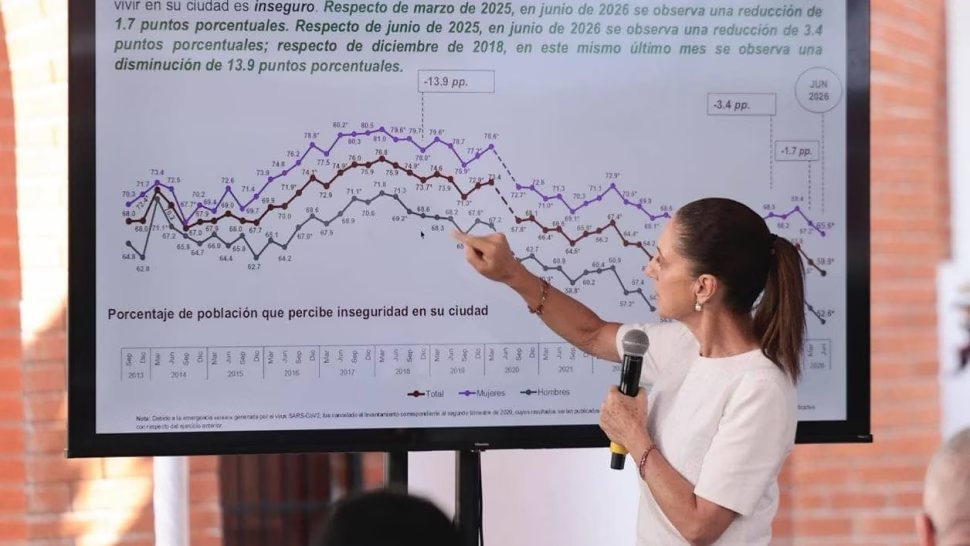
Perception of insecurity in Mexico drops to 59.8%, the lowest figure since 2018.

ENSU results

President Claudia Sheinbaum reported that the perception of insecurity in urban areas fell to 59.8% in June 2026, according to the National Urban Public Security Survey (ENSU) of the INEGI. In December 2025 it was 63.8%, which represents six consecutive months of decline.

“The important thing here is that we are giving results in the security indicators and people are beginning to notice this decrease,” he said during the morning conference in Cuernavaca, Morelos.

Historical comparison

Sheinbaum recalled that in December 2018, under the government of Andrés Manuel López Obrador, the perception of insecurity was 73.7%. The previous lowest point was reached in September 2024 at 58.6%. The president attributed the improvement to the National Security Strategy.

The ENSU measures citizens’ feeling of insecurity in their environment. Recent data reflects a positive trend, although the challenge remains to maintain the reduction in crime. The authorities continue to implement actions to consolidate these results.

Continue reading

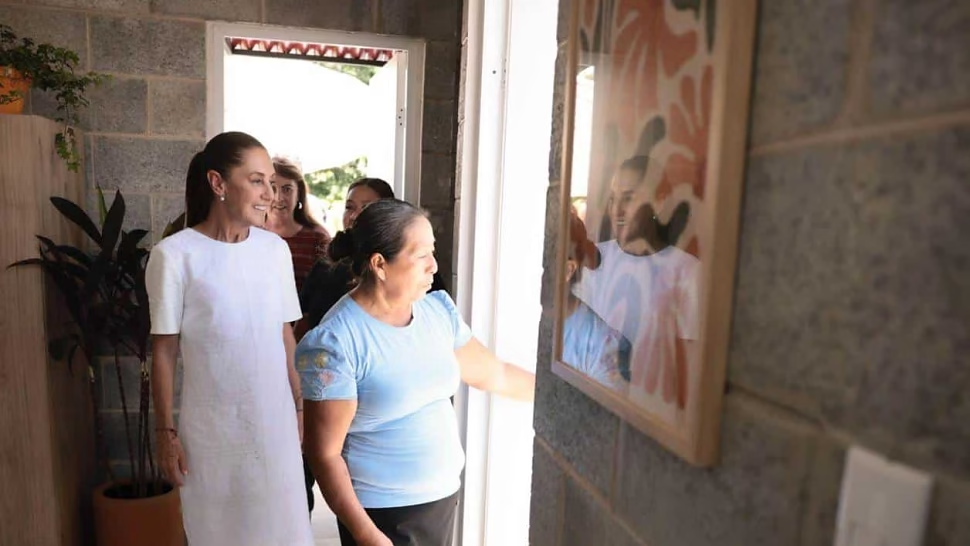
Sheinbaum delivers 43 homes in Morelos through the Housing Plan

President delivers homes, settlements and deeds in Xoxocotla, Morelos.

President Claudia Sheinbaum led in Xoxocotla, Morelos, the delivery of 43 new homes from Conavi, 348 settlement certificates from Fovissste and 79 deeds from INSUS. It’s all part of the Housing for Wellbeing Program.

“Previous governments took from the people, we increased the minimum wage, we are providing homes with accessible loans and we are removing debt from families,” said the president.

“Those from before governed for a few, the governments of the Transformation govern by the people and for the people of Mexico,” he added.

Plan details

Sheinbaum recalled that the program contemplates the construction of 1.8 million new homes in the country; the forgiveness and restructuring of unpayable loans for 5 million families; and the delivery of one million deeds to guarantee legal certainty.

The homes are aimed at people with incomes of one to two minimum wages. The land for new houses is already available throughout the national territory.

The Secretary of Agrarian Development, Edna Elena Vega Rangel, explained that in Morelos the goal was expanded from 10 thousand to 24 thousand new homes. Of these, 3,893 are already hired. In addition, 8 thousand families will receive deeds and more than 35 thousand will improve unpayable loans. Nationally, the program will benefit more than 10 million families.

The director of Conavi, Rodrigo Chávez Contreras, reported that of the 500 thousand homes under his charge there are already 320 projects to build 150 thousand houses. Of them, 75 thousand have already been assigned in 119 municipalities. In Morelos, 2,000 homes are being built in seven municipalities; 90 of them for Xoxocotla, of which 43 were delivered today.

Governor Margarita González Saravia thanked the president and confirmed that the state already has land for the 24 thousand houses in eleven municipalities.

One beneficiary, Araceli Pacheco López, thanked the delivery of her home, which she described as “very nice.”

Continue reading

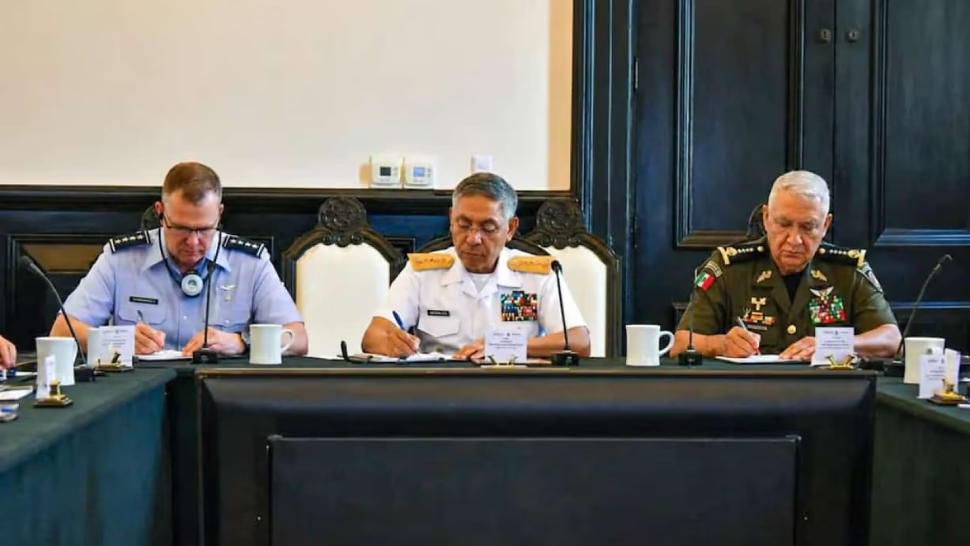
US Commander meets with Sedena and Semar in Veracruz

Senior military commanders of Mexico and the United States review joint strategies against organized crime.

The commander of the United States Northern Command, General Greg Guillot, visited Mexico to meet with senior officials from the Secretariat of National Defense (Sedena) and the Secretariat of the Navy (Semar). The meetings occurred on July 22 in Veracruz.

Bilateral security cooperation

Guillot met with the head of the Sedena, General Ricardo Trevilla, and with the Secretary of the Navy, Admiral Raymundo Pedro Morales. The US embassy described the meetings as progress in the defense relationship between both countries.

Among the topics addressed are specialized training in special operations and against organized crime, the exchange of information, and cooperation to counter unmanned aerial systems. The North American Maritime Security Initiative was also reviewed.

“The security of North America depends on the strength of its alliances and the ability of its members to act with common objectives,” said General Guillot.

Both nations reiterated their commitment to expanding cooperation, respecting sovereignty, territorial integrity and shared responsibility for security.

Continue reading